
Almost every building you hold to produce income qualifies for a cost segregation study. Property type does not decide eligibility. It decides yield: the share of depreciable basis that moves into 5-, 7- and 15-year property. In R.E. Cost Seg's anticipated results, that share runs from about 19% on mid-rise and high-rise apartments to 53% on condo units. Mobile home parks reach 77%.
The timing is better than it has been in years. The One Big Beautiful Bill Act (OBBBA) made 100% bonus depreciation permanent for property acquired after January 19, 2025. That is the rule in IRS Notice 2026-11, §§ 2.02(1) and 3.07. Our bonus depreciation guide for real estate investors covers the full rules.
Below you will find the qualification rules, a worked example, ranges for 20 property types and the cases where a study does not pay.
Key takeaways
- Any building held to produce income qualifies for a cost segregation study; a personal residence does not.
- Property type sets yield, not eligibility: anticipated reclassification runs from about 19% to 53% of basis, and up to 77% for mobile home parks.
- Residential rentals depreciate over 27.5 years and commercial property over 39 years; both benefit from a study.
- Heavy site work, specialty systems and tenant improvements push a property toward the top of its range.
- 100% bonus depreciation is permanent for property acquired after January 19, 2025, and the binding contract date sets the acquisition date.
- A property bought in a prior year still qualifies through a look-back study, with no amended returns.
- A deduction is only worth what you can use; passive loss rules decide that for most investors.
Does your rental property qualify for a cost segregation study?
Yes, if you hold it to produce income or use it in a business, it is a depreciable building, and you own it now.
Cost segregation is an engineering-based study that identifies short-life assets inside a building's depreciable basis and assigns them shorter recovery periods. Three conditions decide eligibility:
- Income or business use. Depreciation is allowed only for property used in a business or held to produce income (IRC §167). A personal residence does not qualify.
- Depreciable property. Buildings and their components qualify. Land never does, because it does not wear out.
- Current ownership. Property placed in service this year qualifies directly. Earlier purchases qualify through an accounting method change.
Land matters most in practice. You cannot depreciate land (IRS Publication 527). Your land value allocation sets the ceiling on everything a study can do.
Yes, cost segregation works on residential rental property. A single family rental qualifies. So does a duplex or a 200-unit complex. Unit count does not change eligibility. For the mechanics, start with how a cost segregation study works.
Residential rental property depreciates over 27.5 years and nonresidential real property over 39 years under IRS Publication 946. That changes the size of the slow remainder after a study. It does not change whether a study works.
Why the study matters for bonus depreciation. Bonus depreciation applies only to property with a recovery period of 20 years or less (IRC §168(k)(2)). The building shell never qualifies. The 5-, 7- and 15-year components a study identifies do. Used property qualifies too, if you did not use it before you bought it (Treas. Reg. §1.168(k)-2(b)(3)(iii)).
What does a study change on a single family rental? A worked example
On the assumptions below, a study adds $92,654 of first-year depreciation on a $400,000 single family rental, worth $34,282 in federal tax.
Hypothetical example, not a client result. Assume a $400,000 rental acquired and placed in service in January 2026. Land is supported at 20%. The study supports 30%, inside the 27% to 38% single family range. The owner can use the loss at a 37% federal rate.
| Step | Calculation | Result |
|---|---|---|
| Depreciable basis | $400,000 − $80,000 land | $320,000 |
| 5-year property (appliances, flooring, finishes) | $320,000 × 20% | $64,000 |
| 15-year land improvements (driveway, fencing, landscaping) | $320,000 × 10% | $32,000 |
| Bonus on reclassified property | $96,000 × 100% | $96,000 |
| Remaining 27.5-year building | $320,000 − $96,000 | $224,000 |
| Year-one building depreciation | $224,000 × 3.485% (January, mid-month) | $7,806 |
| Total year-one depreciation with study | $96,000 + $7,806 | $103,806 |
| Year-one depreciation without study | $320,000 × 3.485% | $11,152 |
| Additional year-one depreciation | $103,806 − $11,152 | $92,654 |
| Federal tax reduction at 37% | $92,654 × 37% | $34,282 |
The example excludes state tax, study fees and recapture. Lifetime depreciation is the same either way. The benefit is timing, and it only counts if you can use the loss this year.
Which bonus rate applies to your property?
Your acquisition date sets the rate. All citations in this section refer to Notice 2026-11.
- Acquired after January 19, 2025: 100%, with no placed-in-service deadline (§§ 2.02(1), 3.07).
- Acquired on or before January 19, 2025: the TCJA phase-down applies. The rate is 40% if placed in service in 2025, and it falls 20 points a year (§ 2.01).
- Contract date: the acquisition date is the latest of signing, state-law enforceability, the end of any cancellation period or satisfaction of contingencies. A contract that caps damages, such as a liquidated damages clause, is not binding (§§ 2.02(1), 2.03(2)(b)).
- New construction: self-built property qualifies if physical work of a significant nature begins after January 19, 2025. Paying more than 10% of total cost, excluding land and preliminary activities, is a safe harbor (§ 2.03(2)(c)). See new construction depreciation.
- Elections: for the taxable year that includes January 20, 2025, you may elect 40% instead of 100% (§ 4.03). You may also elect out of bonus for any class of property (§ 2.05).
The notice is interim guidance. You may rely on its sections 3 through 5 until proposed regulations are published, if you apply them in their entirety (§ 6.02). A look-back study uses the rate for the year the property was placed in service.
What reclassification range does each property type yield?
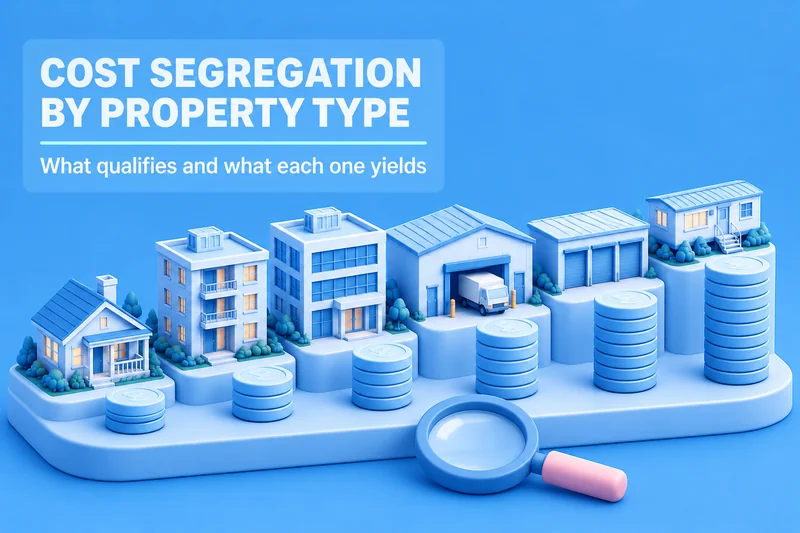
In R.E. Cost Seg's anticipated results, yield ranges from about 19% on mid-rise and high-rise apartments to 77% on mobile home parks.
| Property type | Anticipated reclassification (share of depreciable basis) | What drives it | Recovery period |
|---|---|---|---|
| Single family home | 27% to 38% | Appliances, flooring, driveway, landscaping | 27.5 years |
| Multifamily, 2 to 4 units or 5+ units | 26% to 35% | Repeated unit components, parking | 27.5 years |
| Apartment building(s) | 26% to 38% | Unit finishes, limited site work | 27.5 years |
| Apartment complex | 32% to 46% | Pools, courts, extensive site work | 27.5 years |
| Mid-rise or high-rise apartments | 19% to 31% | Mostly structure, little site work | 27.5 years |
| Condo unit | 33% to 53% | Interior finishes; little or no land improvements | 27.5 or 39 years |
| Hotel or motel | 29% to 46% | Furnishings, finishes, site work | 39 years |
| Restaurant | 27% to 49% | Kitchen systems, finishes, drive-through site work | 39 years |
| Medical office building | 27% to 42% | Dedicated power and plumbing, casework, parking | 39 years |
| Assisted living facility | 29% to 46% | Furnishings, finishes, site work | 39 years (27.5 if it meets the 80% dwelling-unit rent test) |
| Office building | 28% to 41% | Interior finishes, dedicated electrical, parking | 39 years |
| Retail building | 28% to 42% | Tenant improvements, signage, parking | 39 years |
| Shopping center | 27% to 36% | Parking fields, site lighting, signage | 39 years |
| Mixed use (retail with apartments) | 24% to 38% | Retail finishes, unit components | Mixed |
| Self-storage | 34% to 44% | Drive aisles, fencing, gates, access systems | 39 years |
| Industrial facility (manufacturing, warehouse) | 25% to 39% | Process connections, dock equipment, site work | 39 years |
| Office/warehouse flex | 22% to 32% | Office finishes, dock equipment, paving | 39 years |
| Auto dealership or repair shop | 31% to 44% | Lot paving, lighting, service equipment connections | 39 years |
| Daycare facility | 35% to 43% | Playground and site work, finishes | 39 years |
| Mobile home park | 40% to 77% | Pads, utilities, roads, site work | 15 and 39 years |
These ranges are anticipated results from baseline to optimal, not an IRS benchmark or a promise. Your building lands where its documentation puts it. Our guide to the reclassification percentage explains how the share is measured.
Mobile home parks top the table for a simple reason. Most of the value sits in pads, roads and utilities, which are land improvements. Mid-rise and high-rise apartments sit at the bottom because the building is mostly structure.
Short-term rentals are a use, not a building type. They start from the single family or condo range. Furnishings conveyed with the property add to the 5-year share. A building where more than half the units are used on a transient basis is not residential rental property (IRC §168(e)(2)(A)). Confirm the recovery period with your CPA before you model a result.
Does residential or commercial property benefit more?
Commercial property usually reclassifies a similar or larger share, but residential property recovers its remainder faster.
- Recovery period: 27.5 years for residential rental, 39 years for nonresidential.
- Typical share: 26% to 38% for most apartment buildings; 27% to 44% for most commercial classes.
- Components: residential yields appliances and finishes; commercial yields tenant improvements, dedicated power and site work.
A worked comparison. Assume two properties at $2,000,000, each with 20% land, placed in service in January 2026, at 37%.
| Step | Apartment building (30%) | Medical office building (35%) |
|---|---|---|
| Depreciable basis | $1,600,000 | $1,600,000 |
| Reclassified and bonused | $480,000 | $560,000 |
| Remaining building | $1,120,000 × 3.485% = $39,032 | $1,040,000 × 2.461% = $25,594 |
| Total year-one depreciation | $519,032 | $585,594 |
The medical building produces $66,562 more first-year depreciation, worth $24,628 at 37%. The gap is first-year only. Over the full recovery period, each property deducts the same $1,600,000. The difference is timing.
Is a study worth it on one rental, or only on a portfolio?
One property is often enough. The single family example above produced $34,282 of first-year federal tax reduction for an owner who could use the loss. Usability matters more than portfolio size.
Find your property type
Each group below links to a detailed guide for that property class.
Residential and multifamily
Apartment buildings, small multifamily and single family rentals. See multifamily and apartment buildings, duplex and triplex properties and small properties around $200,000.
Short-term rentals
Furnished rentals can reclassify more than unfurnished ones when the furnishings convey with the property. See cost segregation for Airbnb properties and bonus depreciation on Vrbo rentals.
Hospitality and food service
Hotels and restaurants carry furnishings, kitchen systems and decorative finishes. See hotels, bed and breakfasts, restaurants and bonus depreciation on hospitality properties.
Medical and healthcare
Dedicated power, medical gas and casework drive results. Separately purchased medical equipment stays on its own schedule. See healthcare facilities and medical office buildings, medical equipment and HIPAA improvements, dental clinics and veterinary clinics.
Self-storage
Drive aisles, fencing and access systems make self-storage one of the stronger classes, at 34% to 44%. See self-storage cost segregation. Refrigerated buildings are covered in cold storage and refrigeration buildings.
Commercial, retail and office
Tenant improvements are often a major driver here. See commercial real estate, single-tenant retail, retail tenant improvements, office buildings and mixed-use properties.
Industrial and specialty
Process connections, dock equipment and site work drive results. See manufacturing facilities, warehouses and distribution, data centers, car washes, auto dealerships and auto repair shops.
Leisure and other
Purpose-built properties often carry more short-life property than a standard building. See golf courses, gyms and fitness centers, event venues, mobile home parks, banks and credit unions, charter schools and daycare centers.
What drives the variation between similar buildings?
Land allocation, building age, tenant improvements and specialty systems explain most of the spread.
- Land allocation. A high land share shrinks the depreciable basis before the study starts.
- Age and condition. A recent renovation puts flooring and finishes on the books at current cost.
- Tenant improvements. Build-outs lean heavily toward 5-year property and, for nonresidential buildings, qualified improvement property, which is 15-year property.
- Specialty systems. Specialty electrical and plumbing can qualify when it serves equipment rather than the building. The IRS Cost Segregation Audit Techniques Guide (ATG) sets out the criteria examiners apply.
A land allocation example. Two office buildings each sell for $1,000,000. One allocates 20% to land, leaving $800,000 of basis. The other allocates 40%, leaving $600,000. At 35%, the first reclassifies $280,000 and the second $210,000. At 37%, the $70,000 gap is worth $25,900 of first-year tax.
Site work is easy to miss. Paving, curbing, fencing and landscaping are generally 15-year land improvements under asset class 00.3 in Publication 946. On a property with large parking fields, site work can be a large share of the reclassified basis.
What if I bought the property years ago?
It is not too late. A look-back study claims missed depreciation in the current year through Form 3115. Rev. Proc. 2025-23, section 6.01, lists it as an automatic change. The catch-up flows through a §481(a) adjustment, and you do not amend prior returns.
What can reduce your benefit?
Passive loss rules, the excess business loss cap, state conformity and recapture can each shrink or delay the cash value.
- Passive activity rules. Under IRC §469, most rental losses offset only passive income. Unused losses carry forward. See the passive activity loss rules.
- Real estate professional status. It needs more than 750 hours and more than half your working time in real property trades, plus material participation. See qualifying as a real estate professional.
- Short-term rentals. An activity with average customer use of 7 days or less is not a rental activity under Treas. Reg. §1.469-1T(e)(3). With material participation, the loss is not passive.
- Excess business loss cap. For 2026, §461(l) limits net business loss against other income to $256,000 ($512,000 for a joint return) under Rev. Proc. 2025-32. The excess carries forward.
- State conformity. Not every state follows federal bonus. California, for example, does not conform (FTB Form 3885F). Check state conformity before modeling state savings.
- Recapture on 5- and 7-year property. IRS Publication 544 explains the rules. On a taxable sale, depreciation on 5- and 7-year property is ordinary income to the extent of gain. Bonus on 15-year site work above straight-line is also ordinary income.
- Recapture on the building. Straight-line building depreciation is unrecaptured §1250 gain, taxed at up to 25% (IRC §1(h)(1)(E)). See depreciation recapture explained.
- 1031 exchanges. An exchange can defer recapture, but it does not eliminate it. Section 1245 recapture can still apply if the replacement property holds less 5- and 7-year property (IRC §1245(b)(4)). See bonus depreciation recapture in 1031 exchanges.
When is a cost segregation study usually not worth it?
A study rarely pays when the benefit barely clears the fee, the sale is near, or the loss cannot be used.
- Thin benefit. The first-year benefit does not clearly exceed the study fee.
- Near-term sale. Recapture at sale shortens the benefit window.
- No way to use the loss. Without passive income, professional status or short-term rental participation, the deduction suspends.
- Fully depreciated property. No basis remains to reclassify.
- Personal residence. Personal-use property is not depreciable.
A marginal example. An investor buys a $150,000 condo rental with 25% land, leaving $112,500 of basis. A study at 33%, the bottom of the condo range, reclassifies $37,125. At 37%, that is worth $13,736. But this investor has W-2 income and no passive income. The loss suspends and carries forward. The deduction is real; the cash arrives later. Our guide on when not to do a study covers more edge cases.
Will a cost segregation study trigger an audit?
The IRS publishes a full guide for examining studies, so expect any study to be judged on its documentation. The ATG lists 13 elements of a quality study. It tells examiners to view "rule of thumb" studies with caution because they lack documentation. See our IRS audit guide for cost segregation.
Frequently asked questions
Which property types benefit most from cost segregation?
Site-heavy properties reclassify the most. In R.E. Cost Seg's anticipated results, mobile home parks run 40% to 77%, daycare facilities 35% to 43% and self-storage 34% to 44%. Mid-rise and high-rise apartments reclassify least, at 19% to 31%.
Does cost segregation work on residential rental property?
Yes. Residential rental property qualifies fully and depreciates over 27.5 years. Anticipated reclassification runs 27% to 38% for single family homes and 26% to 38% for most apartment buildings.
What percentage of my purchase price can be reclassified?
Reclassification applies to depreciable basis, not purchase price. Subtract land first. Most property types then run between about 25% and 45% of basis, with site-heavy properties higher.
Can I do a cost segregation study on a single family home?
Yes, if you rent it out or use it in a business. A home you live in does not qualify, because personal-use property is not depreciable.
Does 100% bonus depreciation apply to a property I bought in 2025?
It depends on the contract date. Property acquired after January 19, 2025 qualifies for 100% under Notice 2026-11. Property acquired on or before that date and placed in service in 2025 gets 40%.
Your next step
Property type sets your yield; eligibility is rarely the constraint. Land allocation, age, tenant improvements and specialty systems explain the rest. A prior-year purchase still qualifies through a look-back study.
Get a free proposal with your property type, purchase price and placed-in-service date. You will see an estimated range and first-year benefit before you commit.
R.E. Cost Seg performs cost segregation studies. Ranges reflect anticipated results and are not a guarantee for any property. This article is general information, not tax advice. Confirm your situation with your tax advisor.