
What if your mobile home park could generate over $300,000 in first-year tax deductions, enough to fund infrastructure upgrades or acquire your next community? This isn't theoretical. It's what we delivered for an investor who had just closed on a $3.8 million stabilized property with 85 pads, paved roads, utility hookups, and a small leasing office after reclassifying nearly $1.1 million in assets through cost segregation.
Stories like this are common in mobile home park investing. These communities are loaded with fast-depreciating assets, underground utilities, concrete pads, roads, fencing, signage, and electrical pedestals. But unless you break them out properly, the IRS treats everything like long-term property, even components that clearly don't last that long.
Here's what matters: The IRS allows you to reclassify these components into 5-, 7-, or 15-year depreciation categories. Instead of waiting decades to recover your investment, you can claim substantial deductions immediately.
R.E. Cost Seg specializes in working with mobile home park owners and operators to uncover the hidden value in every community. Our engineering-based studies typically reclassify 30% to 40% of a park's depreciable basis into shorter-life categories, generating five-figure to six-figure tax savings in year one.
This article breaks down exactly which mobile home park components qualify for accelerated depreciation and what it means for your bottom line.
What a Proper Cost Segregation Study Can Reveal: A Sample Analysis
Mobile home parks don't look like traditional buildings, but they contain a large volume of depreciable infrastructure that qualifies for faster write-offs.
Let's break down a typical scenario:
- Total property cost: $3.5 million (excluding land)
- Reclassified to short-life assets: $1.2 million (34%)
- First-year deduction (with 100% bonus depreciation): $1.2 million
- Estimated tax savings (at 30%): ~$360,000
The reclassified assets in this example included:
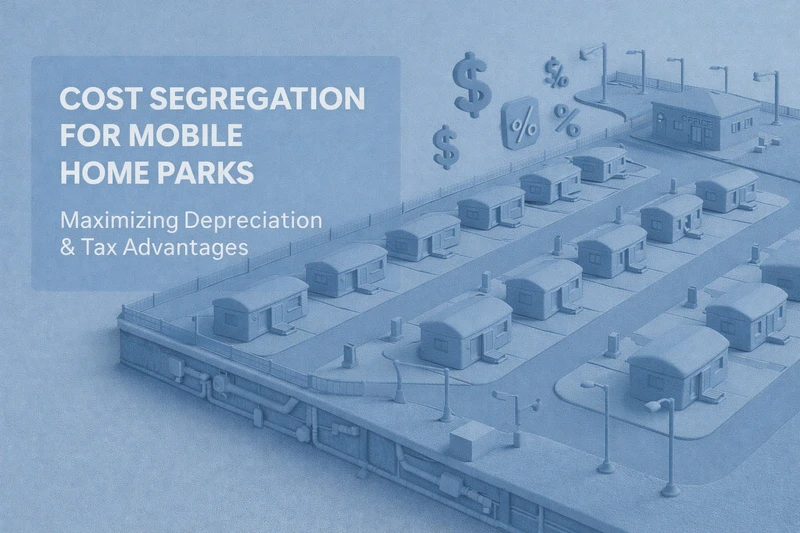
- Asphalt roads and driveways
- Concrete pads and foundations
- Stormwater and sewer systems
- Electrical hookups and pedestals
- Water and gas lines
- Perimeter fencing and lighting
- Leasing office improvements and signage
These are all depreciable over 5, 7, or 15 years. Under the 2025 bonus depreciation law, 100% of qualifying short-life assets can be written off in the first year if the property was acquired and placed in service after January 19, 2025.
What Actually Gets Reclassified in a Mobile Home Park
Most of the value in a mobile home park isn't in the homes. It's in the infrastructure that makes the community function. A cost segregation study identifies and reclassifies those components, often moving them out of the 39-year category (or 27.5-year, if the park includes owner-rented residential units) and into much shorter recovery periods.
Here are the types of assets commonly reclassified:
- Land improvements (15-year) Roads, sidewalks, signage, street lighting, fencing, landscaping, concrete pads, and drainage systems
- Utility infrastructure (15-year) Water and sewer lines, electrical service lines, gas distribution systems, utility pedestals, and backflow preventers
- Site components (5- or 7-year) Mailbox clusters, trash enclosures, benches, bike racks, and detached storage units
- Structures (27.5- or 39-year) Leasing office, laundry room, maintenance shed — these remain long-life properties but may include short-life components (e.g., flooring, cabinetry, lighting) that can be broken out.
These are assets you've paid for, but unless they're classified correctly, you're waiting decades to recover their cost through depreciation.
Why Cost Segregation Is Often Overlooked in MHPs
Mobile home park owners frequently underestimate the value of cost segregation because the property doesn't resemble traditional commercial real estate. There's no office tower or warehouse. But the idea that "it's just land" is both incorrect and expensive.
Here's why this misconception persists, and why it's wrong:
- You don't own the homes: True. But you do own the infrastructure that serves them.
- There's no main building: Yes, but land improvements often make up a substantial portion of the basis.
- Accountants use default schedules: Most CPAs apply straight-line depreciation unless you bring in a study.
- Infrastructure isn't visible: Underground utilities and service lines are easy to miss unless the study includes a detailed engineering review.
These assumptions are understandable. But they leave money behind year after year, especially on stabilized parks with high upfront infrastructure costs.
Avoiding Errors: Key Issues That Undermine Results
To get the most from a cost segregation study on a mobile home park, you need the right approach. Here are the most common mistakes that reduce benefit or create risk:
- Treating land improvements as part of the land Land is non-depreciable, but land improvements (roads, pads, utilities) are not. Misclassifying these means zero deductions.
- Overstating the depreciable basis by underallocating land Mobile home parks often carry significant land value due to zoning, entitlements, and location. Inflating the depreciable basis by underallocating land is a common audit flag that can unravel the entire study.
- Skipping buried or utility assets If your provider isn't experienced in mobile home infrastructure, they may not account for underground assets properly.
- Failing to separate shared-use systems If your park has a leasing office, laundry room, or rec facility, these need to be split into short- and long-life components.
- Not documenting capital improvements Repairs and upgrades made after acquisition (e.g., road resurfacing, pad replacements) often qualify for short-life treatment but are missed.
- Ignoring partial dispositions when replacing infrastructure When you repave roads, replace sewer lines, or swap out electrical pedestals, the tangible property regulations allow you to write off the remaining undepreciated cost of the old asset. Combined with a cost segregation study, this creates a double benefit that most park owners miss entirely.
- Working with generalists Many cost segregation firms use generic templates not designed for mobile home parks. That approach leaves valuable components unclassified.
Steps to Prepare for a Mobile Home Park Cost Segregation Study
A little preparation goes a long way in helping your provider uncover every eligible deduction. Here's how to get ready:
- Hire a firm familiar with MHP infrastructure. You need someone who knows how to identify land improvements, not just building components.
- Gather site maps and utility diagrams. These help the engineer see what's buried, where, and how it serves the community.
- Compile contractor invoices and capital project records. Any improvements made post-acquisition may be eligible for reclassification.
- Document any structures and shared facilities. Even if small, these may contain short-life assets that qualify for bonus depreciation.
- Coordinate with your tax team Ensure your CPA is ready to file Form 3115 if needed, and that the depreciation aligns with your broader tax planning.
Park-Owned Homes: An Often-Overlooked Depreciation Opportunity
Many mobile home park operators own at least some of the homes in their community. These park-owned homes (POHs) represent a separate and significant depreciation opportunity that goes beyond infrastructure.
The classification depends on whether the home is permanently affixed to the land. If a manufactured home still has its axle, tongue, and is titled as personal property with the state, there is a credible argument that it qualifies as tangible personal property rather than real property. That distinction matters because tangible personal property can qualify for a much shorter recovery period and may be eligible for bonus depreciation.
If the home has been permanently set on a foundation with the axle and tongue removed, it is generally classified as residential rental property and depreciated over 27.5 years. But even then, a cost segregation study can reclassify interior components like appliances, carpeting, cabinetry, and decorative lighting into 5- or 7-year property.
For park owners with a portfolio of POHs, these deductions can add up quickly and should be evaluated alongside the infrastructure study.
Choosing the Right Provider for Mobile Home Park Depreciation Strategy
Mobile home parks are asset-rich, but structurally unique. Their value lies in infrastructure, not vertical square footage. That means a cost segregation study must be tailored to surface-level and underground improvements, not buildings.
The right firm understands how to break out buried utilities, exterior systems, and pad-level infrastructure, backed by engineering documentation that holds up under scrutiny.
R.E. Cost Seg specializes in complex property types like mobile home parks. Our team identifies the overlooked components that standard accounting practices miss, unlocking depreciation where others assume there's none to be found.