
One of the first questions investors ask about cost segregation is simple: "How much of my property can I reclassify?"
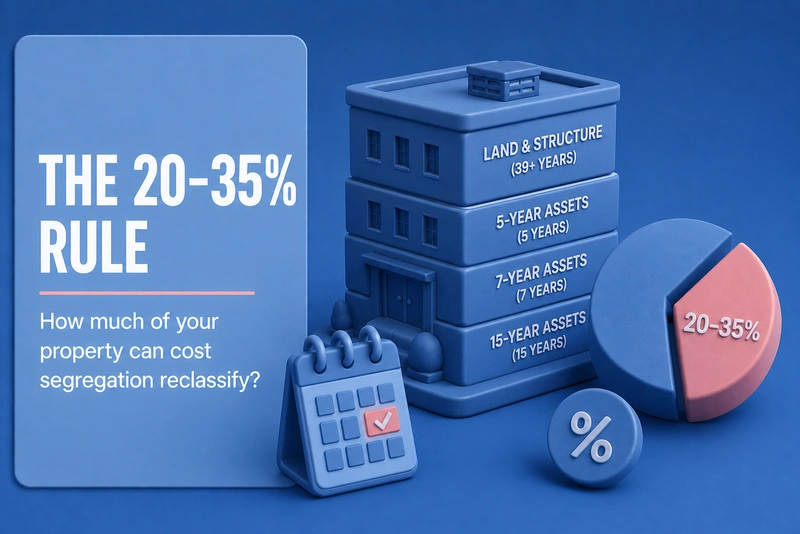
Across the thousands of studies R.E. Cost Seg has completed, most properties land in a familiar range. Roughly 25 to 45% of the depreciable basis moves into shorter-life categories — the typical band from single-family rentals through most commercial assets. Equipment-heavy specialty properties such as car washes and gas stations go far higher, and simple buildings with little site work run lower, but the majority cluster in that band.
That benchmark is useful because it lets you estimate savings before you order a study, set realistic expectations, and understand why some property types accelerate more than others.
This article explains what the range means, breaks down typical percentages by property type, shows what moves the number up or down, and gives you a simple formula to estimate your own savings. It also covers the limits you need to understand before counting on any of it.
What "Reclassification" Means in Cost Segregation
Under standard depreciation, residential rental property depreciates over 27.5 years, and commercial property depreciates over 39 years under IRS MACRS rules. Every component, from the roof to the plumbing to the parking lot to the carpet, sits on that same long schedule.
A cost segregation study changes that. Engineers analyze the building and identify components that qualify for shorter recovery periods:
- 5-year property: carpeting, decorative fixtures, appliances, specialty lighting, and signage
- 7-year property: office furniture and certain equipment
- 15-year property: parking lots, landscaping, sidewalks, fencing, exterior lighting, and retaining walls
The reclassification percentage is the share of the depreciable basis that moves out of the 27.5- or 39-year bucket and into these shorter-life categories.
Here is what that looks like on a $1 million property. After a 15% land value exclusion, the depreciable basis is $850,000. A 30% reclassification moves $255,000 into 5-, 7-, and 15-year property.
With 100% bonus depreciation, you can deduct that $255,000 in a single year instead of spreading it out. The One Big Beautiful Bill Act made 100% bonus depreciation permanent for qualified property acquired and placed in service after January 19, 2025. Property acquired on or before that date follows the earlier phase-down, which allowed only 40% bonus for assets placed in service in 2025 under prior law, dropping to 20% in 2026 and zero after.
At a 37% marginal rate, the full $255,000 deduction produces about $94,350 in first-year tax reduction ($255,000 × 37%). That figure is a gross deduction. What you actually keep depends on the rules covered further below.
Reclassification Rates by Property Type
Component mix drives the percentage. Properties with more specialty equipment, fixtures, and site improvements reclassify at higher rates. Simpler structures fall toward the lower end.
Here are typical ranges from R.E. Cost Seg studies:
| Property Type | Typical Reclassification % | Key Drivers |
| Quick-service restaurants | 34–49% | Kitchen equipment, drive-through lanes, signage, paving |
| Hotels and motels | 29–46% | Room fixtures, specialty HVAC, decorative finishes, site work |
| Assisted living facilities | 29–46% | Resident-room buildouts, specialty systems, grounds and parking |
| Dine-in restaurants | 27–45% | Commercial kitchens, ventilation, specialty flooring, decorative finishes |
| Self-storage | 34–44% | Roll-up doors, security systems, paving, fencing |
| Medical and dental offices | 27–42% | Exam room buildouts, specialized plumbing, medical gas systems |
| Retail / single-tenant | 28–42% | Storefront fixtures, signage, parking lots, landscaping |
| Office buildings | 28–41% | Tenant improvements, specialty lighting, parking areas |
| Industrial and warehouse | 25–39% | Process electrical, dock equipment, yard paving, fencing |
| Multifamily / apartments | 26–38% | Appliances, flooring, cabinetry, site improvements |
| Single-family rentals | 27–38% | Flooring, appliances, cabinetry, driveways, landscaping |
| Shopping centers | 27–36% | Common-area finishes, signage, large parking fields, landscaping |
The low end of each range is the baseline result, what a conservative and well-documented study typically produces for that asset class. The high end is the optimized result, reached when the property has the site work, buildout, and equipment to support it.
Every figure here is a share of depreciable basis, not purchase price. The distinction matters on land-heavy properties. Where land is 15% of the price, a 30% reclassification of basis works out to about 26% of what you paid.
Specialty Properties That Sit Above the Table
A handful of asset classes are not really buildings with equipment in them. They are equipment with a small building attached. On these properties most of the depreciable basis reclassifies, and in some cases nearly all of it.
| Property Type | Typical Reclassification % | Key Drivers |
| Car washes | Close to 100% | Tunnel and bay equipment, conveyors, water reclamation, canopies, paving |
| Gas stations (fuel only) | About 95% | Dispensers, underground tanks, canopies, paving, signage |
| Gas station with convenience retail | 81–95% | Fuel equipment plus store fixtures, coolers, and buildout |
| RV parks | 60–78% | Utility hookups, pads, interior roads, landscaping, amenity buildings |
| Mobile home parks | 40–77% | Site utilities, pads, roads, common-area improvements |
The reason these run so high is structural rather than aggressive. On a car wash or a fuel site, the 39-year building shell is a small share of what you bought. Nearly everything else is 5-year equipment or 15-year land improvement.
Two cautions apply. Land allocation matters more here than anywhere else, because these are land-intensive assets and the percentage is a share of depreciable basis, not price. And the spread within each class is wide, since a tunnel car wash and a self-service bay are different assets. Treat these as directional and request a proposal for a property-specific figure.
Short-term rentals are usually houses or condos rather than hotels. Use the single-family range for the building itself. Furniture and equipment you buy separately are depreciated on their own schedules and sit outside the reclassification percentage.
Why do restaurants and hotels reclassify more than apartments?
Restaurants carry commercial kitchens, grease traps, specialized ventilation hoods, decorative wall treatments, and custom flooring. Hotels add room-specific fixtures, extensive decorative finishes, conference buildouts, and large parking areas. These components qualify for 5-, 7-, or 15-year recovery. A standard apartment building has fewer specialty systems, so it reclassifies less, though appliances, flooring, cabinetry, and site improvements still move a meaningful share.
What Moves the Percentage Up or Down
Three asset categories determine your reclassification percentage.
Site Improvements (15-Year Property)
Site improvements are often the largest single category of reclassified assets. They include:
- Parking lots and driveways
- Sidewalks and curbing
- Landscaping and irrigation
- Exterior lighting
- Fencing and retaining walls
- Signage foundations
Properties with extensive site work, large parking areas, and multi-building campuses see higher rates. A self-storage facility with acres of paved surface reclassifies more than a downtown office building with no parking lot.
Personal Property (5- and 7-Year)
Interior components that are not permanently attached to the building structure can qualify as personal property:
- Carpet and vinyl flooring
- Decorative light fixtures
- Cabinetry and millwork
- Appliances
- Window treatments
Properties with recent renovations or upscale finishes carry more qualifying personal property. A freshly renovated boutique hotel reclassifies more than a dated motel with original finishes.
Renovations and Age
Recent renovations push the percentage higher. New flooring, cabinetry, fixtures, and landscaping all qualify for shorter recovery periods.
Older properties may reclassify at lower percentages when qualifying components have been fully depreciated or replaced. Even so, a look-back study on an older property can still capture missed accelerated depreciation from the original purchase. It does this through a change in accounting method and a Section 481(a) catch-up on your current return, filed on IRS Form 3115, with no amended returns required.
Consider two $500,000 single-family rentals. Property A is a basic ranch with a gravel driveway and minimal landscaping, and it reclassifies at 27%. Property B has extensive landscaping, a paved parking area, decorative lighting, and upgraded flooring, and it reclassifies at 38%.
Each has a depreciable basis of $425,000 ($500,000 × 85%). Property A reclassifies $114,750, and Property B reclassifies $161,500. At a 37% rate, that is about $42,450 versus about $59,750 in first-year deductions. The purchase price is identical. The component mix is what changes the result.
What the Estimate Leaves Out
A reclassification percentage tells you how much you can accelerate. It does not tell you how much you will actually save this year. Three rules shape the real outcome.
Passive activity loss rules. Most rental losses are passive. You generally cannot deduct them against W-2 or active business income unless you qualify for real estate professional status or use the short-term rental loophole. Otherwise the loss carries forward until you have passive income or sell.
Depreciation recapture. Accelerated deductions reduce your basis. When you sell, part of the gain is taxed as depreciation recapture, up to 25% on straight-line building depreciation and at ordinary rates on accelerated components. Cost segregation shifts much of the benefit forward in time. It does not erase the tax entirely.
Deferral, not free money. A first-year deduction is worth the most when you can use it now and reinvest the savings. For a long-term hold with usable losses, that time value is significant. For a quick sale, the benefit shrinks.
Does cost segregation eliminate taxes or just delay them?
For most investors it is primarily a deferral. You pull deductions forward to boost early cash flow, then face recapture on part of the gain at sale. The value comes from the time between the two, plus any difference in tax rates.
How to Estimate Your Tax Savings Before Ordering a Study
You do not need a completed study to get a rough estimate. Use this three-step formula.
Step 1: Calculate your depreciable basis. Subtract land value from the purchase price. Land is often 15 to 25% of the price and varies by market, so use your county assessor's land-to-improvement ratio where possible.
Step 2: Apply the reclassification percentage for your property type. Use the table above and pick the midpoint of the range. The low end is the baseline case and the high end assumes the property supports an optimized result.
Step 3: Multiply by your marginal tax rate. This gives your estimated first-year deduction from the accelerated component.
Here is an example on a $750,000 multifamily property:
- Land value (15%): $112,500
- Depreciable basis: $637,500
- Reclassification at 32%, the midpoint for multifamily: $204,000
- Deduction with 100% bonus depreciation: $204,000 in year one
- Tax reduction at 37%: about $75,500 ($204,000 × 37%)
That is a rough figure. The actual number comes from a site-specific engineering analysis, but the formula gives you a reliable starting point for deciding whether a study makes financial sense.
How accurate is this estimate?
It is a ballpark. Properties with unusual features, such as extensive renovations, large sites, or specialty equipment, may exceed it. Simple buildings with minimal site work may fall below. For a property-specific number, use the R.E. Cost Seg depreciation calculator or request a proposal with your property details.
Know the Range, Then Get the Exact Number
Key takeaways:
- Most properties reclassify about 25 to 45% of the depreciable basis. Equipment-heavy specialty assets go well above that, and simple buildings with little site work run lower.
- Property type is the biggest factor. Restaurants, hotels, and self-storage accelerate the most, and shopping centers and basic single-family rentals the least.
- Car washes, fuel sites, RV parks, and mobile home parks are a category of their own, reclassifying anywhere from 40% to nearly all of the basis.
- Site improvements (15-year) and personal property (5- and 7-year) drive the number.
- Every benchmark here is a share of depreciable basis, not purchase price.
- The three-step formula, depreciable basis times reclassification percentage times tax rate, gives a reliable pre-study estimate.
- Passive loss limits and recapture determine how much of that estimate you actually keep, and when.
Knowing the typical range helps you evaluate the return on a study before you commit. For most $500,000-plus properties with usable losses, the first-year deduction runs well into the tens of thousands.
Want your property's specific reclassification percentage? Run the numbers with the depreciation calculator, then request a free proposal to compare the estimate against an engineered study.