
One of my clients is a healthcare group expanding its footprint with a new 40,000-square-foot specialty clinic. The CFO had done his homework on 179 deductions and depreciation schedules, but when I brought up cost segregation, he admitted he hadn’t considered it.
I got to work, and within two weeks, we had identified over $1.3 million in assets that could be reclassified and depreciated in the first year. That single decision freed up capital to fund an imaging suite ahead of schedule.
This scenario isn’t unusual. In the healthcare sector, where facilities are complex, capital-intensive, and heavily regulated, cost segregation is often the missing link in a comprehensive tax strategy. Especially now, with 100% bonus depreciation back on the table, healthcare property owners and operators have a renewed opportunity to maximize tax savings and cash flow.
In this article, I’ll break down exactly how cost segregation applies to healthcare facilities, what to expect from a study, and why this strategy is more relevant now than ever.
What Cost Segregation Means for Healthcare Facilities
Cost segregation is a method of accelerating depreciation on parts of a building that wear out more quickly than the building itself. Instead of writing off the entire building over 39 years (the default for commercial property), you break out certain components, like flooring, lighting, plumbing, and specialized equipment, and depreciate them over 5, 7, or 15 years.
For healthcare facilities, this is a game-changer.
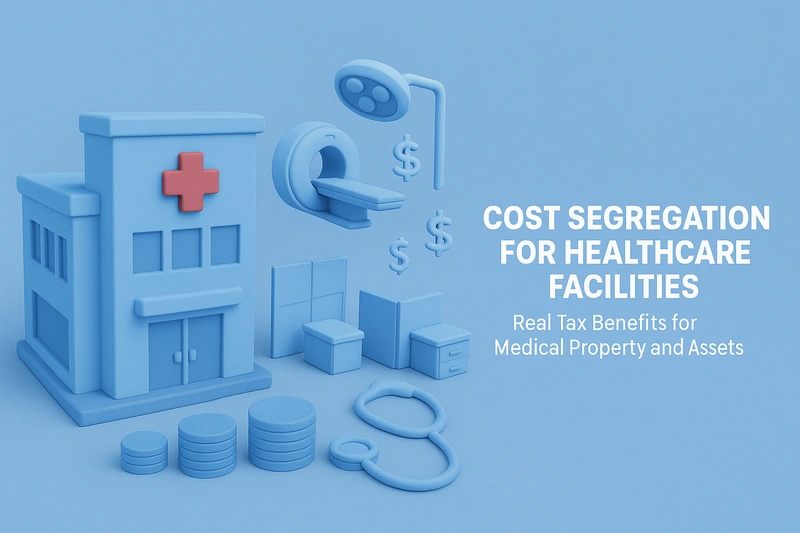
Medical buildings are not like standard office buildings. They’re filled with highly specialized equipment, custom wiring, modular partitions, sterilization units, and patient-focused infrastructure. All of that may qualify for shorter depreciation periods if properly identified through a cost segregation study.
By fast-tracking those write-offs, owners and operators can reduce taxable income. Freeing up real dollars that can be reinvested in staffing, upgrades, or expansion.
What Can Be Reclassified? A Look Inside the Walls
In a healthcare environment, many assets are prime candidates for reclassification. Here’s what typically qualifies:
- Medical equipment: MRI machines, imaging suites, surgical lighting, autoclaves, and lab installations
- Specialized electrical and plumbing: Think about lead-lined walls, oxygen piping, or electrical circuits for radiology
- Interior finishes: Vinyl flooring in exam rooms, wall paneling, cabinetry, nurse stations, and even waiting room fixtures
- Tenant improvements: Custom build-outs for leased spaces (e.g., outpatient clinics or dental offices)
- Site work: Parking lots, sidewalks, signage, lighting, and landscaping often qualify for 15-year depreciation
These elements are foundational to how a medical facility operates, and they depreciate far faster than concrete walls or steel framing.
When to Consider a Cost Segregation Study
The right timing can make a cost segregation study far more valuable. In healthcare, that timing depends on what stage you’re at with your facility. Whether you’re breaking ground, buying an existing building, or retrofitting an aging space, the opportunity to claim accelerated depreciation is likely there; you just need to know when and how to capture it.
Here are the best moments to consider a study:
- Right after new construction is completed
If you’ve just built a new hospital, clinic, or outpatient center, a cost segregation study allows you to break out the assets immediately, before the first tax return is filed. - When acquiring an existing medical property
Buying a building? Even if it’s not new, you can analyze the purchase price and reallocate portions of it (e.g., electrical systems, finishes, site improvements) to shorter depreciation schedules. - After major renovations or build-outs
Healthcare facilities constantly evolve. If you’ve invested significantly in updated equipment, tenant improvements, or medical-specific infrastructure, those updates may be depreciated faster through a study. - If your project is still in design or under construction
By involving a cost segregation provider early, you can track and separate costs properly, ensuring that things like gas lines, custom lighting, and specialty flooring don’t get lumped into the 39-year bucket. - Even years after the building is already in use
Haven’t done a study yet? You’re not out of luck. The IRS allows retroactive cost segregation through a change in accounting method (Form 3115). You can reclaim missed depreciation from previous years, often without amending past returns.
Real-World Financial Impact: A Hypothetical Case Study
Let’s say you’re building a $5 million outpatient surgical center. You’ve got imaging rooms, lead-lined walls, dedicated HVAC zones, specialty plumbing, lab space, and high-end interior finishes. Most of this falls into the category of assets that wear out far faster than the shell of the building, and that’s where cost segregation comes in.
With a proper study, let’s assume 35% of your total project cost can be reclassified into 5-, 7-, or 15-year property. That’s $1.75 million you don’t have to stretch out over four decades.
Thanks to the reinstated 100% bonus depreciation for property purchased and placed in service after January 19, 2025, you could write off that $1.75 million in full in Year One. That could easily reduce your tax liability by several hundred thousand dollars, and that money can be redirected into staff hiring, new equipment, or expansion planning.
Even if your facility is already built, a retroactive study could yield a similar deduction this year, without the need to amend prior returns.
Final Thoughts: Work with a Partner Who Knows Healthcare
Cost segregation isn’t just about tax savings, it’s about freeing up capital to grow your practice, upgrade your facilities, or simply run leaner in a margin-sensitive industry. With 100% bonus depreciation restored, the opportunity is real, but only if you act at the right time and with the right guidance.
That’s where R.E. Cost Seg comes in. We specialize in cost segregation for complex properties like healthcare facilities, surgical centers, imaging clinics, specialty care, and more. Our team doesn’t just understand the tax code. We understand what’s behind your walls and how to properly classify it to maximize benefit.