
What if your hotel renovation could generate $600,000 in first-year tax deductions, enough to cover a new booking system and refreshed lobby build-out? This isn't theoretical. It's what we delivered for a boutique hotel operator renovating a 60-room property after reclassifying nearly $2 million in assets through cost segregation.
Stories like this are common in hospitality. Hotels are loaded with fast-depreciating assets—furniture and fixtures, lighting, signage, dedicated guest room HVAC units, pool decks, and parking areas. But unless you break them out properly, the IRS treats everything like a 39-year building, even components that clearly don't last that long.
Here's what matters: The IRS allows you to reclassify these components into 5-, 7-, or 15-year depreciation categories. Instead of waiting decades to recover your investment, you can claim substantial deductions immediately.
With the One Big Beautiful Bill Act permanently restoring 100% bonus depreciation for qualifying property both acquired and placed in service after January 19, 2025, now is a prime time to revisit what your hotel is really worth, on paper and on your tax return.
R.E. Cost Seg specializes in working with hotel owners, operators, and developers to uncover the hidden value in every property. Our engineering-based studies typically reclassify 29% to 46% of a hotel's depreciable basis into shorter-life categories, generating six-figure tax savings in year one.
That range runs from the baseline result, what a conservative and well-documented study produces on a straightforward property, to the optimized result on a hotel with the site work, buildout, and specialty systems to support it. Hotels sit near the top of our reclassification percentage benchmarks for exactly that reason. Note that these figures are a share of depreciable basis, not purchase price. On a property where land is 15% of what you paid, a 40% reclassification of basis works out to about 34% of the purchase price.
This article breaks down exactly which hotel components qualify for accelerated depreciation and what it means for your bottom line.
What Is Cost Segregation (As It Applies to Hotels)?
Cost segregation allows hotel owners to accelerate depreciation on parts of the building that wear out faster than the structure itself. Without it, the IRS lumps everything into a 39-year schedule, even assets like furniture, lighting, and flooring that clearly don't last that long.
A proper engineering study reclassifies those components into 5-, 7-, or 15-year categories. That means you can take bigger deductions sooner, reduce taxable income in the early years, and free up cash when it matters most.
This is a major advantage in hospitality, where guest-facing assets turn over quickly, and brand standards demand frequent updates. From furniture, fixtures & equipment cycles to signage and pool decks, many hotel components qualify, as long as you identify and document them properly.
One important consideration: accelerated depreciation isn't free money; it's a timing benefit. When you sell the property, depreciation taken on 5- and 7-year personal property is subject to recapture as ordinary income (up to 37%) rather than at the 25% unrecaptured Section 1250 rate that applies to building depreciation.
For owners planning a long hold or 1031 exchange, the math still works in your favor. The payoff is real: faster capital recovery, stronger cash flow, and more room to reinvest in operations, upgrades, or expansion.
What Can Be Reclassified? Inside the Hotel Property Breakdown
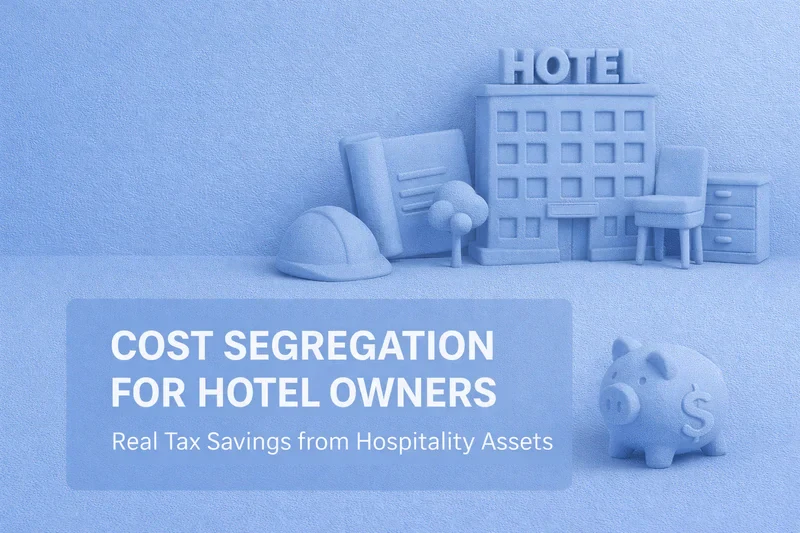
Hotels are full of assets that wear out or become outdated far faster than 39 years. A good cost segregation study breaks these components out into shorter depreciation schedules (typically 5, 7, or 15 years), so you can capture the value of those assets sooner.
Here's a breakdown of what commonly qualifies in a hotel setting:
- Furniture, fixtures & equipment (FF&E) Beds, dressers, nightstands, desks, chairs, lamps, and minibars, all of it counts. These are typically replaced every 5-7 years and are prime candidates for short-life depreciation.
- Specialty lighting & electrical systems Accent lighting in lobbies, sconces in guest rooms, outdoor lighting, and emergency exit signs can often be separated from the building's structural wiring.
- Flooring & finishes Carpet, tile, vinyl plank flooring, wallpaper, and custom woodwork wear out faster than walls and ceilings, and are generally depreciated over 5 or 7 years.
- Guest room appliances & amenities TVs, coffee makers, hair dryers, safes, minifridges, and dedicated HVAC units serving individual guest rooms (such as PTAC units) can all be eligible.
- Signage & branding elements Exterior monument signs, wayfinding signage, branded awnings, and digital display boards often qualify for 15-year depreciation.
- Site improvements Parking lots, sidewalks, curbs, fencing, landscaping, outdoor pools, patios, and decorative features typically fall into the 15-year category.
- Renovation build-outs If you've customized a leased hotel space or reconfigured internal layouts, such as adding a lounge, spa area, or business center, those build-out costs can often be accelerated as well.
Qualified Improvement Property (QIP): Interior improvements made after the building was first placed in service, think lobby renovations, hallway upgrades, or guest room refreshes, may qualify as QIP. This category has a 15-year recovery period and is eligible for bonus depreciation under current law. QIP doesn't include building enlargements, elevators, escalators, or internal structural framework, but it covers most interior renovation work that hotel operators regularly undertake for brand compliance or guest experience upgrades.
An engineering-based study with a site visit ensures these components are properly identified and documented for IRS compliance.
When to Consider a Cost Segregation Study
The best time to do a cost segregation study is when it can make the biggest impact on your tax strategy. In hospitality, that depends on where your property is in its lifecycle: newly built, newly acquired, recently renovated, or already in operation.
Here are the key opportunities to consider a study:
- After new construction Just opened a new hotel? A study lets you reclassify eligible assets right away, before the first tax return is filed.
- When acquiring a hotel Even without major upgrades, a study can break out short-life assets from the purchase price of an existing property. Keep in mind that land value must be excluded from the depreciable basis, so proper allocation is essential.
- Following renovations or rebranding Recent updates for a flag change or PIP? A study can accelerate deductions on FF&E, finishes, or guest-facing upgrades.
- During planning or construction Involve a provider early to document costs in detail and ensure eligible assets don't get lumped into 39-year property.
- Even years later The IRS allows retroactive studies through Form 3115, so you can claim missed depreciation in the current year through a Section 481(a) "catch-up" adjustment—no amended returns required. This automatic change can generally be made once every five years.
How Much Could a Cost Segregation Study Save a Hotel Owner?
Let's say you're developing a $7 million midscale hotel with 100 rooms, a pool, a fitness center, and conference space. Like most hotels, it's packed with short-life assets: guest room furniture, carpet, lighting, signage, landscaping, and parking areas.
With a proper cost segregation study, you might reclassify 29% to 46% of the depreciable basis into 5-, 7-, or 15-year property. On a $7 million construction basis, that is roughly $2 million to $3.2 million that doesn't need to sit on a 39-year depreciation schedule.
Thanks to 100% bonus depreciation now available for eligible property that was acquired and placed in service after January 19, 2025, you could write off that full amount in year one. At a 37% marginal rate, that is roughly $750,000 to $1.2 million in first-year tax reduction.
Signed your construction contract in 2024? The new "component election" still lets you claim 100% bonus on FF&E and other components acquired after January 19, 2025, even though the larger project doesn't qualify.
That kind of capital can go straight back into your business: covering debt service, investing in marketing, refreshing your digital booking infrastructure, or accelerating the next location.
Hotel owners who qualify for Real Estate Professional Status or materially participate in operations can use these deductions to offset other income directly. Even if your hotel is already up and running, a retroactive study could yield similar first-year deductions now, without needing to amend prior returns.
Partner with a Specialist Who Understands Hotels
In hospitality, timing is everything, and that applies to taxes, too. Cost segregation gives hotel owners a smart way to pull forward depreciation, boost cash flow, and recover capital faster, especially under the reinstated 100% bonus depreciation rules.
But the real value comes from doing it right.
At R.E. Cost Seg, we specialize in working with hotel owners, operators, and developers to uncover the hidden value in every property, from branded flag renovations to boutique builds. Our team understands both the tax code and the realities of hotel construction, operations, and asset turnover.
Whether you're opening a new location or looking back at past improvements, we can help you turn your property's details into meaningful deductions, without the guesswork.
Ready to see what your hotel could save?Request a free cost segregation estimate today.