
Most investors assume every wire and every pipe in a rental property depreciates on the same schedule. That assumption quietly costs them money.
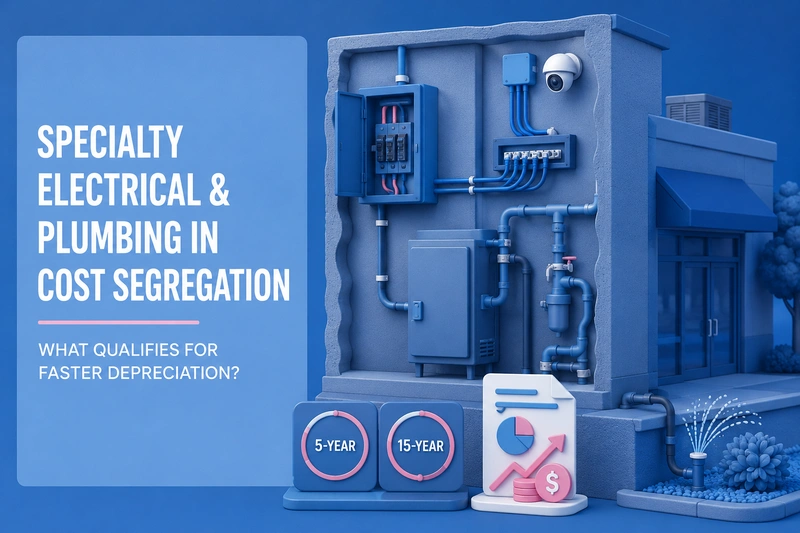
The IRS separates general building systems from specialty systems that serve specific equipment or functions. General electrical and plumbing, the main panel, the primary wiring, and the water line from the street, depreciate over 27.5 years for residential or 39 years for commercial under IRC § 168, because the tax code treats them as building components (§ 1250 property). Components that serve a specific piece of equipment or a business function can instead qualify as § 1245 personal property with a 5-year life, or as 15-year land improvements. A cost segregation study identifies and reclassifies them.
This article shows how the IRS distinguishes specialty systems from general ones, how the reclassification translates into real dollars, what an engineer looks for on site, and, just as important, the recapture and eligibility rules you should weigh before you count the savings.
General vs. Specialty Systems: The Test That Actually Matters
The IRS applies a functional-use test. The IRS Cost Segregation Audit Techniques Guide treats electrical and plumbing "used in the operation or maintenance of the building or necessary to provide general building services" as building components. It treats connections "necessary to and used directly with a specific item of machinery or equipment" as personal property. Classification turns on what a component serves, not where it sits.
General building systems serve the entire structure. They include:
- Main electrical panel and primary distribution wiring
- Primary water supply line from the street
- Main sewer and drain lines
- Central HVAC ductwork and wiring
- General-purpose lighting and outlets
These depreciate with the building, 27.5 years for residential, 39 years for commercial.
Specialty systems serve a specific purpose, piece of equipment, or area. These can qualify for 5-year or 15-year recovery:
- Dedicated circuits for specific commercial appliances or equipment
- Security and alarm system wiring
- Data and telecommunications cabling
- Irrigation piping (15-year land improvement)
Consider the tax impact. A main electrical panel in a commercial building depreciates over 39 years. A dedicated 220V circuit running from that panel to a commercial oven can qualify for a 5-year life. Same building, same electrician, different treatment, because the circuit serves one machine.
The One Big Beautiful Bill Act restored 100% bonus depreciation and made it permanent, but only for qualifying property acquired and placed in service after January 19, 2025. Property under a binding contract signed before January 20, 2025 follows the prior phase-down by placed-in-service year, 40% in 2025, 20% in 2026, and none after. When it applies, 100% bonus depreciation lets you deduct that circuit's full cost in year one instead of spreading it across decades.
Specialty Electrical Systems That Can Qualify
Most properties contain more specialty electrical than investors realize. A cost segregation engineer identifies each component and ties it to a function.
5-year personal property:
- Dedicated circuits serving specific appliances or equipment (ranges, dryers, dishwashers, and booster or process water heaters serving specific equipment; general-service water heaters stay with the building)
- Security and alarm system wiring
- Data and telecommunications cabling
- Decorative, task, accent, or display lighting
- Generator hookups and transfer switches serving specific equipment
- Intercom and doorbell systems
- Garage door opener wiring
15-year land improvement property:
- Landscape and exterior pathway lighting circuits
- Signage electrical feeds
- Parking lot lighting wiring
- Exterior security camera wiring
Classification is fact-specific. General-purpose outlets and lighting that serve the building as a whole stay on the 27.5- or 39-year schedule, even when the same crew installs them alongside specialty work. An engineer documents each circuit's function so the study can defend the split.
Consider a $500,000 apartment building with the following specialty electrical:
- Circuits serving specific appliances (4 units): $12,000
- Security and alarm wiring: $5,000
- Data and telecom cabling: $6,000
- Landscape lighting: $7,000
- Exterior security cameras: $5,000
Total specialty electrical: $35,000, $23,000 as 5-year property and $12,000 as 15-year property. If the property qualifies for 100% bonus depreciation, you deduct the full $35,000 in year one. At a 37% marginal rate, that produces $12,950 in tax savings from the electrical systems alone.
Does wiring inside walls still qualify, or only exposed wiring?
Location does not determine classification. Concealed wiring qualifies just like exposed wiring when it serves a specific, dedicated function. A dedicated circuit running through the wall to a commercial range is 5-year property whether you can see it or not. The engineer traces the circuit's function, not its physical path.
Specialty Plumbing Systems That Can Qualify
Plumbing follows the same test, but the line is stricter than many investors expect. Routine supply and waste lines that serve bathrooms, kitchens, and the building generally are building components on the 27.5- or 39-year schedule. Plumbing earns a 5-year life only when it serves specific equipment or a business process.
5-year personal property:
- Dedicated supply and waste connections to specific appliances (dishwasher, ice maker, garbage disposal)
- Gas piping to specific appliances (range and dryer)
- Connections to booster or process water heaters serving specific equipment (general-service water heaters stay with the building)
- Process plumbing for a commercial kitchen, laboratory, or similar function
15-year land improvement property:
- Irrigation and lawn sprinkler piping
- Exterior drainage serving landscaped areas
- Dedicated exterior hose bibs for landscape maintenance
Here is the distinction that trips people up. The supply and drain lines to a standard toilet, tub, or bathroom sink generally stay structural. The dedicated line to an ice maker or a commercial dishwasher does not. Only the branch that serves specific equipment or a process moves to the faster class.
Consider a rental property with the following specialty plumbing:
- Dishwasher, ice maker, and disposal connections: $3,500
- Gas piping to range and dryer: $2,000
- Booster water-heater connection serving specific equipment: $1,500
- Irrigation system: $3,500
Total specialty plumbing: $10,500, $7,000 as 5-year property and $3,500 as 15-year property. Deducted in year one at 37%, that produces $3,885 in tax savings. Note what is not on the list: the bathroom and general kitchen-sink lines, which remain part of the building.
What about the main water line from the street? Does any part qualify?
The main supply line from the street to the building is a general building system, so it depreciates over 27.5 or 39 years. Only the branches that serve specific equipment or a process, not every branch to every fixture, become candidates for reclassification. A study documents which branches meet that test.
The Site Visit: What Engineers Actually Look For
A cost segregation engineer does more than count outlets and faucets. The inspection is systematic.
For electrical, the engineer traces each circuit from the panel to its endpoint and identifies dedicated circuits by breaker label, wire gauge, and termination point. A 20-amp circuit feeding a general-purpose outlet is building property. A 30-amp circuit dedicated to specific equipment can be personal property.
For plumbing, the engineer maps supply and drain lines from their main connections to individual endpoints, documents each branch point, and measures equipment-specific connections for classification.
Blueprint review supplements the walkthrough. Mechanical and electrical drawings show circuit routing and pipe sizing that a visual inspection can miss.
Virtual inspections use detailed photos, videos, and construction documents to classify systems without an in-person site visit. Documentation quality, not building age, drives how easily an engineer can identify and support each component. Well-labeled panels and complete drawings help; missing records slow the analysis, whether the building is new or old.
Real Dollar Impact: A Full Property Example
An investor buys a $1.2 million commercial property and commissions a study. Land is not depreciable (IRS Publication 946), so start by carving it out. Assume roughly $240,000 in land value, leaving a depreciable building basis of $960,000. Spread over 39 years, that is about $24,615 per year.
Specialty electrical identified:
- Circuits serving specific equipment: $22,000
- Security and alarm wiring: $12,000
- Data and telecom cabling: $18,000
- Task, accent, and display lighting: $15,000
- Landscape and parking-lot lighting: $18,000
- Total: $85,000 ($67,000 at 5-year, $18,000 at 15-year)
Specialty plumbing identified:
- Appliance gas and water connections: $10,000
- Dedicated equipment supply lines: $8,000
- Irrigation piping: $7,000
- Total: $25,000 ($18,000 at 5-year, $7,000 at 15-year)
Total reclassified: $110,000, $85,000 as 5-year property and $25,000 as 15-year property.
If the property qualifies for 100% bonus depreciation, you deduct the full $110,000 in year one, producing $40,700 in tax savings at a 37% rate. Compare that with standard depreciation on the same $110,000: about $2,821 per year, or roughly $1,044 in annual savings. The study accelerates deductions on the reclassified components that would otherwise have been spread across decades.
Does this work for residential rentals or only commercial?
Both. Residential and commercial buildings contain the same categories of specialty systems, and the § 1245 and § 1250 rules apply the same way. The only difference is the general recovery period, 27.5 years for residential versus 39 years for commercial. Specialty components qualify for 5-year or 15-year treatment regardless of property type.
Before You Count the Savings: Recapture and Eligibility
Accelerated deductions come with two conditions worth planning for.
First, depreciation recapture. When you sell, depreciation on 5-year property is generally recaptured as ordinary income under IRC § 1245, up to the amount of gain. Fifteen-year land improvements are § 1250 property: depreciation in excess of straight line, including bonus depreciation, is generally recaptured as ordinary income, while the remaining depreciation may be subject to the 25% unrecaptured § 1250 gain rate. Cost segregation shifts basis into faster classes, so it front-loads deductions but can also enlarge the ordinary-income recapture layer at sale. For most investors the time value of money still favors the study, but the trade-off is real, and a 1031 exchange can defer the hit.
Second, you have to be able to use the loss. Passive activity rules can suspend the deduction unless you have passive income, qualify for real estate professional status, or meet the short-term rental exception. And if the property was placed in service in a prior year, you do not have to amend, you can catch up missed depreciation through a change in accounting method on Form 3115.
Not All Systems Are Created Equal
The electrical and plumbing in your property are not one uniform asset. They are a mix of general and specialty systems, each with its own tax treatment.
Key takeaways:
- General building systems, main panel, primary wiring, main water supply, depreciate over 27.5 or 39 years.
- Specialty components that serve specific equipment or functions can qualify for 5-year (personal property) or 15-year (land improvement) recovery.
- The IRS functional-use test asks what a component serves, not where it sits, and general bathroom and kitchen plumbing usually stays structural.
- 100% bonus depreciation applies only to qualifying property acquired and placed in service after January 19, 2025. Property under a binding contract signed before January 20, 2025 follows the prior phase-down by placed-in-service year, 40% in 2025, 20% in 2026, and none after.
- On sale, 5-year property is generally subject to ordinary-income recapture under § 1245. Fifteen-year land improvements fall under § 1250, with excess-over-straight-line depreciation generally recaptured as ordinary income and the remaining depreciation potentially taxed at the 25% unrecaptured § 1250 gain rate.
- A study typically reclassifies a meaningful share, often roughly 20% to 35%, of a building's depreciable basis, but the exact amount depends on an engineering analysis of your property.
The wires behind your walls and the pipes under your floors may be sitting on years of accelerated deductions. Estimate your first-year deduction or get a free proposal to see how much of your property's electrical and plumbing qualifies.