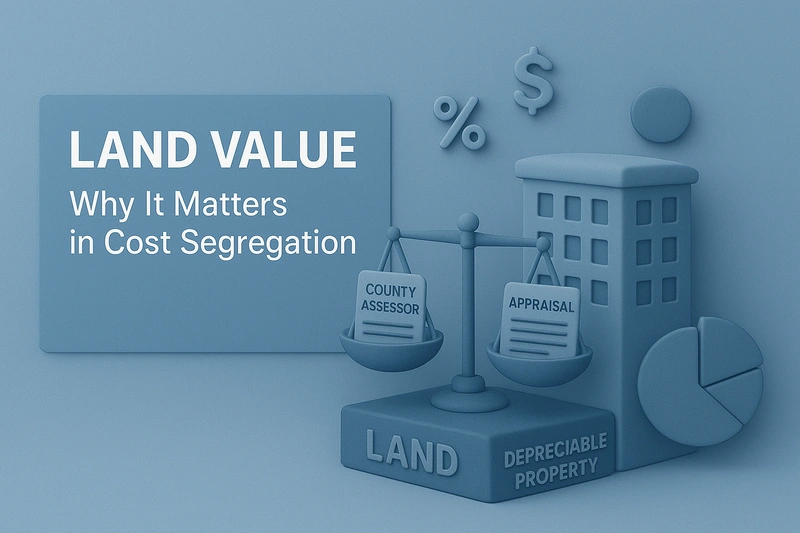

Every year, thousands of real estate investors unknowingly forfeit tens of thousands in tax deductions by misallocating their property's land value. Consider this scenario: Two investors purchase identical $2 million commercial properties. One accepts the county assessor's 35% land allocation. The other obtains a professional appraisal showing 20% land value. The difference? $300,000 in additional depreciable basis, worth roughly $7,700 in extra first-year depreciation on a 39-year schedule, or about $2,850 in tax savings at a 37% marginal rate. When combined with cost segregation strategies, that gap widens dramatically, because the same $300,000 can be reclassified into 5-, 7-, and 15-year property and deducted in full in year one.
Land never depreciates. This fundamental IRS rule means every dollar allocated to land becomes permanently excluded from depreciation deductions. For investors leveraging cost segregation studies to accelerate depreciation, proper land valuation becomes even more critical. The allocation method you choose directly impacts your depreciable basis and, consequently, your annual tax savings.
This article examines the two primary land valuation methods available to investors: county assessor valuations and professional appraisals. You'll learn when each method makes financial sense, how to maximize your depreciable basis within IRS guidelines, and specific strategies to optimize your property allocation. The stakes are significant. The approach is straightforward. Let's begin.
The Foundation: Understanding Land Value in Property Allocation
Land represents the one component of real property that never qualifies for depreciation. The IRS maintains this position because land doesn't wear out, become obsolete, or get consumed through use. Treasury Regulation § 1.167(a)-5 requires taxpayers to apportion basis between depreciable and non-depreciable assets when acquiring property for a lump sum. This allocation fundamentally determines your tax benefits from cost segregation services.
The math is straightforward but impactful:
Total Purchase Price - Land Value = Depreciable Basis*
Example: Purchase a $2 million property with $400,000 allocated to land. Your depreciable basis equals $1.6 million. That $1.6 million becomes eligible for depreciation, including accelerated methods through cost segregation and potentially 100% bonus depreciation under current regulations.
The IRS requires land valuation based on "highest and best use" principles. This means valuing land as if vacant, considering its most profitable legal use, regardless of current improvements. This standard applies whether you're using county assessor data or professional appraisals.
*In certain business acquisitions, the allocation may also include additional components such as FFE (fixtures, furniture, and equipment) and goodwill.
What happens if I allocate too little to land value?
Understating land value triggers IRS scrutiny and potential penalties. The Service examines unreasonably low land allocations, particularly those under 10% without strong justification. Auditors look for defensible valuation methodology supported by documentation. Common red flags include inconsistent allocation methods across similar properties, ignoring comparable sales data, and failing to consider location premiums. Maintain comprehensive records supporting your chosen allocation method to withstand potential challenges.
County Assessor Method: The Default Approach
County tax assessors determine property values for tax revenue purposes, typically breaking down the total value between land and improvements. These assessments use mass appraisal techniques, applying standardized formulas across entire neighborhoods or property classes. Most jurisdictions update assessments annually or biannually, though some lag market conditions by several years.
Assessor allocations offer distinct advantages for cost segregation purposes. The data is publicly available at no cost through county websites or tax offices. The IRS generally accepts these valuations as reasonable starting points for depreciation calculations. Documentation comes directly from government sources, providing built-in credibility. Most assessors maintain consistent methodology across similar properties, creating predictable allocation patterns.
However, significant limitations exist. Assessor valuations target tax collection, not fair market value determination. Many jurisdictions intentionally undervalue properties to avoid taxpayer appeals. Assessment methods may not reflect the highest and best use standards required by IRS regulations. Regional inconsistencies create disparities; some counties routinely assign 40-50% to land, while neighboring jurisdictions allocate 20-25% for identical property types.
Consider this Houston investor's experience: County records showed 40% land allocation on a $1.8 million warehouse property, limiting the depreciable basis to $1.08 million. After obtaining an appraisal demonstrating 20% land value based on comparable sales, the investor increased the depreciable basis to $1.44 million. This $360,000 difference generated an additional $9,231 in annual depreciation deductions on the 39-year schedule, before any cost segregation acceleration.
Can I rely solely on county assessor values for my cost segregation study?
Yes, county assessor values meet IRS requirements for land allocation. However, relying solely on assessor data can sometimes lead to land percentages that are higher than necessary, which in turn reduces your available depreciation. Comparing assessor allocations to market-based data is considered best practice.
If assessor values come in high, generally above 30% for commercial properties or 25% for residential rentals, you may consider obtaining an appraisal or other valuation support. It is important to note, though, that an appraisal does not automatically produce a more favorable land-to-building ratio or increase your tax benefits. What it does provide is a more defensible and reliable methodology should your allocation ever be reviewed by the IRS.
Professional Appraisal Method: The Premium Option
Professional appraisals provide the most defensible land valuations for cost segregation studies. Qualified appraisers follow Uniform Standards of Professional Appraisal Practice (USPAP), applying three valuation approaches: sales comparison, income capitalization, and cost approach. For land valuation specifically, appraisers typically use direct comparison to recent vacant land sales or the land residual technique, which subtracts improvement value from total property value.
Appraisals reflect current market conditions, not historical tax assessments. They consider site-specific factors including zoning restrictions, environmental conditions, development potential, and location premiums. This detailed analysis often yields lower land percentages than county assessments, particularly in developed commercial areas where improvements drive property value.
The financial case for professional appraisals becomes clear at higher property values. A $3 million office building with county-assessed 35% land allocation limits depreciable basis to $1.95 million. An appraisal showing 18% land value increases depreciable basis to $2.46 million. That additional $510,000 generates $13,077 in standard first-year depreciation. With cost segregation and bonus depreciation, the difference multiplies significantly.
Appraisals make particular sense for properties exceeding $2 million, recent acquisitions where assessments lag market values, properties in high-land-value markets, and situations where county allocations exceed 30%. The $3,000-$10,000 appraisal cost typically recovers through first-year tax savings alone.
How recent does my appraisal need to be for IRS acceptance?
The IRS prefers appraisals within 12 months of acquisition or placed-in-service date. Bank appraisals from purchase financing generally satisfy requirements. Older appraisals remain acceptable with documented market adjustments. For cost segregation studies performed years after acquisition, contemporary appraisals from the purchase period carry more weight than current valuations.
Head-to-Head Comparison: Which Method Wins?
The choice between county assessor valuations and professional appraisals depends on specific property circumstances and investor objectives. This comparison highlights key decision factors:
County Assessor vs Professional Appraisal Comparison
| Factor | County Assessor | Professional Appraisal |
|---|---|---|
| Cost | Free | $3,000–$10,000 |
| IRS Acceptance | Standard | Preferred |
| Market Accuracy | Variable | High |
| Typical Land Allocation | 25–40% | 15–30% |
| Update Frequency | 1–3 years | Current |
| Audit Defense | Moderate | Strong |
| Documentation | Public Records | USPAP Report |
Strategic decision framework:
- Use County Assessor valuations when: Properties fall below $1 million purchase price. Land allocations appear reasonable at 15-25%. Standard suburban or urban locations without unique characteristics. Budget constraints prevent appraisal investment. Planning basic depreciation without aggressive cost segregation.
- Invest in professional appraisals when: County assessments exceed 30% land allocation. Premium locations command high land values. Planning comprehensive cost segregation studies with site visits. Property values exceed $2 million. Expecting IRS scrutiny due to Real Estate Professional Status or significant deductions. Recent market shifts make assessments obsolete.
The data speaks clearly: Professional appraisals frequently reduce land allocations by 10-20 percentage points versus assessor values. For larger properties, this translates to hundreds of thousands in additional depreciable basis.
Can I use both methods and choose the more favorable one?
No. The IRS prohibits cherry-picking between valuation methods. You must apply consistent methodology supported by documentation. However, you can challenge unreasonable assessor allocations using appraisal evidence. If obtaining an appraisal, use it consistently across your cost segregation study. Switching methods without justification invites scrutiny.
Maximizing Your Depreciable Basis: Action Steps
Pre-acquisition planning yields the greatest land value optimization opportunities. Review county assessor records before closing. If allocations exceed 25% for commercial properties, build appraisal contingencies into purchase agreements. Negotiate purchase price allocations directly with sellers; agreed-upon allocations carry weight with the IRS when documented properly.
Post-acquisition strategies remain viable. Challenge excessive assessor land values through formal appeals or alternative appraisals. Document all capital improvements that don't increase land value. Consider environmental issues or functional obsolescence that may reduce overall property value while maintaining land ratios.
Working effectively with cost segregation professionals requires upfront communication. Provide all available valuations, including purchase documents, assessor records, and appraisals. Discuss land allocation strategies before study commencement. Ensure consistency across your entire portfolio to avoid IRS red flags.
Common Pitfalls and How to Avoid Them
Three allocation errors trigger immediate IRS scrutiny. First, land values below 10% without compelling justification raise red flags. Even dense urban properties rarely justify single-digit land allocations. Second, inconsistent methods across similar properties signal manipulation. Using appraisals for high-land-value properties while accepting assessor values for others appears selective. Third, ignoring environmental contamination or easements that affect property value undermines credibility.
Documentation prevents most audit challenges. Maintain original purchase agreements showing price negotiations. Keep all appraisals, assessments, and broker opinions of value. Document your allocation methodology in writing. Save comparable sales data supporting your position. Create consistent files across all properties.
Professional reports strengthen your position. Quality cost segregation studies explicitly address land valuation methodology. They reference supporting documentation and explain deviation from assessor values when applicable. This transparency demonstrates good faith compliance.
How does land value affect depreciation recapture?
Land never triggers recapture because it was never depreciated. Higher land allocations mean lower depreciation taken, resulting in less recapture exposure upon sale. However, this also means fewer tax benefits during ownership. Balance current tax savings against future recapture liability when setting allocation strategies. Properties held long-term benefit from aggressive depreciation. Properties with shorter holding periods may favor conservative allocations.
The Bottom Line
Land value allocation forms the foundation of every successful cost segregation strategy. County assessor values provide acceptable documentation but often overstate land percentages, limiting depreciation benefits. Professional appraisals frequently reduce land allocations by 10-20 percentage points, unlocking significant additional tax deductions. The investment in proper valuation typically returns multiple times over through enhanced depreciation.
Your property's land allocation directly impacts cash flow through tax savings. Every percentage point shifted from land to depreciable basis accelerates wealth building. The choice between assessment acceptance and appraisal investment depends on property value, current allocations, and investment strategy.