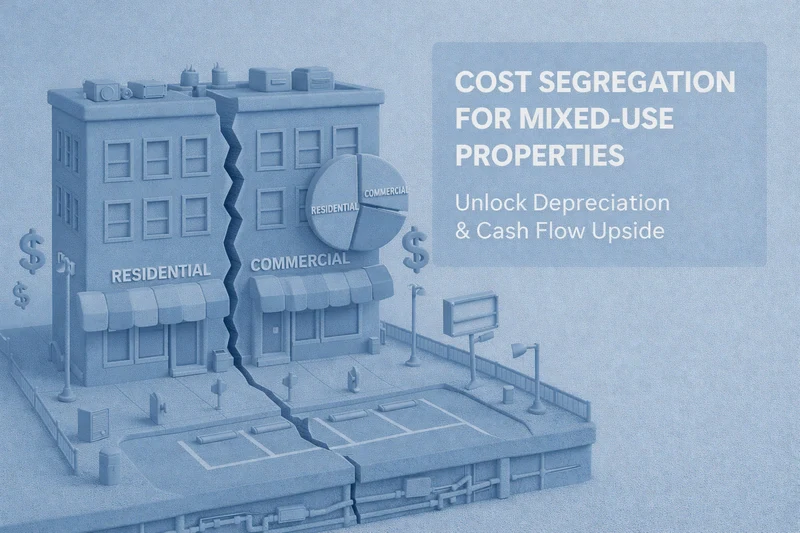

What if your mixed-use development could generate over $600,000 in first-year tax deductions, enough to cover your next capital improvement or pay down acquisition debt? This isn't theoretical. It's what we delivered for a client who had completed a $5.6 million residential-over-retail building in a growing downtown corridor with two floors of apartments over ground-floor commercial tenants.
Stories like this are common in mixed-use real estate. These properties are loaded with fast-depreciating assets, retail build-outs, tenant improvements, parking lots, signage, and specialty electrical. But unless you break them out properly, the IRS treats everything like a single long-term asset, even components that clearly don't last that long.
Here's what matters: The IRS allows you to reclassify these components into 5-, 7-, or 15-year depreciation categories. Instead of waiting decades to recover your investment, you can claim substantial deductions immediately.
R.E. Cost Seg specializes in working with mixed-use property owners and developers to uncover the hidden value in every property. Our engineering-based studies identify and properly allocate both residential and commercial components, generating five-figure to six-figure tax savings in year one.
This article breaks down exactly how cost segregation applies to residential-over-retail properties and what it means for your bottom line.
Understanding the Split: Residential vs. Commercial Depreciation Rules
Mixed-use buildings are subject to multiple depreciation rules. Residential space is depreciated over 27.5 years. Commercial space is depreciated over 39 years. And components that qualify as short-life property can be depreciated over 5, 7, or 15 years, or even written off in full under bonus depreciation rules, depending on the asset and acquisition date.
A critical threshold governs this classification: a building qualifies as residential rental property (27.5-year) only if 80% or more of its gross rental income comes from dwelling units. For residential-over-retail buildings, this test must be evaluated carefully.
If commercial rents are disproportionately high relative to residential rents, the entire building could fail the 80% test and default to a 39-year recovery period as nonresidential real property.
This matters because most residential-over-retail buildings contain systems and improvements that serve both the commercial and residential areas. Examples include:
- Roofs covering both uses
- Shared foundations and structural elements
- Building-wide HVAC, electrical, or plumbing systems
- Exterior features like parking lots, sidewalks, and signage
A cost segregation study identifies which systems and build-out costs belong to the residential portion, which to the commercial, and which can be depreciated separately as short-life property.
Without this separation, you risk depreciating residential components over the longer 39-year commercial schedule, simply lumping everything under one recovery period or missing eligible short-life assets entirely.
What the IRS Allows (and What Needs to Be Allocated)
The IRS doesn't provide a single rulebook for mixed-use buildings. But it does allow and expect owners to allocate depreciation based on how assets are actually used.
For example:
- A storefront HVAC unit serving a retail tenant can be depreciated as a 15-year property.
- Residential kitchen appliances are reclassified as under 5-year personal property.
- Parking lots and signage for commercial tenants are treated as land improvements (15-year).
- Common areas like lobbies or stairwells may require proportional allocation based on square footage or usage.
The key is documentation. You need clear records of how each component was built, where it's located, and who it serves. Without this, auditors may reject the classification, or worse, apply a uniform 39-year schedule to the entire property.
Modeling the Savings: A Realistic Mixed-Use Reclassification Example
Let's say you own a $4.2 million mixed-use property. It includes:
- 18 residential units (about 60% of the square footage)
- 3 commercial tenants on the ground floor (about 40%)
- Shared HVAC and structural systems
- Exterior improvements (parking, sidewalks, signage)
Here's how a cost segregation study might break it down:
- Total property cost: $4.2 million
- Allocated to residential (27.5-year): $2.5 million
- Allocated to commercial (39-year): $1.1 million
- Short-life property (5-, 7-, 15-year): $600,000
- Bonus depreciation (if eligible): Up to 100% of short-life assets
- First-year deduction potential: $600,000+
This doesn't just accelerate depreciation. It improves cash flow, reduces current-year tax liability, and makes the property more financially efficient, especially for investors using leverage or syndicating equity.
Where Mixed-Use Owners Typically Leave Money Behind
Cost segregation can be incredibly effective for mixed-use properties, but only if the analysis is specific to how the building is constructed and used. In this asset class, small mistakes can compound into long-term tax inefficiencies. Here are some of the most common ways owners undercut their own tax position:
- Depreciating the entire building as residential Even if the residential portion dominates the square footage, commercial components must be treated separately. And if commercial rents push the building below the 80% gross rental income threshold, the entire structure may need to be depreciated over 39 years.
- Failing to identify short-life commercial assets Items like tenant improvements and signage often qualify for accelerated depreciation but are missed without a study.
- Not allocating shared systems properly Electrical, plumbing, or structural systems that serve both uses must be proportionally divided and classified based on use.
- Overlooking land improvements Sidewalks, lighting, and landscaping are often lumped into the building's basis instead of being depreciated over 15 years.
- Using generic templates Cost segregation studies must be tailored. A boilerplate approach won't accurately capture the complexity of mixed-use real estate.
Each of these mistakes leads to slower depreciation and higher tax bills every year the asset is held.
Before You Start: Planning Steps for Mixed-Use Owners
Getting the most out of cost segregation starts well before the study itself. A little planning on the front end makes it easier to conduct a precise analysis and ensures your provider can do their job properly. Here's what to prepare:
- Work with a provider experienced in mixed-use assets. These properties are complex. You need someone who understands both residential and commercial classification rules.
- Clarify how the space is divided. Have accurate square footage, floor plans, and use breakdowns ready. This information is also critical for evaluating the 80% gross rental income test.
- Gather construction and improvement records. Invoices, blueprints, and contractor specs are essential for proper classification.
- List shared systems and infrastructure. Identify what serves the residential areas, the commercial space, or both.
- Coordinate with your tax advisor. Make sure the study supports your broader tax strategy and is filed correctly.
Why Strategic Execution Matters in Mixed-Use Cost Segregation
Mixed-use buildings are powerful investment assets, but they're not simple. The blend of residential and commercial use introduces complexity that most generic accounting firms aren't equipped to handle.
Cost segregation can significantly improve the return profile of your property, but only if the analysis is engineered to match how the building is designed, used, and documented.
R.E. Cost Seg specializes in identifying and properly classifying every qualifying asset in mixed-use real estate. If you're managing or planning a residential-over-retail investment, a precise cost segregation study can help you recover more, faster, and do it by the book.


.webp)