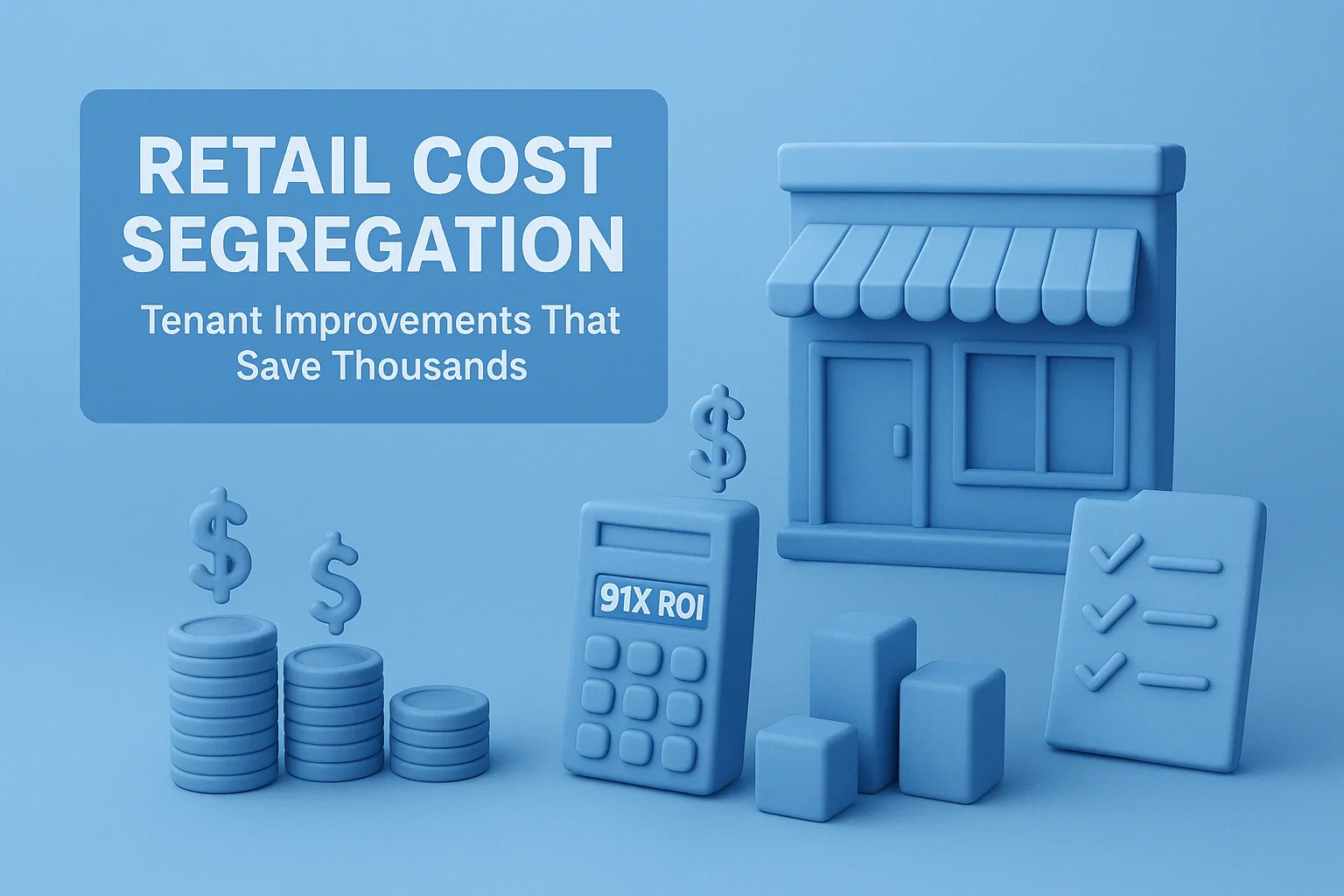

What if your retail tenant improvements could save you $30,000 or more in taxes this year alone? This isn't theoretical. It's happening right now for property owners who understand how cost segregation transforms standard depreciation schedules into immediate cash flow.
Retail construction costs have increased 25% since 2020. Tenant improvement allowances in prime locations now average $50 to $100 per square foot. Yet many retail property owners continue depreciating these improvements over 39 years, missing significant tax savings available today.
Here's what matters: The IRS allows you to accelerate depreciation on specific components of your retail tenant improvements. Instead of waiting decades to recover your investment through depreciation, you can claim substantial deductions immediately.
With the Big Beautiful Bill restoring permanent 100% bonus depreciation for properties purchased and placed into service after January 19, 2025, the opportunity has never been greater.
R.E. Cost Seg specializes in identifying these opportunities through engineering-based cost segregation studies. We help retail property owners reclassify 20% to 40% of their building costs into shorter depreciation periods.
The result? Five-figure to six-figure tax savings in year one.
This article breaks down exactly how retail tenant improvements qualify for accelerated depreciation and what it means for your bottom line.
Understanding Retail-Specific Tenant Improvements
What Makes Retail TIs Unique?
Retail tenant improvements differ fundamentally from standard commercial buildouts. These spaces require specialized components designed for customer interaction and merchandise display.
Key retail-specific improvements include:
- Point-of-sale systems and payment processing infrastructure
- Specialized lighting systems for merchandise display
- Custom millwork and movable display fixtures
- Security systems, cameras, and anti-theft devices
- Storefront modifications and branded signage
- Customer traffic flow elements and queue management systems
Each component serves a specific retail function separate from the building's structural shell. This distinction matters for depreciation purposes.
The Depreciation Disconnect
Standard tax treatment places all commercial property improvements on a 39-year straight-line depreciation schedule. This approach ignores reality.
Most retail fixtures and specialized systems require replacement every 5 to 10 years due to wear, technology updates, or rebranding requirements.
The IRS recognizes this disconnect. Through proper cost segregation analysis, non-structural improvements qualify for accelerated depreciation. Personal property components depreciate over 5 or 7 years. Land improvements take 15 years. Qualified improvement property also qualifies for 15-year treatment.
R.E. Cost Seg identifies these opportunities through detailed engineering analysis. Our studies document which improvements qualify for shorter lives based on IRS guidelines and court precedents. We separate true building components from trade fixtures and specialized retail equipment.
The impact on cash flow is immediate and substantial. Property owners recover their investment faster while reducing current tax obligations.
The Financial Impact: Real Numbers That Matter
Case Study: 10,000 Square Foot Retail Space
Let's examine actual numbers from a recent retail tenant improvement project. The property owner invested $500,000 in buildout costs for a national retailer, with the property placed in service after January 19, 2025.
Traditional Depreciation Approach:
- Total investment: $500,000
- Annual depreciation: $12,820 (39-year schedule)
- First-year tax savings: $4,487 (assuming 35% tax rate)
With Cost Segregation (100% Bonus Depreciation):
- 35% reclassified to 5-year property: $175,000
- 15% reclassified to 7-year property: $75,000
- 20% reclassified to 15-year property: $100,000
- 30% remains 39-year property: $150,000
First-Year Depreciation Calculation:
- 5-year property with 100% bonus depreciation: $175,000
- 7-year property with 100% bonus depreciation: $75,000
- 15-year property with 100% bonus depreciation: $100,000
- 39-year property: $3,846
- Total first-year depreciation: $353,846
Tax Impact:
- First-year tax savings with cost segregation: $123,846
- Traditional method tax savings: $4,487
- Additional cash flow generated: $119,359
This $119,359 represents real money available for reinvestment, debt reduction, or distribution to partners. A fully engineered cost segregation study starts at $2,730 for commercial property, and a tenant improvement project of this size and complexity typically prices somewhat above that. Either way, the first-year return runs more than 20 times the study fee.
How much can I really save with retail cost segregation?
With permanent 100% bonus depreciation restored by the Big Beautiful Bill, retail properties see unprecedented tax savings. For every $1 million invested in tenant improvements on properties placed in service after January 19, 2025, property owners generate $200,000 to $350,000 in immediate tax savings. The exact amount depends on property specifics and improvement types. Properties with extensive specialty fixtures, technology infrastructure, and land improvements produce the highest savings.
Retail Components That Qualify for Accelerated Depreciation
5-Year Property
The IRS classifies specific retail equipment and fixtures as 5-year property when they meet certain criteria. These items typically relate directly to business operations rather than building structure.
Technology Infrastructure:
- Point-of-sale terminals and payment processing equipment
- Digital menu boards and electronic display screens
- Inventory tracking systems and RFID scanners
- Customer WiFi infrastructure and dedicated data cabling
- Self-checkout kiosks and mobile payment systems
Specialized Equipment:
- Refrigeration units in convenience stores and groceries
- Commercial kitchen equipment for restaurant spaces
- Salon chairs, spa equipment, and specialized fixtures
- Beverage dispensing systems and coffee stations
- Display freezers and specialty food service equipment
7-Year Property
Office furniture and fixtures fall into 7-year classification when they're movable and not permanently attached to the building structure.
Furniture and Fixtures:
- Movable display cases and modular shelving systems
- Customer seating, tables, and waiting area furniture
- Decorative light fixtures not hardwired to building systems
- Window treatments, blinds, and removable partitions
- Artwork, decorative elements, and accent pieces
15-Year Property
Land improvements and qualified improvement property receive 15-year treatment, now qualifying for 100% bonus depreciation when applicable.
Site Improvements:
- Parking lot striping, bumpers, and directional signage
- Exterior lighting for parking and walkways
- Sidewalks, landscaping, and irrigation systems
- Outdoor seating areas and patio improvements
- Cart corrals and drive-through lanes
Qualified Improvement Property (QIP): Interior improvements to nonresidential buildings qualify as QIP when placed in service after the building was first placed in service. These improvements must be made by the taxpayer, whether lessor, lessee, or building owner. QIP includes interior walls, flooring systems, ceiling tiles, and HVAC modifications serving specific tenant spaces. It excludes building enlargements, elevators and escalators, and the internal structural framework. With 100% bonus depreciation restored, QIP now delivers immediate write-offs. See our full guide to qualified improvement property.
What tenant improvements don't qualify for accelerated depreciation?
Structural components remain 39-year property regardless of cost segregation analysis. These include load-bearing walls, roof structures, foundation elements, and building-wide HVAC systems. Permanent plumbing and electrical distribution also stay in the 39-year category. However, dedicated systems serving specific retail functions may qualify for shorter lives. R.E. Cost Seg engineers evaluate each component based on IRS guidelines and relevant court cases to maximize legitimate reclassifications.
The TI Allowance Advantage
Maximizing Landlord-Funded Improvements
Tenant improvement allowances create unique depreciation opportunities. Understanding who claims these benefits determines your tax strategy.
Who gets the TI depreciation benefit - landlord or tenant?
The party paying for improvements claims depreciation. Landlord-funded improvements through TI allowances belong to the landlord for tax purposes. Tenant expenditures above the allowance create tenant-owned depreciable property. Mixed funding requires careful allocation. R.E. Cost Seg helps both parties maximize their respective benefits through proper classification and documentation.
Scenario 1: Landlord Provides $50 Per Square Foot TI Allowance
When landlords fund improvements, they claim depreciation benefits. Smart landlords incorporate cost segregation into their TI strategy. A $500,000 TI allowance on a property placed in service after January 19, 2025, generates approximately $125,000 in first-year tax savings through 100% bonus depreciation. This tax benefit often justifies higher TI allowances during lease negotiations.
Property owners should document improvement costs separately from base building costs. This documentation supports future Form 3115 filings if retroactive cost segregation becomes necessary.
Scenario 2: Tenant Exceeds TI Allowance
Tenants who spend beyond the landlord's allowance can depreciate their excess investment. A retailer receiving $300,000 in TI allowance but spending $500,000 total can claim depreciation on the $200,000 difference. Cost segregation services apply to this tenant-funded portion.
How Documenting your TI Can Save you Money
Documentation drives successful cost segregation studies. Maintain detailed invoices showing individual component costs. Separate contracts for different improvement categories. Photograph installations during construction. These records support depreciation positions during IRS review.
Coordinate with your landlord regarding improvement ownership. Written agreements should specify which party owns specific improvements. This clarity prevents disputes and ensures proper depreciation treatment.
Timing Your Cost Segregation Study
Optimal Timing Scenarios
Strategic timing maximizes cost segregation benefits for retail properties, especially with permanent 100% bonus depreciation now available.
New Lease Build-Out: Complete your study immediately after construction finishes. Fresh documentation and contractor records simplify the engineering analysis. Site visits capture component details while installations remain visible.
Property Acquisition: Include cost segregation in your due diligence process. Properties purchased and placed in service after January 19, 2025, benefit from permanent 100% bonus depreciation. R.E. Cost Seg provides preliminary assessments during negotiation phases.
Major Renovations: Analyze before and after renovation to capture maximum benefits. Pre-renovation studies establish baseline depreciation. Post-renovation analysis identifies new qualifying components eligible for 100% bonus depreciation.
Retroactive Opportunities
Missing prior years doesn't mean missing benefits. Look-back studies apply regardless of how long you have owned the property, provided it has not been fully depreciated. File Form 3115 for automatic accounting method changes. Claim all missed depreciation in the current tax year without amending previous returns.
This "catch-up" depreciation creates substantial current-year deductions. Properties placed in service during the previous 100% bonus depreciation years (2017-2022) generate especially large benefits. Properties acquired before January 19, 2025, still qualify for significant accelerated depreciation through cost segregation.
Is it too late to do cost segregation if I've owned the property for years?
No. Look-back studies through Form 3115 capture all previously unclaimed accelerated depreciation in your current tax year. This creates immediate tax savings without amended returns. R.E. Cost Seg regularly performs these retroactive studies, often generating six-figure deductions for older properties. While these won't qualify for the new 100% bonus depreciation, significant benefits remain available.
Action Steps for Retail Property Owners
Your Cost Segregation Roadmap
1. Assess Your Property: Properties with tenant improvements exceeding $250,000 typically justify cost segregation studies. With 100% bonus depreciation restored, even smaller projects may warrant analysis. Recent acquisitions or renovations present ideal opportunities. Multiple retail locations multiply benefits across your portfolio.
2. Gather Documentation: Collect construction invoices showing cost breakdowns. Compile architectural plans and specifications. Organize lease agreements detailing TI allowances and improvement responsibilities. Provide purchase agreements for acquired properties, especially those after January 19, 2025.
3. Calculate Potential Savings: Multiply your total TI investment by 30% for conservative reclassification estimates. Apply 100% bonus depreciation for qualifying components on properties placed in service after January 19, 2025. Factor your marginal tax rate against accelerated depreciation amounts. Compare these savings against your current depreciation schedule.
R.E. Cost Seg provides a free bonus depreciation calculator showing specific saving projections based on your property details and the Big Beautiful Bill provisions.
What if I get audited after doing cost segregation?
Quality engineering-based studies withstand IRS scrutiny. R.E. Cost Seg follows the IRS Cost Segregation Audit Technique Guide precisely. Our reports include detailed engineering documentation supporting every reclassification. We provide audit support if questions arise. Properly documented studies have excellent track records during examinations.
The Bottom Line
Retail cost segregation on tenant improvements generates immediate cash flow through accelerated depreciation. Property owners typically recover their study investment within months while creating five-figure to six-figure tax savings.
With permanent 100% bonus depreciation restored by the Big Beautiful Bill for properties purchased and placed in service after January 19, 2025, the opportunity is unprecedented.
Get your free preliminary analysis from R.E. Cost Seg. We'll calculate specific tax savings for your retail property based on your tenant improvements, purchase price, and land value. Most retail property owners discover $50,000 to $200,000 in immediate tax savings through strategic cost segregation.