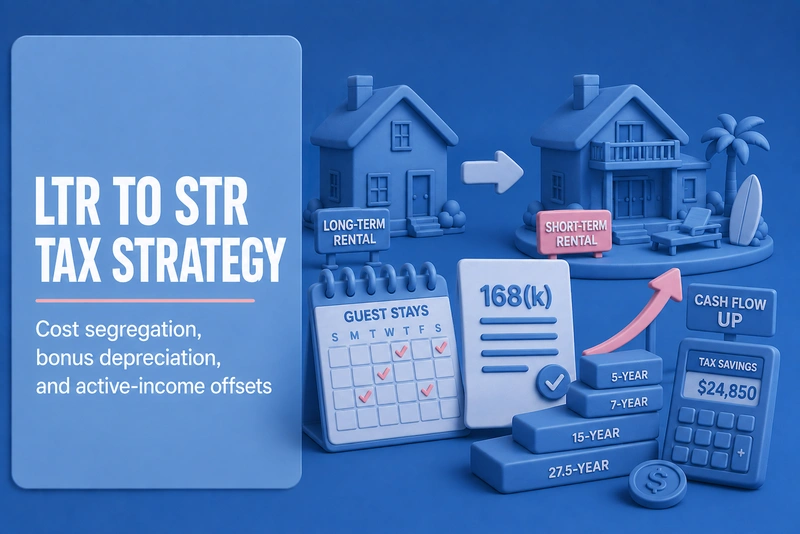

The One Big Beautiful Bill Act restored 100% bonus depreciation for qualified property acquired and placed in service after January 19, 2025 (One Big Beautiful Bill Act, amending IRC §168(k); IRS Notice 2026-11). For real estate investors, that change is relevant to one move in particular: converting a long-term rental into a short-term rental.
A growing number of long-term rental owners are making the switch. The motivation is usually higher cash flow. The conversion can also change how the property's losses are treated for tax purposes.
A long-term rental generates passive losses. Under IRC §469, those losses can only offset passive income. For most W-2 earners, the losses sit unused, sometimes for years.
A short-term rental with material participation flips that classification. The same property and the same depreciation deductions now reduce your ordinary taxable income, including W-2 and business income (subject to the limits discussed below).
Pair that conversion with a cost segregation study, and the first-year deductions behind short-term rental tax benefits can reach six figures on higher-value properties when 100% bonus depreciation applies and you have enough active income to absorb the loss. This article explains how the tax classification changes, how cost segregation applies differently after conversion, and what the numbers look like in before/after scenarios.
Long-Term vs. Short-Term: The Tax Classification Difference
The IRS treats long-term and short-term rentals differently. The distinction centers on one concept: passive vs. non-passive activity.
Long-term rentals are treated as passive activity under IRC §469. Losses from passive activities can only offset passive income. Without other passive income, those losses are suspended. They carry forward until you generate passive income or sell the property (IRC §469(b)).
There is a middle band many articles skip. A property with an average stay of 8 to 30 days is not automatically a short-term rental for these purposes. It generally escapes rental treatment only if you also provide significant personal services (Treas. Reg. §1.469-1T(e)(3)(ii)(B)). The strategy below focuses on the cleaner 7-day threshold.
One major exception applies to standard rentals: investors who qualify as a Real Estate Professional can treat rental losses as non-passive. But REPS requires more than 750 hours per year in real property trades or businesses AND more than half of all your personal-service hours in real property (IRC §469(c)(7)). Most W-2 earners do not qualify.
Short-term rentals follow a different set of rules. Under Treasury Regulation §1.469-1T(e)(3)(ii)(A), a property with an average customer stay of 7 days or less is not a "rental activity" at all. Instead, it is tested like any other trade or business, non-passive only if the owner materially participates.
Material participation requires meeting one of seven tests (Treas. Reg. §1.469-5T(a)). The most accessible for W-2 earners: participating more than 100 hours during the year and more than any other individual.
When a short-term rental is materially active, its losses are non-passive. They reduce W-2 income, business income, and other active income. Note one cap: the excess business loss limitation under IRC §461(l) can limit how much a high earner deducts in a single year, roughly $256,000 single / $512,000 married filing jointly for tax years beginning in 2026.
The One Big Beautiful Bill Act’s re-indexing lowered these thresholds from their 2025 levels ($313,000 / $626,000), so do not rely on the older, higher figures when planning a large 2026 conversion. Any excess generally carries forward as a net operating loss.
Here is what that means in practice. An investor owns a long-term rental generating $15,000 in paper losses from depreciation. As an LTR, those losses are passive. They offset nothing because the investor has no other passive income.
After converting to a short-term rental and materially participating, that $15,000 in annual depreciation losses reduces W-2 income directly. At a 37% marginal rate, that is $5,550 in tax savings that did not exist before the conversion.
Now scale that with cost segregation.
The STR Loophole Explained
The STR loophole is not a loophole in the traditional sense. It is a specific IRS classification with clear rules.
Here is how it works:
- Average rental period of 7 days or less. The IRS measures this by dividing total rental days by the number of separate rentals for the tax year (Treas. Reg. §1.469-1T(e)(3)(iii)).
- Material participation. The owner must meet one of the seven material participation tests (Treas. Reg. §1.469-5T(a)). The 100-hour test is the most accessible for W-2 earners.
- Non-passive classification. When both conditions are met, losses from the STR are non-passive and reduce your active income.
This matters for cost segregation. A cost segregation study generates large paper losses in year one through bonus depreciation on reclassified components. Without the STR classification, those losses sit as passive, unusable unless you have passive income or REPS status.
With the STR classification plus material participation, the losses immediately reduce your taxable income. Subject to the §461(l) cap, the accelerated depreciation becomes a direct offset against your highest-taxed income.
Do I need to be a Real Estate Professional to use the STR loophole?
No. The STR loophole is a completely separate pathway from Real Estate Professional Status. REPS requires more than 750 hours in real property trades and more than half of all your working hours in real estate (IRC §469(c)(7)). The STR material participation test requires only 100+ hours on the specific property and more hours than any other individual (Treas. Reg. §1.469-5T(a)(3)). Many active Airbnb hosts can meet the 100-hour mark, but only if they log more hours than anyone else working on the property, including cleaners, co-hosts, and managers.
How Cost Segregation Changes After Conversion
A cost segregation study generates the same accelerated depreciation on the reclassified components whether the property is a long-term or short-term rental. Those 5- and 15-year components keep their asset recovery periods, and the bonus depreciation percentage does not change.
The building itself is different. A short-term rental with an average stay under 30 days is generally 39-year nonresidential real property under the IRS transient-use rule, rather than 27.5-year residential rental property, so the remaining building basis depreciates more slowly after conversion. Change-in-use rules apply, so confirm the mechanics with your CPA.
The bigger change is the classification of the resulting losses.
- Long-term rental with cost seg: Accelerated depreciation creates passive losses. Those losses can only offset passive income. No passive income means suspended losses.
- Short-term rental with cost seg and material participation: Accelerated depreciation creates non-passive losses. Those losses reduce W-2 income, business income, and other active income in the current year (subject to §461(l)).
Same study, same accelerated deductions, different tax outcome.
If you already have a cost segregation study from when the property was a long-term rental, the study results carry forward. You do not need a new study. The reclassified components keep their recovery periods. The loss classification changes when the property qualifies as a materially active STR.
If you never had a cost segregation study, the conversion is a good time to consider one. A look-back study captures missed accelerated depreciation from prior years. If only one return has been filed since the property was placed in service, that is usually done with an amended return. After two or more returns, it is a single catch-up adjustment (a §481(a) adjustment) filed with Form 3115. The catch-up uses the bonus rate that applied in the year the property was originally placed in service. Combined with the STR classification, that catch-up amount becomes non-passive and offsets active income.
A quick note on the numbers below: each scenario assumes 100% bonus depreciation, which applies to qualified property acquired and placed in service after January 19, 2025 (One Big Beautiful Bill Act, amending IRC §168(k); IRS Notice 2026-11). Property acquired before January 20, 2025 may still fall under the prior phase-down (40% for 2025). All figures are federal only; many states do not conform to bonus depreciation, so your state result may differ.
Here is the math on an $800,000 single-family home with a $680,000 depreciable basis (after 15% land value). Cost segregation reclassifies 27%, the single-family baseline, or $183,600, into 5- and 15-year property.
- As a long-term rental: $183,600 in passive losses. The investor has no passive income. Tax savings this year: $0.
- As a short-term rental with material participation: $183,600 in non-passive losses reduces W-2 income. At a 37% marginal rate: $67,932 in tax savings this year.
The property is the same. The study is the same. The rental strategy made it usable.
Before and After: Two Conversion Scenarios
Both scenarios assume 100% bonus depreciation and enough active income to absorb the loss. After conversion, the building portion is depreciated over 39 years. For simplicity, the figures use a full year of depreciation.
Scenario 1: Single-Family Home at $500,000
Before (Long-Term Rental):
- Depreciable basis (after 15% land): $425,000
- Standard depreciation: $425,000 ÷ 27.5 = ~$15,450/year
- Classification: passive loss
- Investor's passive income: $0
- Current-year tax benefit: $0 (losses suspended)
After (Short-Term Rental + Cost Segregation):
- Cost segregation reclassifies 27%, the single-family baseline: $114,750 into accelerated categories
- Bonus depreciation: $114,750 in year one (at 100% bonus)
- Building depreciation on remaining $310,250 over 39 years: ~$7,960
- Total first-year deduction: ~$122,700
- Classification: non-passive (material participation confirmed)
- Investor's W-2 income: $250,000
- Tax savings at a 37% marginal rate: ~$45,400 in year one
The property is the same. The building is the same. The only changes: the rental strategy and a cost segregation study.
Scenario 2: Vacation Condo at $400,000
Before (Long-Term Rental):
- Depreciable basis (after 20% land): $320,000
- Standard depreciation: $320,000 ÷ 27.5 = ~$11,600/year
- Classification: passive
- Investor has no passive income
- Current-year tax benefit: $0
After (STR, 120 hours of material participation):
- Cost segregation reclassifies 33%, the condo unit baseline: $105,600
- Bonus depreciation: $105,600 in year one (at 100% bonus)
- Building depreciation on remaining $214,400 over 39 years: ~$5,500
- Total first-year deduction: ~$111,100
- Classification: non-passive
- Investor's consulting income: $300,000
- Tax savings at a 37% marginal rate: ~$41,100 in year one
If you list on a platform like VRBO, the same rules apply: the average stay and your participation hours drive the result, not the booking channel.
Both scenarios follow the same pattern. Conversion plus cost segregation plus material participation turns deductions that were previously locked into immediately usable ones.
What if I convert mid-year?
You can convert at any point during the tax year. The IRS evaluates the average rental period for the full year, so if your average guest stay is 7 days or less for the year, the property can qualify as a short-term rental for that year. Participation hours generally count from the date the property is placed in service as an STR. How partial-year participation is measured can be fact-specific, so confirm your approach with your CPA.
Key Requirements and Pitfalls
The STR loophole draws IRS scrutiny. Follow these rules carefully.
Operate as an actual short-term rental. The average rental period must be 7 days or less (Treas. Reg. §1.469-1T(e)(3)(ii)(A)). Booking records from your platform or property management software serve as documentation.
Document material participation. Keep a contemporaneous log of hours spent on guest communication, cleaning coordination, pricing, and maintenance. The IRS can request this documentation during an audit.
Check local regulations. Some cities restrict or ban short-term rentals. Zoning laws, HOA rules, and permitting requirements can prevent you from legally operating an STR. Verify compliance before converting.
Watch the personal use rule. Under IRC §280A, if you use the property personally for more than the greater of 14 days or 10% of rental days, your deductions are limited. This rule primarily affects vacation properties that owners also use.
Management companies complicate material participation. If you hire a full-service property manager, you must still spend more than 100 hours and more hours than the manager. Active involvement in pricing, guest screening, and property decisions helps establish participation.
Plan for recapture at sale. Cost-seg recapture generally falls into three buckets: 5- and 7-year personal property is Section 1245 property, so depreciation is recaptured as ordinary income when you sell; 15-year land improvements are Section 1250 property, but depreciation in excess of straight line, including 100% bonus depreciation, is also recaptured as ordinary income; and straight-line depreciation on the building itself is subject to the 25% unrecaptured Section 1250 gain rate (IRS Topic No. 409). The classification during ownership (LTR or STR) does not change these recapture rules.
Does converting back to long-term rental affect my depreciation?
The 5- and 15-year components continue on their schedules, and change-in-use rules govern the building's recovery period. Losses revert to passive classification. Any suspended passive losses from the prior LTR period remain available when you generate passive income or sell the property (IRC §469(b)). The depreciation already claimed is not repaid. It is simply subject to recapture when you eventually sell.
The Strategy Behind the Strategy
Key takeaways:
- Short-term rentals with material participation generate non-passive losses. This is the main tax difference between LTR and STR.
- The STR loophole does not require Real Estate Professional Status. More than 100 hours of material participation, and more than anyone else, is the threshold.
- Cost segregation produces the same accelerated deductions for LTR and STR, though the building itself is generally 39-year as an STR. The STR classification is what makes those deductions immediately usable against active income.
- The before/after scenarios show differences of roughly $41,000 to $45,000 in first-year tax savings from the same property, assuming 100% bonus depreciation and enough active income to absorb the loss.
- At sale, cost-seg depreciation is recaptured at ordinary rates (up to 37%), not the 25% real-property rate, so factor recapture into your hold-and-sell plan.
- Keep contemporaneous logs of your participation hours, booking records, and average-stay calculations. They are the records the IRS will ask for if the return is examined.
Switching rental strategies changes more than your cash flow. It can change how the property's losses are treated.
Ready to see the before-and-after numbers for your specific property? Get a free proposal and model what a conversion and cost segregation study could produce.