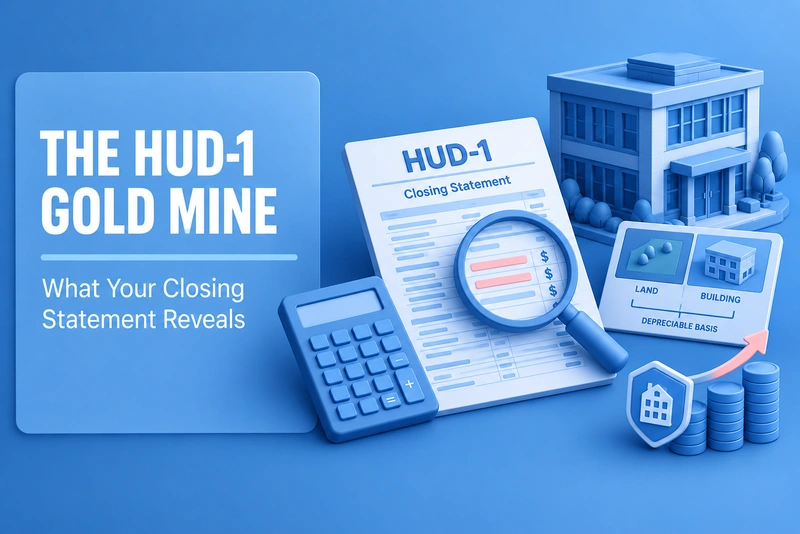

Your closing statement is one of the most valuable tax documents you own. Most investors file it away after settlement and never open it again.
The HUD-1 settlement statement, and its modern replacement, the Closing Disclosure, holds the exact data a cost segregation study needs. That data sets your depreciable basis and drives your accelerated depreciation deductions.
This article breaks down the sections that matter. You will see which lines affect depreciation, and how R.E. Cost Seg turns this document into the foundation of your study.
HUD-1 vs. Closing Disclosure: Which One Do You Have?
Which form you received depends on when your loan application was taken, not simply when you closed.
If your mortgage application was taken before October 3, 2015, you likely received a HUD-1 settlement statement. This is the traditional multi-page form that itemizes every charge and credit in the deal.
If your application came on or after that date, you received a five-page Closing Disclosure. The Consumer Financial Protection Bureau introduced this form under the TILA-RESPA Integrated Disclosure (TRID) rule, effective October 3, 2015.
One caveat matters for investors. TRID covers most consumer mortgage loans, but business-purpose loans and all-cash deals are usually exempt. If you bought through an LLC, you may have an ALTA or HUD-style settlement statement instead.
Both documents report the same core data: purchase price, closing costs, prorations, and credits. Both give your cost segregation firm what it needs.
If you cannot find yours, contact your title company or closing attorney. Your lender may also keep a copy on file.
The Lines That Matter for Cost Segregation
Not every line affects your depreciation. Here are the ones that do.
Purchase price. This is your starting point. The contract sale price sets your acquisition cost before adjustments.
Prorations. Property taxes, HOA fees, and insurance are often split between buyer and seller at closing. The tax treatment depends on who owed the tax. If you pay taxes the seller owed for the period before you took ownership, and the seller does not repay you, add that amount to your basis. If you reimburse the seller for taxes they prepaid, you generally deduct it as an expense rather than add it to basis.
Closing costs that add to basis. These costs increase your depreciable basis:
- Title insurance (owner's policy)
- Recording fees
- Transfer taxes and stamps
- Attorney fees related to the purchase
- Survey costs
- Title search fees
Closing costs that do NOT add to basis. These costs do not add to basis, but they are not lost either. On a rental, loan origination fees, points, and lender fees are capitalized and amortized over the life of the loan; prepaid taxes and insurance are deducted as operating expenses in the year they cover; and escrow deposits are simply your funds on deposit. The IRS treats loan-related fees and points as costs of getting a loan, not part of your basis:
- Loan origination fees
- Prepaid interest (points)
- Mortgage insurance premiums
- Lender inspection fees
- Prepaid property taxes and insurance held in escrow
Here is how the math works. An investor buys an $850,000 rental property. The closing statement shows $12,400 in basis-eligible costs: title insurance, recording fees, transfer taxes, and attorney fees. The total cost basis is $862,400.
After an 18% land exclusion ($155,232), the depreciable basis is $707,168. A study then reclassifies 30% of that basis, or $212,150, into 5-, 7-, and 15-year property. With 100% bonus depreciation, the investor deducts $212,150 in year one. At a 37% rate, that is about $78,496 in tax savings.
Now leave those $12,400 off. The depreciable basis drops to $697,000, and the first-year reclassification falls to $209,100. That is roughly $3,050 less in year-one deductions, worth about $1,129 in lost tax savings at 37%. Every dollar of basis counts.
Do closing costs affect my depreciation deductions?
Yes. Basis-eligible closing costs raise your total cost basis, which raises your depreciable basis after the land exclusion. A higher depreciable basis means more components to reclassify and larger accelerated deductions. Always give your complete closing statement to your cost segregation firm so no eligible dollar is missed.
Can You Actually Use These Deductions?
Big first-year deductions only help if you can use them this year.
Cost segregation deductions are usually passive losses. Passive losses generally offset passive income only, not W-2 or active business income. The exception is if you qualify as a real estate professional or meet the short-term rental rules.
There is also a cost at sale. Accelerated depreciation is subject to recapture. 5- and 7-year components are recaptured as ordinary income; 15-year land improvements and the building are Section 1250 property, only depreciation above straight line is ordinary, and the rest is unrecaptured Section 1250 gain taxed at up to 25%.
These examples assume 100% bonus depreciation. Under the One Big Beautiful Bill Act, 100% bonus is permanent for qualified property acquired and placed in service after January 19, 2025. Property acquired on or before January 19, 2025 stays on the prior phase-down by placed-in-service year: 40% for 2025, 20% for 2026. Ask your CPA which rate applies to your purchase.
How Land Value Gets Determined
Land cannot be depreciated, so the IRS requires you to allocate part of your purchase price to land and exclude it from your depreciable basis. The method you use directly affects your tax savings.
County assessor method. Your local assessor assigns separate values to land and improvements for property tax purposes. Many CPAs use this ratio as a default. It is simple, but assessor values often lag the market.
Appraisal-based method. A professional appraisal gives a more precise land-to-improvement ratio. It reflects current market conditions, comparable sales, and site-specific factors.
Why the method matters. Consider the same $850,000 property. The assessor allocates 22% to land ($187,000). An appraisal allocates 15% ($127,500). That is a $59,500 difference in depreciable basis.
At a 30% reclassification rate with 100% bonus depreciation, that $59,500 adds $17,850 in first-year deductions. At a 37% rate, that is about $6,605 in tax savings.
R.E. Cost Seg analyzes land value in every study. The goal is the allocation the evidence best supports: an appraisal that separately values the land is stronger than a stale assessor ratio, and when it justifies a lower land share, the depreciable basis rises accordingly.
What R.E. Cost Seg Does With Your Closing Statement
Your closing statement is the starting point. Here is how the study builds from there.
Step 1: Extract the cost basis. The team pulls the purchase price and identifies every basis-eligible closing cost. This sets your total cost basis.
Step 2: Determine the land allocation. Using assessor data, appraisals, or comparable analysis, the team sets the land exclusion and calculates your depreciable basis.
Step 3: Apply engineering analysis. A specialist conducts a physical or virtual inspection. An engineer then assigns each building component to the correct asset recovery period: 5-, 7-, 15-, or 27.5/39-year property.
Step 4: Deliver the schedules. The completed study includes detailed depreciation tables and audit-ready documentation. For a look-back study, the team also prepares Form 3115 to catch up missed depreciation through a change of accounting method. Your CPA receives everything ready to integrate into your return.
Accurate documentation from day one prevents problems at filing. It also strengthens your position if the IRS reviews the return.
What other documents do I need besides my closing statement?
Your closing statement is the most important document. Beyond it, R.E. Cost Seg may request:
- Floor plans or property photos (a smartphone walkthrough works)
- Renovation invoices or contractor receipts for post-purchase improvements
- The property's current county assessment
The pre-study checklist outlines everything needed to get started.
What to Do If You've Lost Your Closing Statement
It happens. Older purchases may no longer be in your files. Here is how to recover the document.
Contact your title company or closing attorney. They typically retain settlement records for several years and can usually reissue a copy.
Check your lender's records. Your mortgage lender received a copy at settlement and can provide a duplicate.
Search your email. Many closings now arrive digitally. Search for the title company name, the property address, or "closing disclosure."
Use alternative documentation. If the statement truly cannot be found, a study can still proceed. The purchase agreement, loan documents, and county assessor records provide enough data to establish your basis.
Your Closing Statement Is Your Starting Line
That stack of settlement paperwork holds the keys to your depreciation strategy. The essentials:
- Basis-eligible closing costs raise your depreciable basis. In our example, missing $12,400 in costs cut year-one deductions by about $3,050.
- Land allocation drives your result. The gap between a 22% assessor split and a 15% appraisal was $59,500 in depreciable basis, or about $6,605 in tax savings.
- The closing statement is the foundation, not the whole study. The engineering analysis built on top is where most of the value is created.
- Deductions must be usable. Passive loss rules and recapture at sale can change your real benefit, so confirm the timing with your CPA.
Want to see your numbers? Get a free proposal and find out how much of your basis is depreciable.