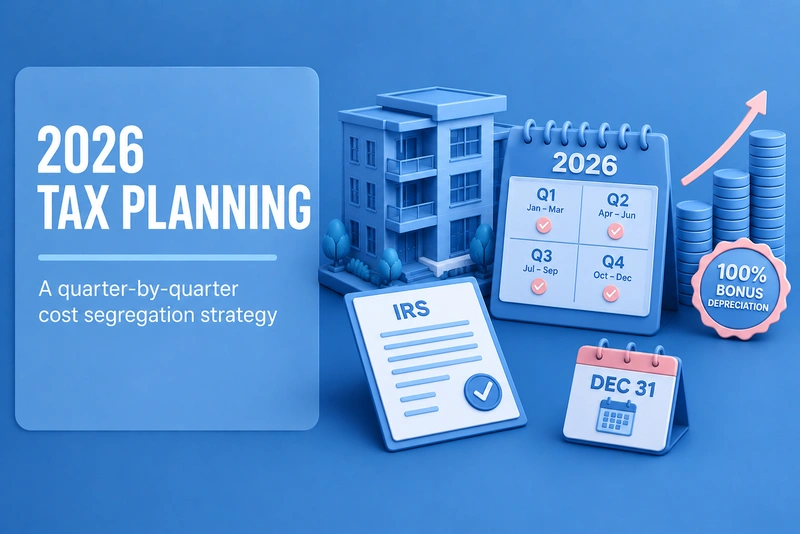

The One Big Beautiful Bill Act (OBBBA) made 100% bonus depreciation permanent for qualified property acquired and placed in service after January 19, 2025 (IRS Notice 2026-11). For the first time since the Tax Cuts and Jobs Act of 2017, investors can plan depreciation around a 100% rate with no scheduled phase-down or sunset date.
That predictability creates an opportunity. Investors who build a structured plan around cost segregation capture deductions sooner than those who treat depreciation as an afterthought. The gap between proactive planning and a year-end scramble can reach tens of thousands of dollars, as the examples below show.
This article lays out a quarter-by-quarter tax planning calendar for 2026. Each section includes action items, deadlines, and worked examples. Use them to coordinate your CPA, your cost segregation firm, and your acquisition timeline. The framework applies whether you own one rental or twenty.
Every tax-savings figure below assumes the resulting depreciation losses are currently deductible. Rental losses are generally passive. They can only offset passive income unless you qualify as a real estate professional or materially participate in a short-term rental. At-risk and excess-business-loss limits also apply. Confirm your own facts with your CPA before relying on any number (IRS Pub. 925).
The 2026 Depreciation Landscape
Under the phase-down, the rate is set by the year the property is placed in service: 80% for 2023, 60% for 2024, 40% for 2025, 20% for 2026, and zero after (IRC §168(k)). OBBBA did not lift those years back to 100%. For example, property acquired in 2024 but placed in service in 2026 receives the 20% rate, not 60%. What changed is the rate going forward: qualified property acquired and placed in service after January 19, 2025 now qualifies for 100%.
This matters for older properties too. If you own a property that was never studied, you can still catch up the missed accelerated depreciation. The Form 3115 method change applies the bonus rate that was in effect on each property's placed-in-service date, not today's 100% rate.
Other TCJA provisions remain in effect for 2026. Section 199A still provides a 20% qualified business income deduction for pass-through entities, now made permanent (IRS). The 2026 tax brackets reflect updated inflation adjustments, and the top marginal rate remains 37%. That keeps accelerated depreciation valuable for high-income investors.
The cost of waiting is real. Consider an investor who acquired and placed a $1.5 million rental in service in mid-2025, after January 19, but delayed a study. After an 18% land allocation, the depreciable basis is $1.23 million. At a 30% reclassification, that is $369,000 in components eligible for 100% bonus depreciation. At a 37% marginal rate, delaying the study defers $136,530 in tax savings. The sooner you plan, the sooner those deductions compound.
Q1 (January–March): Laying the Foundation
The first quarter is your planning window. Use it to map every deduction you will claim for the rest of the year.
Review prior-year returns. Pull your 2024 and 2025 returns and list every property you own. For each one, confirm whether a cost segregation study has been completed. If not, that property is a candidate for a look-back study.
Identify catch-up opportunities. A Form 3115 accounting method change lets you claim missed accelerated depreciation in the current year through a Section 481(a) adjustment, without amending prior returns (IRS Form 3115 Instructions). This is one of the most overlooked moves in real estate. The catch-up applies the bonus rate from each property's in-service year.
Consider an investor who owns three rental properties:
- Property A: $600,000 duplex placed in service in 2021, depreciable basis $492,000
- Property B: $450,000 single-family rental placed in service in 2022, depreciable basis $369,000
- Property C: $800,000 fourplex acquired and placed in service in mid-2025 (after January 19), depreciable basis $656,000
Each basis reflects an 18% land allocation. At a 28% average reclassification, the studies identify $241,080 of short-life components across Properties A and B. Because those properties have an adopted depreciation method from prior returns, the investor files Form 3115 with the 2025 return and claims a Section 481(a) catch-up adjustment equal to the accelerated depreciation that should have been taken, less the depreciation already claimed.
Property C is different. Because it was first placed in service in 2025, the investor has not used the incorrect method on two consecutively filed returns. If the original 2025 return has not yet been filed, the investor simply claims the correct depreciation on that return; no Form 3115 is needed. If the 2025 return was already filed using the wrong treatment, the correction generally belongs on an amended 2025 return. At a 28% reclassification, Property C has $183,680 of short-life components potentially eligible for 100% bonus depreciation, subject to the loss limitations described above.
Study fees for all three total roughly $12,000 to $18,000. Weigh that cost against the accelerated deductions and your own return timeline.
Should I wait until I file my 2025 return to start planning for 2026?
No. Your 2026 plan should begin in January, before you file your 2025 return. Look-back studies filed with your 2025 return need to be commissioned in Q1. Map any properties you plan to acquire in 2026 against your income projections now. Waiting until April puts you behind.
Q2 (April–June): Execute and File
Q2 is execution season. Your Q1 planning now turns into filed returns and commissioned studies.
File your 2025 return. If you completed look-back studies in Q1, include them with your 2025 filing. Coordinate Form 3115 and the catch-up adjustment with your CPA. If your CPA is unfamiliar with the form, your cost segregation firm can provide the completed schedules and filing instructions.
Commission studies for new acquisitions. Order a study by April on any property you bought in Q1. The sooner it is complete, the sooner you can factor the deductions into your estimated tax payments.
Align studies with your acquisition pipeline. If you plan to close in Q2, order the study at closing rather than months later. This removes delays and keeps the deductions ready for your current-year return.
Here is a worked example. An investor closes on a $1.8 million commercial property in May 2026. After the land allocation, the depreciable basis is $1.476 million. The investor orders a study at closing. It reclassifies 32%, or $472,320, into 5-, 7-, and 15-year property. Because the property was acquired and placed in service after January 19, 2025, 100% bonus applies, so the investor deducts the full $472,320 in 2026. At a 37% rate, that is $174,758 in tax savings.
The investor then reduces the Q3 estimated tax payment by $174,758, keeping that cash available for the next acquisition.
Evaluate Real Estate Professional Status. If you or your spouse qualifies and materially participates in the rentals, rental depreciation can offset W-2 and other active income. This is not automatic. You must spend more than 750 hours in real property trades or businesses. That work must also exceed half of your personal service hours, and you must materially participate in the rentals (IRC §469(c)(7)). Q2 is the time to confirm you are tracking those hours.
Q3 (July–September): Mid-Year Checkpoint
July marks the halfway point. Use Q3 to assess where you stand and adjust.
Review year-to-date income. Compare your actual income to your January projections. If income is running higher than expected, you may need more depreciation to offset it. This is the time to accelerate planned acquisitions or study unstudied properties.
Adjust estimated tax payments. The Q3 payment is due September 15. If you completed a study in Q2, factor those deductions into your September payment. Many investors overpay because they ignore accelerated depreciation until year-end, which hands the IRS an interest-free loan.
Begin year-end acquisition planning. If your projections show you need more deductions in Q4, start identifying properties now. Closing takes time. Finding and closing a property between October and December is possible but tight, so an earlier search gives you more options and better pricing.
Review your portfolio. Do you own properties that have never been studied, or properties depreciated during the phase-down years? Each one is a potential catch-up deduction through Form 3115.
Can I adjust my estimated tax payments based on a cost segregation study?
Yes. Once a study is complete, the resulting deductions reduce your taxable income for the year. You can, and should, adjust your remaining estimated payments to reflect the lower liability. Work with your CPA to recalculate after each study is delivered.
Q4 (October–December): Year-End Sprint
The fourth quarter is your final chance to capture 2026 deductions.
The December 31 deadline is firm. A property must be placed in service by December 31 to qualify for 2026 depreciation (IRS Pub. 946). Placed in service means the property is ready and available for its intended use, not necessarily occupied. A vacant rental placed in service on December 15 still qualifies for 100% bonus depreciation on its short-life components, regardless of the in-service date.
Here is how a late-year purchase works. An investor places a $750,000 rental property in service on December 15, 2026. After an 18% land allocation, the depreciable basis is $615,000. A study reclassifies 30%, or $184,500, into 5-, 7-, and 15-year property. Because the property was acquired after January 19, 2025, 100% bonus applies, so the investor deducts the full $184,500 in 2026. At a 37% rate, that is $68,265 in tax savings.
The remaining $430,500 stays in the 27.5-year class. Residential rental property uses the mid-month convention. A mid-December in-service date produces only about half a month of building depreciation, roughly $650 in year one (IRS Pub. 527). First-year deductions total about $185,150. The bonus deduction is not prorated by date, but the straight-line building depreciation is.
R.E. Cost Seg offers rush studies for late-year closings. If you close in November or December, expedited turnaround helps your study land before your filing deadline. Share your timeline early.
Extension strategy. If your study will not be complete before April 15, 2027, file an extension. An extension gives you until October 15, 2027 to file your 2026 return with all cost segregation deductions included. Filing an extension is routine and gives you time to file an accurate return.
Key Deadlines and Dates for 2026
Coordinating Your Team
A strong 2026 plan needs three professionals working together.
Your CPA handles return preparation, estimated tax calculations, and overall strategy. The CPA fits cost segregation deductions into your full picture, including QBI, passive activity rules, and state tax. Many states do not conform to federal bonus depreciation, so your state benefit may differ from the federal figure.
Your cost segregation firm conducts the engineering study, identifies reclassifiable components, and delivers IRS-ready documentation. R.E. Cost Seg provides completed depreciation schedules and Form 3115 filings your CPA can plug into the return.
Your financial advisor helps you deploy the savings. Reinvesting in real estate, paying down debt, or funding retirement accounts each puts the freed-up cash back to work.
One more factor to weigh: depreciation recapture. Accelerating deductions now can increase the tax due when you sell, so model the hold-period trade-off before you commit.
Involve your cost segregation firm at acquisition, or as soon as you identify an unstudied property. Most CPAs welcome the collaboration once they see the study results.
How long does a cost segregation study take?
A standard study takes about 4 to 6 weeks after all property documentation is received. Rush studies can be completed in 2 to 3 weeks. Virtual inspections using engineer-guided video walkthroughs have made the process faster, with no on-site visit to schedule.
Build Your 2026 Plan Now
Proactive planning captures more deductions than a reactive year-end scramble. Here is your framework:
- Q1 (by April 15): Review your portfolio, identify unstudied properties, and order look-back studies before the filing deadline.
- Q2 (by June): File returns with catch-up deductions, commission studies for new acquisitions, and confirm your real estate professional hours.
- Q3 (by September 15): Adjust estimated tax payments for completed studies and start planning Q4 acquisitions.
- Q4 (by December 31): Close on final properties, order rush studies, and set your filing strategy with your CPA.
With permanent 100% bonus depreciation, every quarter you plan is a quarter of deductions secured.
See what your properties could deliver. Request a free proposal for a property-specific estimate of your first-year deductions.