
You just ordered a cost segregation study. Now what? Who calls you first? Who reviews the property? And who do you contact when a question comes up three weeks in?
Most investors never think about the team behind their study. It pays to. Knowing who handles what saves you time, prevents miscommunication, and helps your report move faster.
This article introduces the two people who drive your R.E. Cost Seg study: your Customer Success Manager and your engineer. You will learn exactly who does what, and who to contact at every stage.
What Is a Cost Segregation Study?
A cost segregation study is an IRS-recognized, engineering-based tax strategy that reclassifies building components into shorter depreciation categories. Residential rental property is normally depreciated over 27.5 years, and nonresidential property over 39 years. A study moves qualifying components into 5-year, 7-year, or 15-year asset recovery periods.
The result is larger deductions in the early years of ownership.
Here is what that can look like. Say you buy a rental property for $1.2 million. After excluding $200,000 in land value, your depreciable basis is $1,000,000. A study might reclassify $280,000, about 28% of that basis, into accelerated categories.
Whether you can deduct that $280,000 in year one depends on bonus depreciation.
How 100% Bonus Depreciation Applies
The One Big Beautiful Bill Act restored permanent 100% bonus depreciation for qualified property acquired and placed in service after January 19, 2025. Property placed in service before that date may fall under the older phase-down schedule (40% in 2025, 20% in 2026), so purchase timing matters.
When 100% bonus applies, that $280,000 becomes a first-year deduction instead of a write-off spread over decades. Two caveats: passive activity loss rules may limit how much you can use this year, and accelerated depreciation is subject to recapture when you sell.
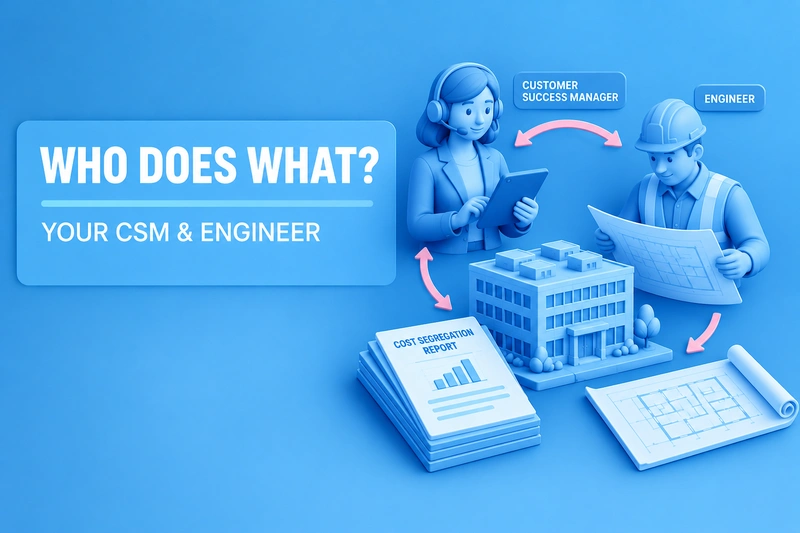
Getting these numbers right takes two skill sets, client management and engineering analysis. That is why every study involves two key team members.
The Customer Success Manager: Your Single Point of Contact
Your Customer Success Manager (CSM) is the person you interact with most. This person coordinates every moving piece so you do not have to.
What the CSM handles:
- Onboarding: Walks you through the process and sets expectations on day one
- Document collection: Requests your closing statement, floor plans, photos, and renovation records
- Scheduling: Coordinates in-person site visits or virtual inspections with the site visit specialist.
- Progress updates: Keeps you informed at every stage
- Report delivery: The final cost segregation report is uploaded to the client portal, which automatically notifies the client. If the final study results fall below the baseline estimates in the original proposal, the Account Manager contacts the client. Results walkthroughs are handled by R.E. Cost Seg’s Director of Engineering.
- Post-delivery support: Answers follow-up questions and coordinates with your CPA
When to contact your CSM:
- "Where is my report?"
- "What documents do you still need?"
- "Can I add another property to my order?"
- "How do I share this with my CPA?"
How Long Does a Cost Segregation Study Take?
At R.E. Cost Seg, most studies take 2 to 4 weeks from the time all documents are submitted. Complex properties or large portfolios can take longer. Your CSM gives you a specific timeline during onboarding and updates you if anything changes.
The Engineer: The Technical Expert Behind the Numbers
While your CSM manages the relationship, your engineer manages the analysis. This is the person who examines your property and determines which components qualify for accelerated depreciation.
What the engineer handles:
- Property review: Analyzes construction documents, blueprints, floor plans, and photos
- Asset classification: Identifies and categorizes qualifying components such as specialty electrical, plumbing, cabinetry, flooring, landscaping, and paving
- Depreciation calculations: Assigns each component to the correct recovery period (5-year, 7-year, or 15-year)
- Report production: Creates the detailed engineering report that supports your tax filing
What the engineer finds in practice:
Take a $900,000 single-family rental with a $150,000 land allocation, which leaves a $750,000 depreciable basis. The engineer identifies $187,500 in 5-year personal property (cabinetry, appliances, specialty electrical, flooring) and $75,000 in 15-year land improvements (driveway, landscaping, fencing). That is $262,500 in reclassified assets, roughly 35% of the basis.
If 100% bonus depreciation applies and the investor can use the full deduction, that $262,500 comes off in year one. At a 37% marginal tax rate, that is about $97,125 in first-year tax savings, before accounting for passive activity limits or future recapture.
Will I speak directly with the engineer?
In most cases, your CSM handles communication. If the engineer needs specific property details, the CSM coordinates that conversation. For technical questions about asset classifications, your CSM loops in the engineer.
How the Two Roles Work Together
The CSM and engineer work in tandem, and communication flows through a clear structure:
You → CSM → Engineer → CSM → You
Here is why that matters. The CSM collects your documents and organizes everything the engineer needs. The engineer then focuses entirely on the technical analysis without chasing paperwork. Once the report is completed and uploaded to your client portal, your CSM remains your main contact to answer follow-up questions, coordinate with your CPA, and manage any necessary revisions.
This structure works for three reasons:
- Efficiency. Engineers spend their time on analysis, not admin work.
- Specialization. Each team member focuses on core expertise.
- Accountability. One person owns the client relationship from start to finish.
Start with your CSM for every question, including billing and technical questions. The CSM handles client communication, works with the appropriate account team on billing matters, and coordinates with engineering whenever technical input is needed.
Your Communication Cheat Sheet
Here is a quick reference for who handles what:
- "Where is my report?" → Customer Success Manager
- "What documents do you need?" → Customer Success Manager
- "Can I add another property?" → Customer Success Manager
- "Why was my parking lot classified as 15-year?" → Engineer (through your CSM)
- "How do I share this with my CPA?" → Customer Success Manager
- "What qualifies as personal property in my building?" → Engineer (through your CSM)
- "I want a free proposal." → Customer Success Manager, who loops in the Account Manager to gather the necessary details and prepare the proposal
The rule is simple. Start with your CSM. If it is a technical question, the CSM brings in the engineer.
Key Takeaways
- Every study pairs two roles: your Customer Success Manager (client-facing) and your engineer (technical analysis).
- A study reclassifies components from the standard 27.5- or 39-year schedules into 5-, 7-, and 15-year categories (28–35% of depreciable basis in the examples above).
- With 100% bonus depreciation, permanent for property placed in service after January 19, 2025, reclassified assets can be deducted in year one, subject to passive loss rules and future recapture.
- R.E. Cost Seg studies typically take 2 to 4 weeks after all documents are submitted.
Your team is built to keep the process simple, so you can stay focused on your investment.
Curious how much of your property could shift into accelerated categories? Get a free proposal or book a call to see your estimated first-year deductions.