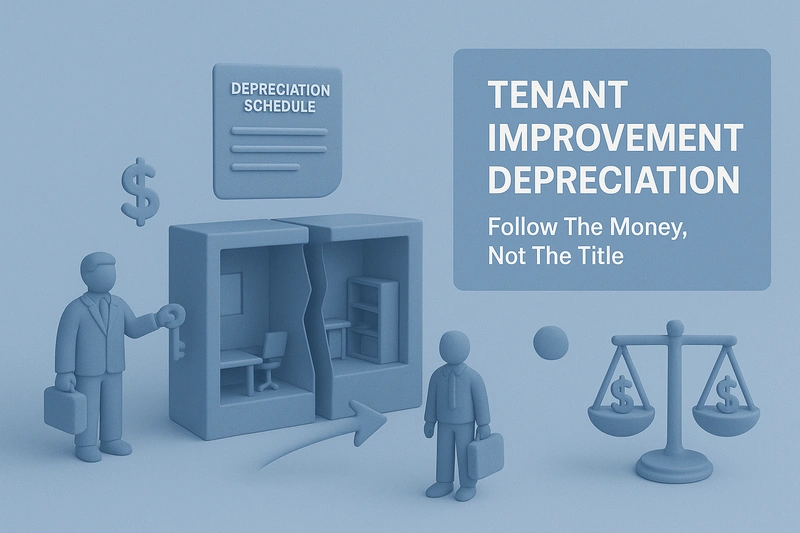

When it comes to tenant improvements, tax ownership does not automatically follow the checkbook or the name on the title. The party that gets to depreciate the improvements is the one who owns them for tax purposes, and that is not always the party who paid.
Who Gets to Depreciate Tenant Improvements?
Tax ownership follows the benefits and burdens of the improvements: who actually controls them, uses them, and stands to gain or lose from them.
This is where most of the confusion starts. A landlord can pay for a build-out and still not be the one who depreciates it. A tenant can hold no legal title and still be the correct owner for tax purposes. What matters is the economic reality the lease creates.
This is not a soft guideline. Depreciation belongs to the tax owner under IRC §167 and §168. The Tax Court set out the defining factors in Grodt & McKay Realty, Inc. v. Commissioner (1981), ruling that ownership is defined by benefits and burdens, not by funding or legal title. Applied to leasehold improvements, a tenant's spending is treated as a capital investment recovered through depreciation even when title sits with the landlord. Because it turns on economic reality, the answer is always a facts-and-circumstances call.
How Your Lease Dictates Tax Ownership
The IRS weighs a familiar set of factors to determine the benefits and burdens of ownership, and your lease is the main place they show up:
- Legal title. It counts, but it does not settle the question on its own. Bare title resting with the landlord does not stop a tenant from depreciating improvements they paid for and use.
- Control and use. If only the tenant uses the improvement and it has little value to anyone else, that strongly points to the tenant as the owner.
- Maintenance. Whoever is on the hook to keep the improvement up and replace it if it wears out looks more like the owner.
- Risk of loss. Whoever carries the financial risk if the improvement is destroyed or becomes obsolete holds a major incident of ownership.
- Lease-end reversion. If the improvements revert to the landlord at termination, that pulls ownership toward the landlord, but it is not decisive. If the tenant funded the work, used it alone, and walked away with nothing, the tenant may still be the owner for the life of the lease.
No single factor wins. The call is made on the totality of the circumstances, which is why two leases that look similar on the surface can land in entirely different tax positions.
The Role of Tenant Improvement Allowances
Tenant improvement allowances add another layer of complexity:
- Landlord-owned. If the landlord funds and owns the improvements, the landlord depreciates them (generally over 39 years for commercial property, or 15 years where the work qualifies as qualified improvement property).
- Tenant-owned. If the landlord hands the tenant a cash allowance to build improvements the tenant owns, the allowance is usually taxable income to the tenant. The tenant depreciates the improvements, and the landlord writes the allowance off over the lease term as a cost of landing the lease.
- The Section 110 safe harbor. There is one narrow exception. Under IRC §110, a retail tenant on a short-term lease (15 years or less) can exclude a qualifying construction allowance from income. In that case, the landlord is treated as the owner and takes the depreciation.
Can the Tenant Depreciate More Than the Allowance?
Yes. The allowance only covers the landlord-funded slice. Anything the tenant spends above that amount is their own capital investment. If the tenant owns that portion, the tenant depreciates it.
Two critical rules apply here:
- Tax life vs. lease life. The tenant recovers that cost over the asset's normal tax life, 15 years for qualified improvement property (which may also be eligible for bonus depreciation) or 39 years otherwise, no matter how long the lease runs. A five-year lease does not create a five-year tax write-off, even if your book accounting amortizes it that way.
- Abandonment losses. If the lease ends before the cost is fully recovered, the remaining tax basis can usually be claimed as a loss in the year the tenant leaves the space (IRC §168(i)(8)).
Structuring the Lease Before You Sign
Ownership decides who depreciates, and ownership is built on benefits and burdens. The lease is your best tool for controlling this outcome, so set the ownership, reversion, and allowance terms deliberately, and confirm the treatment with your CPA before you sign.
A final note for landlords: when tenant-built improvements revert to you at lease end and were not given in place of rent, you take no income and no basis in them, meaning there is nothing for you to depreciate. You only depreciate what you fund yourself.
For the full picture on recovery periods, bonus depreciation, and the lease clauses that drive classification, see our guide to leasehold improvements and who gets the depreciation.
Not sure which side of the line your build-out falls on? A complimentary lease review from R.E. Cost Seg shows exactly where your depreciation rights stand.