
"Won't I just owe all that depreciation back when I sell?"
This is one of the most common objections we hear about cost segregation. The concern is fair. Depreciation recapture is real. But the math usually favors the investor who holds and reinvests, especially once you pass the five-year mark.
With 100% bonus depreciation, the recapture exposure is fixed from year one. Five years is the time-value milestone. The point where compounding has clearly outrun that fixed recapture bill. This article explains how recapture works, what changes at year five, and the exit strategies that reduce or defer it, with a year-by-year breakdown.
The figures below are illustrative. They assume a 37% ordinary rate, an 8% pre-tax reinvestment return, that you can actually use the first-year deduction (see the passive-activity note below), and that your gain on sale is at least equal to the depreciation claimed. Your results depend on your bracket, your participation status, and your exit.
What Is Depreciation Recapture and Why Does It Matter?
Depreciation recapture is how the IRS recovers part of the tax benefit you claimed through depreciation when you sell. It is not a penalty. It is a settling of accounts. Two rules matter for real estate investors.
The building shell. Gain attributable to the straight-line depreciation you took on the building is taxed as unrecaptured Section 1250 gain at a maximum rate of 25%. This is a common point of confusion: for 27.5- and 39-year property depreciated straight-line under MACRS, there is generally no ordinary-income "Section 1250 recapture", only the 25%-capped unrecaptured 1250 gain.
The accelerated components. The 5- and 7-year assets a cost segregation study reclassifies are Section 1245 personal property. Gain up to the depreciation taken on them is recaptured as ordinary income, which can reach 37%. (Note: 15-year land improvements and qualified improvement property are usually Section 1250 property, not 1245, though bonus depreciation on them can still create ordinary-income recapture to the extent it exceeds straight-line.)
Here is the key nuance. Section 1245 recapture carries the higher rate, but those same assets generated the largest first-year deductions. The tax savings arrive years before the recapture bill, and recapture is capped at the lower of the depreciation you took or the gain you realize.
Why the Early Deduction Wins
Consider an investor who claims $200,000 in accelerated depreciation. At a 37% rate, that is $74,000 of tax savings in year one. If the property later sells at a gain, the recapture on those §1245 assets can also reach $74,000, but the investor held and reinvested that $74,000 for years in between.
A dollar of tax savings today is worth more than a dollar of recapture paid years from now. That time-value gap is the core math behind cost segregation.
Why Five Years Is the Turning Point
A study reclassifies building components into 5-, 7-, and 15-year asset recovery periods. With 100% bonus depreciation, the eligible short-life assets are deducted in year one. Without bonus, 5-year assets are recovered under 5-year MACRS, technically spread across six tax years because of the half-year convention.
Bonus depreciation is now a permanent 100% deduction for qualified property acquired and placed in service after January 19, 2025, under the One Big Beautiful Bill Act. Timing matters: property under a written binding contract entered before January 20, 2025, falls under the prior-law phase-down, 40% for 2025 and 20% for 2026, so confirm your acquisition and placed-in-service dates before assuming the full 100%.
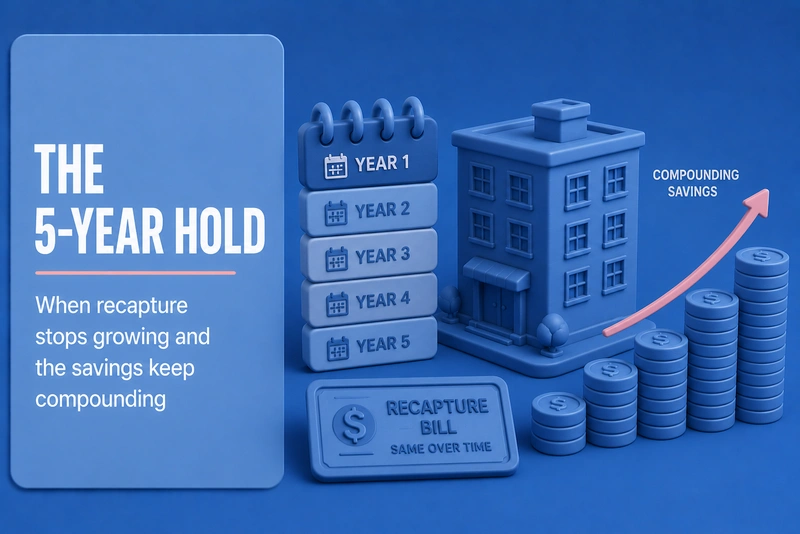
Either way, the recapture exposure on the accelerated assets is fixed once the depreciation is fully claimed. By year five, the 5-year property is effectively fully depreciated, and after that:
- No additional recapture accumulates on the 5-year assets
- The banked tax savings keep compounding when reinvested
- Appreciation builds equity without increasing the recapture number
The recapture becomes a fixed, known figure while total return keeps growing.
Does the five-year mark eliminate recapture?
No. Recapture does not disappear at five years, and the amount owed on sale does not shrink just because you wait. What improves is the net benefit: you have fully captured the accelerated depreciation and given the savings maximum time to compound, so recapture becomes a smaller share of your total return.
Year-by-Year Recapture Exposure
This table models a $1 million property with $250,000 reclassified to 5-year property and bonus depreciation claimed in year one. The $250,000 deduction produces $92,500 in year-one tax savings at 37%. Each row compounds that year-one lump sum at 8%.
The recapture bill stays flat. The reinvested savings keep growing, so the spread widens every year you hold. A word of caution: this compares reinvested savings against the nominal recapture. It does not net out capital-gains tax on appreciation, the 3.8% net investment income tax, state tax, or selling costs, so treat the "net benefit" column as the time-value advantage of the deferral, not your total after-tax profit.
Year one is the highest-risk exit: sell immediately and the recapture offsets the savings, which is why property sale tax planning matters. Years two and three build the advantage. Years four and five are the tipping point. From year six on, only the 27.5- or 39-year building depreciation continues, and every additional year widens the gap.
What if I sell in year three?
You keep the benefit you have earned. You still had three years of reinvested savings working for you, and recapture reduces your net gain without erasing it, roughly a $15,392 time-value advantage in this example. Selling early shrinks the edge; it does not eliminate it.
Strategies That Reduce or Defer Recapture
Holding maximizes the compounding benefit, but several strategies reduce or defer recapture:
1031 Exchange. A like-kind exchange defers gain and recapture into the replacement property. Important caveat: since the 2017 tax law, §1031 applies to real property only. Most reclassified components still count as real property for exchange purposes under Reg. §1.1031(a)-3, but genuinely movable §1245 items such as appliances, furniture, equipment, may not. Those can ride along only under the 15% incidental-property rule; beyond that they are boot, and boot pulls recapture out first. Plan the allocation with your advisor.
Installment Sale. Spreading payments over multiple years defers the capital-gain portion, but not recapture. Under the tax code, depreciation recapture is recognized in full in the year of sale regardless of the installment method. Size your down payment to cover that immediate tax.
Opportunity Zone investment. Reinvesting eligible capital gains, including qualified §1231 gains, into a Qualified Opportunity Fund can defer that gain and, if the QOF investment is held at least 10 years, exclude the fund's appreciation from tax. Only capital gains qualify. Ordinary-income §1245 recapture, the layer cost segregation enlarges, cannot go into a QOF and is paid in the year of sale. The unrecaptured §1250 building layer is a capital gain, so it can. For a cost-seg property, the Opportunity Zone play covers appreciation plus the building layer, while the §1245 recapture is due at sale, the same asymmetry as an installment sale. Note the program was overhauled into "OZ 2.0" for investments after December 31, 2026, with new rules and designations, so check current terms before investing.
Hold until death. Under the step-up in basis at death, the heir's basis resets to fair market value, which eliminates the decedent's accumulated depreciation recapture for the heir. It is the most powerful tool for generational wealth (estate-tax exposure above the exemption is a separate question).
Partial dispositions. When you replace a component such as a roof or HVAC, a partial disposition election under Treasury Regulation §1.168(i)-8 lets you write off the retired asset's remaining basis without selling the property.
Before you count on a first-year deduction, confirm you can use it. Passive activity loss rules can suspend rental losses unless you have passive income to absorb them or qualify as a real estate professional (or use the short-term rental exception), and the excess business loss limitation can cap what flows through in a given year.
Book a call to model your specific recapture scenario and exit options.
The Net Benefit Math: Why Recapture Is Not the Enemy
Recapture is a cost of doing business, not a reason to skip a study. Compare two investors who each own the same $1 million commercial property for seven years. To keep the comparison honest, we isolate the $250,000 of components a study would reclassify — the only depreciation cost segregation actually changes.
Investor A completes the study and accelerates that $250,000 into year one. Investor B skips it, so the same $250,000 stays in the 39-year building basis and depreciates at about $6,410 per year. Investor A's accelerated assets are §1245 (recaptured at 37%); Investor B's stay §1250 (unrecaptured 1250 gain, capped at 25%). Even with the higher recapture rate, Investor A wins on time value.
Investor A comes out roughly $44,000 ahead, even after paying recapture at the higher rate. The year-one lump sum simply compounds more than Investor B's standard depreciation trickling in over time.
Is recapture taxed at ordinary or capital-gains rates?
It depends on the asset. Unrecaptured §1250 gain on the building is capped at 25%. §1245 recapture on the accelerated components is taxed at ordinary rates up to 37%, the higher rate lands on the assets that produced the largest upfront deductions. In most holds beyond a couple of years, the time value of the early deduction still outweighs the higher recapture rate, but the outcome depends on your bracket, gain, and exit.
Hold, Plan, and the Math Works
Depreciation recapture is real, but it is predictable, capped, and generally smaller than the benefit it follows.
Key takeaways:
- By year five the 5-year property is effectively fully depreciated, so recapture on it stops growing and the net benefit is firmly established.
- Recapture is a fixed number once depreciation is claimed; it does not grow the longer you hold.
- §1245 components are recaptured at up to 37%; the building's unrecaptured §1250 gain is capped at 25%.
- Recapture is deferrable (1031, hold-till-death) but not via installment sale, which defers only the capital-gain portion.
- The time value of a year-one deduction outweighs later recapture in most multi-year holds, not all, so model your own numbers.
Stop fearing recapture and start planning your exit around it. Get a free proposal to see your projected five-year net benefit on your own property.