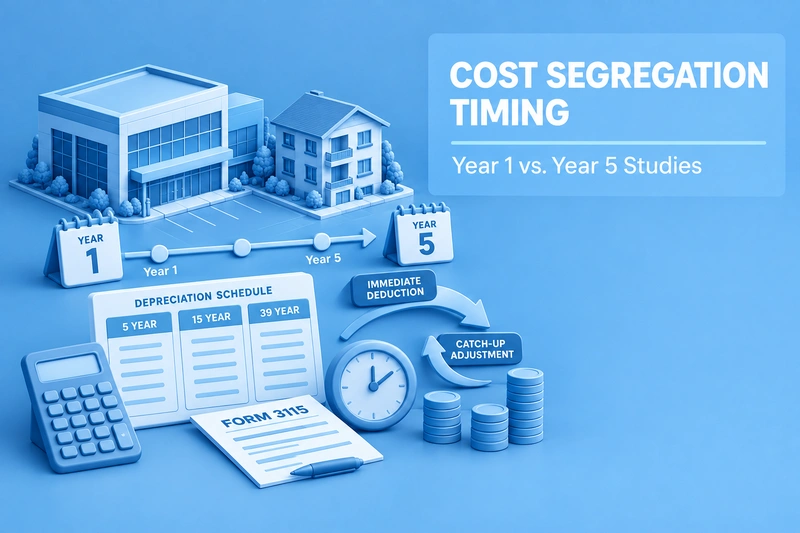

Cost segregation timing is not a simple choice between “Year 1” and “Year 5.” Several facts control the filing treatment. These include acquisition and placed-in-service dates, asset eligibility, return history, and the taxpayer’s ability to use the deductions.
The One Big Beautiful Bill Act restored permanent 100% bonus depreciation for eligible property acquired after January 19, 2025. The property must also satisfy the applicable placed-in-service and eligibility rules. IRS Notice 2026-11 guidance explains the current framework.
A cost segregation study does not create new basis or make land depreciable. It identifies costs that belong in shorter recovery periods instead of the building’s 27.5- or 39-year class. The main benefit is timing: eligible deductions may be claimed earlier.
Start With the Asset, Not the Study Date
Bonus depreciation follows the asset’s tax facts. The study-completion date does not set the bonus rate.
For property acquired and placed in service after January 19, 2025, eligible assets generally may qualify for 100% bonus depreciation. Assets acquired before that cutoff may remain under the earlier phase-down rules. For ordinary eligible property placed in service in 2023, 2024, qualifying pre-cutoff 2025 cases, and qualifying pre-cutoff property placed in service in 2026, the general rates were 80%, 60%, 40%, and 20%, respectively.
A building acquisition must be separated into land, long-life building basis, and qualifying components. The building itself generally remains 27.5- or 39-year property. Components with a MACRS recovery period of 20 years or less may qualify for bonus depreciation when all requirements are met.
Contract timing can affect the acquisition date, but it is not the only issue. Self-constructed property, related-party purchases, components of larger projects, and binding-contract facts require separate analysis. The placed-in-service date also matters.
Year 1 Studies and Look-Back Corrections
A Year 1 study is completed before the first return reporting depreciation for the property. The taxpayer generally implements the study on that timely filed return and reports depreciation on Form 4562. This avoids correcting an established method, but it does not eliminate normal return forms or documentation.
A look-back study reviews depreciation reported on one or more prior returns. The filing method depends on the return history:
- No incorrect return filed: Implement the study on the first return.
- One incorrect return filed: An amended return is generally the appropriate correction under the two-return rule.
- Two or more incorrect returns filed: The taxpayer generally has adopted a depreciation method and may need Form 3115.
For an eligible automatic change, Revenue Procedure 2025-23 lists designated change number 7 for a change from an impermissible to a permissible depreciation method. The taxpayer follows the automatic-change procedures under Revenue Procedure 2015-13 and files Form 3115 with the timely original return, including extensions. The current procedures also require the applicable duplicate filing.
A negative Section 481(a) adjustment generally equals cumulative depreciation allowable under the corrected method minus cumulative depreciation actually claimed. It is generally deducted in full in the year of change under this automatic change. Eligibility and scope limitations must still be checked.
A Transparent Year 1 Example
Assume an investor buys and places a commercial building in service in March 2025. The purchase price is $2 million, including $400,000 of nondepreciable land. The depreciable building basis is therefore $1.6 million.
For illustration only, assume the study classifies:
- $320,000 as eligible 5-year property
- $240,000 as eligible 15-year property
- $1,040,000 as 39-year nonresidential real property
Also assume the shorter-life assets qualify for 100% bonus depreciation and the taxpayer does not elect out. These are example assumptions, not expected allocation ranges.
Without cost segregation, first-year 39-year depreciation is about $32,479. That estimate uses 9.5 months under the mid-month convention: $1,600,000 × 9.5 ÷ 12 ÷ 39.
With cost segregation:
- Bonus depreciation on 5- and 15-year property: $560,000
- First-year depreciation on the remaining shell: about $21,111
- Total first-year depreciation: about $581,111
- Incremental first-year depreciation: about $548,632
At an assumed 37% marginal federal rate, the incremental federal tax deferral is about $202,994. This is not guaranteed tax savings. The taxpayer must be able to use the deduction, and state treatment may differ.
IRS Publication 946 provides the recovery-period, convention, bonus-depreciation, and Section 179 rules used to build the actual depreciation schedule.
What a Year 5 Correction Changes
Now assume the same taxpayer claimed straight-line depreciation for 2025 through 2028 and corrects the method on the timely filed 2029 return. This is a multi-return method change, so the example assumes Form 3115 is available.
Cumulative depreciation actually claimed through 2028 would be about $155,556:
- 2025 mid-month depreciation: about $32,479
- Three full years at about $41,026 per year: about $123,077
Cumulative depreciation allowable under the corrected method through 2028 would be about $661,111:
- 100% bonus depreciation: $560,000
- 2025 shell depreciation: about $21,111
- Three full years of shell depreciation: $80,000
The negative Section 481(a) adjustment would therefore be about $505,556. The 2029 return would also include about $26,667 of current-year shell depreciation.
By the end of 2029, both methods reach approximately the same cumulative depreciation after correction. The difference is timing. A Year 1 study places more depreciation in 2025. A Year 5 correction places the catch-up in 2029.
This comparison does not prove that Year 1 always wins. An earlier deduction has more present value only when the taxpayer can use it. Passive losses, basis limits, at-risk limits, excess business loss rules, and state adjustments can delay or reduce the benefit.
Passive Activity and Loss-Usability Rules
Rental real estate is generally passive under Section 469, even when the owner participates. IRS Publication 925 explains the principal exceptions, material-participation tests, grouping rules, basis and at-risk ordering, and the $25,000 special allowance.
The special allowance can permit up to $25,000 of qualifying rental real estate loss against nonpassive income when the taxpayer actively participates. It generally phases out between $100,000 and $150,000 of modified adjusted gross income. Filing-status rules and other conditions apply.
Real estate professional status does not automatically make every rental loss deductible. The taxpayer must satisfy two annual tests. First, the taxpayer needs more than 750 hours in qualifying real property trades or businesses. Second, those activities must represent more than half of all personal-service time. The taxpayer must also materially participate in each rental activity unless the taxpayer makes the election under Treasury Regulation Section 1.469-9(g) to treat all interests in rental real estate as one activity. That election is distinct from the general activity-grouping rules under Treasury Regulation Section 1.469-4.
Short-term use is a separate analysis. An activity with an average customer-use period of seven days or less is generally not treated as a rental activity for the passive rules. A different test applies when average use is 30 days or less and significant personal services are provided. The taxpayer must still satisfy one of the material-participation tests for the activity to be nonpassive.
Good records remain essential. Contemporaneous logs are strong evidence, but the rules permit proof by other reasonable means. The 2025 Form 8582 instructions expressly state that daily contemporaneous reports are not mandatory.
State Conformity Can Change the Result
Federal bonus depreciation does not automatically control state depreciation. Each state may conform, decouple, require an addback, or provide a separate recovery schedule.
For example:
- California has continuing federal-state depreciation differences under the 2025 FTB Form 3885 instructions.
- Minnesota requires taxpayers to recalculate bonus depreciation under its current nonconformity guidance.
- Wisconsin states that it has not adopted federal bonus depreciation provisions in its 2025 tax update.
- New York requires depreciation modifications for specified federal provisions under its 2025 reporting guidance.
Do not estimate the state effect by applying the top state rate to a guessed addback. Build separate federal and state fixed-asset schedules. Then model the taxpayer’s actual marginal rates and apportionment.
Multi-state ownership can require several depreciation schedules. The property’s location, taxpayer type, state filing footprint, and entity structure all matter. The state where an LLC was organized does not, by itself, determine every depreciation adjustment.
Recapture and Disposition Planning
Cost segregation can change the character and timing of gain when the property is sold. It does not mean every accelerated dollar is automatically repaid at the same rate.
Cost segregation commonly creates three recapture categories. First, gain on 5- and 7-year Section 1245 property is generally ordinary income to the extent of depreciation allowed or allowable. Second, many 15-year land improvements and qualified improvement property remain Section 1250 property. For those assets, bonus depreciation and other depreciation exceeding straight-line depreciation can constitute additional depreciation recaptured as ordinary income under Section 1250; any remaining eligible gain may be unrecaptured Section 1250 gain. Third, gain attributable to the long-life building may fall within the unrecaptured Section 1250 category rather than ordinary-income recapture.
For individuals, unrecaptured Section 1250 gain is a separate category taxed at a maximum 25% rate. It should not be confused with ordinary-income recapture of Section 1245 property or Section 1250 additional depreciation. IRS Publication 544 explains these character rules, and IRS Topic 409 explains the maximum rate on unrecaptured Section 1250 gain.
A reliable sale model needs:
- Sale-price allocation among land, building, and shorter-life assets
- Adjusted basis by asset
- Depreciation allowed or allowable
- Gain by asset
- Applicable federal and state rates
- Any Section 1031 exchange or installment-sale effects
A short planned holding period can reduce the present-value benefit, but no universal 18-month, three-year, or five-year cutoff applies. Compare the study fee and tax deferral with expected recapture, transaction costs, and the investor’s reinvestment return.
AMT, NOL, and Excess Business Loss Limits
Individual alternative minimum tax exposure should be modeled on Form 6251. For post-1998 property, AMT depreciation generally uses the regular recovery period rather than a separate ADS life, although 3- through 10-year property generally uses the 150% declining-balance method instead of 200%. Property for which bonus depreciation is allowed generally does not produce an AMT depreciation adjustment under Section 168(k)(2)(G). With 100% bonus depreciation, a cost segregation study therefore may create little or no AMT depreciation adjustment, although the taxpayer’s complete Form 6251 position still must be modeled.
For 2025, the individual AMT exemption is $88,100 for single filers and $137,000 for married taxpayers filing jointly. IRS Publication 17 also lists the related phaseout levels. The 2025 SALT deduction limit increased to $40,000, subject to an income-based reduction. The former $10,000 figure should not be used for this analysis.
Post-2020 NOL carryforwards are generally subject to an 80% taxable-income limitation in the carryforward year. That rule does not mean a taxpayer uses 80% of the NOL every year. The IRS NOL examination guidance describes the taxable-income limitation.
The excess business loss limitation applies after basis, at-risk, and passive-loss limits. For 2025, the threshold is $313,000, or $626,000 for a joint return. For 2026, the thresholds are $256,000 and $512,000, respectively, following the OBBBA base reset and inflation adjustment in Revenue Procedure 2025-32. Disallowed excess business losses become NOL carryforwards. The 2025 Form 461 instructions provide the 2025 amounts and calculation order.
Qualified Production Property
Qualified production property is a separate elective provision under Section 168(n). It is not simply another name for assets found in a manufacturing cost segregation study.
In general, QPP is eligible nonresidential real property used as an integral part of a qualified production activity. The activity must involve manufacturing, chemical production, agricultural production, or refining that substantially transforms qualifying property.
The timing window is specific. The property generally must be placed in service after July 4, 2025, and before January 1, 2031. Its construction must begin after January 19, 2025, and before January 1, 2029, or it must satisfy the applicable acquisition rules. The taxpayer must make the required election. Lessors generally do not qualify for the QPP deduction under Notice 2026-16, subject to the detailed ownership and use rules.
A standalone warehouse does not qualify merely because it stores manufactured goods. Storage areas may qualify only when they satisfy the integral-part and activity-scope rules. IRS Notice 2026-16 guidance also addresses designation and recapture when the property stops qualifying.
Manufacturers should analyze QPP separately from Section 168(k) bonus depreciation on shorter-life assets. The two provisions can affect different portions of the facility.
Renovations, QIP, and Section 1031 Exchanges
A renovation creates separate basis, but the entire project does not automatically qualify for bonus depreciation. Each component must be classified by recovery period and tested under the applicable acquisition, construction, and placed-in-service rules.
Qualified improvement property generally covers eligible interior improvements to nonresidential real property after the building was first placed in service. QIP does not include building enlargements, elevators or escalators, or the internal structural framework. Eligible QIP has a 15-year GDS recovery period and may qualify for bonus depreciation.
Roofs, HVAC systems, fire-protection systems, alarm systems, and security systems require careful classification. Some may qualify for Section 179 as qualified real property even when they are not QIP.
A Section 1031 replacement property adds another layer. The taxpayer generally tracks carryover basis and excess basis separately. Final basis allocation should be completed before implementing the cost segregation schedule. IRS Publication 551 explains basis adjustments and separate accounting for additions and improvements.
A study may still be completed during the first ownership year. The CPA should reconcile the exchange documents, Form 8824, carryover basis, excess basis, land allocation, and placed-in-service dates before filing.
Section 179 and Cost Segregation
For tax years beginning in 2025, the maximum Section 179 deduction is $2.5 million. The phaseout begins when qualifying property placed in service exceeds $4 million. Both amounts are indexed after 2025.
Section 179 is limited by taxable income from the active conduct of a trade or business. It can apply to qualifying tangible personal property and certain qualified real property. Qualified real property can include QIP and specified improvements to roofs, HVAC, fire-protection and alarm systems, and security systems, but these building-system categories apply only to nonresidential real property. IRS Topic 704 summarizes the eligible-property rules.
Bonus depreciation has different rules. It is not limited by the Section 179 business-income ceiling, but it still has eligibility, acquisition, placed-in-service, business-use, election, and listed-property requirements.
Tax software applies the statutory ordering rules. Taxpayers should not describe the choice as “saving Section 179 for a future purchase” within the same year. Instead, model the annual Section 179 election, bonus depreciation, regular MACRS depreciation, taxable-income limit, and state conformity together.
A Better Timing Decision Framework
Use this sequence before choosing how to implement a study:
- Confirm ownership, depreciable basis, land allocation, and placed-in-service date.
- Identify shorter-life assets and determine whether each asset qualifies for bonus depreciation.
- Review prior returns and Forms 4562 to apply the two-return rule.
- Determine whether an amended return or Form 3115 is appropriate.
- Model basis, at-risk, passive activity, and excess business loss limits.
- Build federal and state depreciation schedules.
- Model the expected holding period and asset-level recapture.
- Compare after-tax cash flows using a documented discount rate.
A feasibility analysis is more useful than a universal rule. An eligible taxpayer who can use the deduction may benefit from Year 1 implementation. A taxpayer correcting prior depreciation may receive a substantial Section 481(a) adjustment. A taxpayer with suspended losses or a near-term sale may receive less immediate value.
Common Mistakes to Avoid
- Treating the acquisition date as the only bonus-depreciation test
- Using Form 3115 after only one incorrect return without reviewing the two-return rule
- Computing Section 481(a) as bonus depreciation minus all prior straight-line depreciation
- Ignoring the mid-month, half-year, or mid-quarter convention
- Assuming real estate professional status removes every loss limitation
- Combining the seven-day short-term-use test with the significant-services test
- Treating every 15-year asset as Section 1245 property
- Depreciating land instead of qualifying land improvements
- Applying one federal schedule to every state
- Quoting a study ROI without documenting basis, rates, loss usability, and fees
The IRS Cost Segregation Audit Technique Guide emphasizes substantiation of buildings, land improvements, and Section 1245 property. A defensible study should reconcile total basis and explain each material classification.
Key Takeaways
- Bonus depreciation depends on asset eligibility, acquisition or construction timing, and placed-in-service timing, not the study date alone.
- A first-return study, one-return correction, and multi-return method change can require different filing procedures.
- A Section 481(a) adjustment compares cumulative allowable depreciation with cumulative depreciation actually claimed.
- Earlier deductions have value only when the taxpayer can use them after all loss limitations.
- State conformity, recapture, QPP, QIP, Section 179, and exchange basis should be modeled separately.
- Cost segregation is a timing strategy. It should be evaluated with a taxpayer-specific fixed-asset and cash-flow analysis.
Before requesting a timing recommendation, gather the closing statement, fixed-asset schedule, prior Forms 4562, and depreciation reports. Also collect improvement records, passive-loss carryforwards, state returns, and the expected holding period. Then coordinate the study with the taxpayer’s CPA and cost segregation provider.