
Cost segregation results depend heavily on the provider you choose. A quality engineering-based study typically reclassifies 20–40% of a building's depreciable basis into shorter recovery periods, and the amount two firms capture on the same property can differ materially based on their rigor and methodology.
On a mid-sized commercial building, that difference can mean tens of thousands of dollars in first-year deductions.
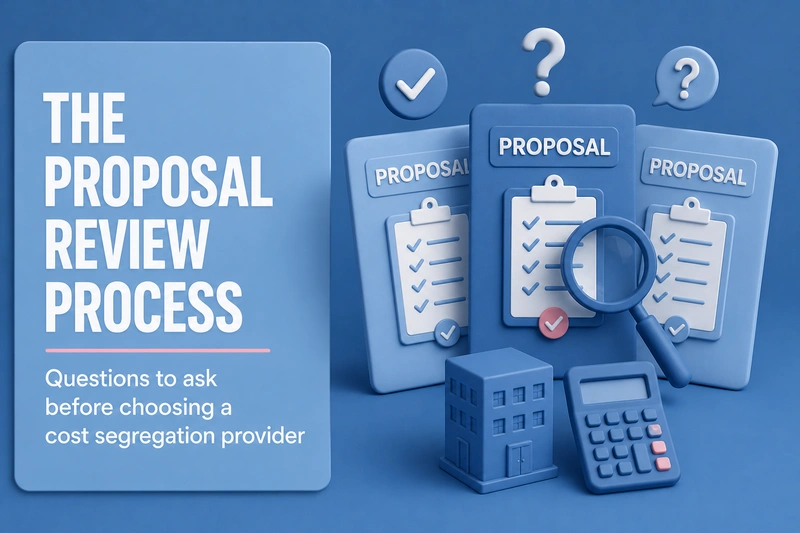
Choosing the right provider matters as much as the decision to pursue cost segregation. This article shows you how to evaluate proposals, recognize warning signs, and select a partner whose work will hold up under scrutiny.
With the return of 100% bonus depreciation made permanent under the One Big Beautiful Bill, eligible accelerated depreciation can now be deducted in full in the first year. One important condition applies: 100% bonus is available for qualifying property acquired and placed in service after January 19, 2025, per IRS guidance on the OBBBA. Property under a written binding contract dated before January 20, 2025, generally remains on the prior phase-down schedule. Because of this, provider selection now has a direct effect on your first-year tax position.
What a Cost Segregation Proposal Should Include
A quality proposal demonstrates thorough preparation. Before signing, confirm that yours includes these components:
- Scope of work: A clear description of what the study covers
- Methodology: An explanation of the engineering approach used
- Estimated accelerated depreciation: Projected dollar amounts by asset class
- Fee structure: Transparent pricing with no hidden costs
- Timeline: Realistic delivery estimates
- Deliverables: A description of the final report and supporting documentation
The methodology section deserves close attention. Engineering-based studies follow the standards described in the IRS Cost Segregation Audit Techniques Guide (ATG), which treats a detailed engineering analysis built from actual cost records as the most reliable approach. These studies provide stronger audit support than desktop estimates or rule-of-thumb calculations.
Example: A $2.5 million multifamily proposal should break down estimated 5-year, 7-year, and 15-year asset classifications. A single lump-sum figure, with no asset-class detail, signals incomplete analysis.
Missing components often point to a provider taking shortcuts. A proposal with no audit-support terms, for example, may indicate the firm won't defend its work.
The Five Questions Every Investor Should Ask
These questions help separate quality providers from firms that deliver weaker results.
1. What methodology do you use, and is it engineering-based?
The IRS ATG favors a detailed engineering analysis based on actual cost records, which it identifies as the most reliable methodology. Quality firms can explain exactly how they classify assets and determine costs. Providers who can't describe their methodology clearly may be relying on template-based shortcuts.
2. Who performs the site visit, and what credentials do they hold?
Experienced engineers should evaluate your property. Ask about professional certifications and experience with your property type. Quality firms conduct thorough site visits using engineering staff, while lower-quality firms may use junior staff or skip inspections.
3. What percentage of my property's cost basis do you typically reclassify?
Reclassification usually falls between 20% and 40% of depreciable basis, though the range varies by property type. Warehouses often land at the lower end, while hotels, restaurants, and specialty properties can run higher. A firm should be able to explain the range for a property like yours. Claims well above the norm may reflect aggressive positions that won't withstand IRS review, while unusually low results can indicate a lack of thoroughness.
4. How do you handle IRS audits or challenges?
Quality providers include audit support at no additional charge. Ask specifically whether they provide written responses to IRS inquiries and expert testimony if needed. Firms that charge extra for audit defense may not fully stand behind their work.
5. Can you provide references from similar property types?
A firm experienced with hotels should have hotel references. Medical office specialists should have medical office clients willing to speak with you. Hesitation on references can signal limited experience.
Do I really need a site visit, or can the study be done from blueprints alone?
Desktop studies exist, but the IRS ATG describes a site visit as part of a quality study, used to document physical details, construction materials, and asset conditions. The IRS does not strictly require an in-person visit. For complex or higher-value properties, engineering-based studies that include a site visit generally provide stronger audit support. When a live visit isn't practical, a detailed engineer-guided video walkthrough can capture the same documentation efficiently.
Red Flags That Should Prompt Caution
Not every provider delivers quality work. Watch for these warning signs:
- Guaranteed dollar amounts before reviewing your property. No credible firm can promise specific results without analyzing the property first.
- No mention of IRS compliance or audit support. This suggests the firm may not stand behind its conclusions.
- Unusually low fees. Budget studies often rely on templates rather than custom engineering analysis.
- Unwillingness to explain methodology or provide sample reports. Transparency reflects confidence in the process.
- Pressure tactics or "limited-time" pricing. Quality firms rarely need high-pressure sales techniques.
- No discussion of land value allocation. Land is non-depreciable, so a firm that ignores it may overstate results.
The lowest-priced proposal is not always the best value. Poor-quality studies can miss significant depreciation or create audit exposure. Fees also vary by property size, type, and complexity, so compare the work behind the number rather than the number alone.
Example: An investor chose a $1,500 "budget" study for a $4 million retail property, and that study identified $320,000 in accelerated depreciation. A second opinion from an engineering-based firm found $890,000 in qualifying assets. The $570,000 difference represents roughly $210,900 in additional first-year tax savings at a 37% marginal rate ($570,000 × 37% = $210,900), assuming the investor can currently use the deduction (see the passive activity rules below). The apparent savings on the study fee cost the investor far more than it saved.
How to Compare Multiple Proposals Side-by-Side
Evaluating proposals calls for consistent criteria. Use this framework when comparing two or three vendors:
| Criteria | Vendor A | Vendor B | Vendor C |
| Methodology | Engineering-based | Desktop | Engineering-based |
| Estimated Reclassification | $780,000 | $520,000 | $810,000 |
| Fee | $4,500 | $1,500 | $5,000 |
| Audit Support | Included | Additional fee | Included |
| Site Visit | Yes (virtual) | No | Yes (in-person) |
| Timeline | 15–20 days | 5 days | 25 days |
| References Provided | Yes | Limited | Yes |
Fee alone is the wrong basis for comparison. Calculate your net benefit: estimated tax savings minus the study fee.
In this example, Vendor B's $1,500 fee looks attractive. But the $260,000 gap in identified depreciation between Vendor B and Vendor A works out to roughly $96,200 in missed tax savings at a 37% rate ($260,000 × 37% = $96,200). The cheaper study leaves far more on the table than it saves.
Is it worth getting multiple proposals, or should I just go with whoever my CPA recommends?
Your CPA's recommendation is a solid starting point, since CPAs often have experience with specific firms and can vouch for report quality. Even so, getting two or three proposals helps you benchmark pricing, methodology, and estimated results. The 20 minutes spent reviewing additional proposals can reveal meaningful differences in expected outcomes.
Understanding Fee Structures and ROI
Cost segregation fees typically follow three models:
- Flat fee: A set price based on property type and size
- Percentage of tax savings: A fee calculated as a portion of the first-year benefit
- Hybrid: A base fee plus a performance component
Flat fees provide cost certainty. Percentage-based fees align the provider's incentives with your outcome but can cost more on properties with strong acceleration potential. One caution: contingency arrangements can create an incentive to overstate personal property, which is why many CPAs prefer flat-fee engagements.
What matters most is return on investment rather than the sticker price.
Example: Consider a $3.2 million industrial warehouse with a depreciable basis of $2.72 million ($3.2M purchase price minus a $480,000 land allocation), placed in service after January 19, 2025 and therefore eligible for 100% bonus depreciation.
- Study fee: $5,000
- Accelerated depreciation identified: $640,000
- Bonus depreciation rate: 100%
- First-year deduction: $640,000
- Tax savings at a 37% marginal rate: $236,800 ($640,000 × 37%)
- ROI: roughly 47:1
In this example, a $5,000 investment produces $236,800 in year-one tax savings, assuming the investor can use the deduction currently. That is capital available for a next acquisition, property improvements, or debt reduction. Evaluate every proposal on net return rather than fee alone.
What if I already did a cost segregation study years ago? Can I get another one done?
Yes. Related: cost segregation study timing. If your original study was low-quality, or you've made significant improvements to the property, a "look-back" study can capture missed depreciation. You can file Form 3115 to change your accounting method and claim overlooked deductions through a Section 481(a) catch-up adjustment, without amending prior returns. This route generally applies once a property has been depreciated on the prior method for two or more years; if only one return has been filed, an amended return may be the better fit, so confirm the timing with your CPA.
Who Can Actually Use the Deductions
Accelerated depreciation only helps if you can use the resulting loss. Under the passive activity rules in IRC §469, rental real estate is generally treated as a passive activity, and passive losses can normally offset only passive income. Losses you can't use are suspended and carried forward to future years, and they are generally released in full when you dispose of your entire interest in a fully taxable transaction, per IRS Publication 925.
Several paths let investors use these losses against other income:
- The $25,000 special allowance. Taxpayers who actively participate in a rental may deduct up to $25,000 of losses against nonpassive income. This allowance phases out between $100,000 and $150,000 of modified adjusted gross income, as described in Publication 925.
- Real estate professional status. Under IRC §469(c)(7), a taxpayer who spends more than 750 hours and more than half of their working time in real property trades or businesses in which they materially participate can overcome the presumption that rentals are passive. The taxpayer must then also materially participate in the rental activity, or elect under Reg. sec. 1.469-9(g) to treat all rental real estate as a single activity, for the losses to be nonpassive.
- The short-term rental approach. When a rental's average guest stay is seven days or less, it is not treated as a "rental activity" under the passive activity regulations. If the owner also materially participates, the losses can be nonpassive. A short average stay alone is not enough; material participation is still required.
Before commissioning a study, confirm with your CPA how you expect to use the deduction. That determines whether the first-year benefit is immediate or deferred.
What Happens at Sale: Depreciation Recapture
Cost segregation accelerates deductions, but it also affects your tax picture when you sell. Under IRS Publication 544, gain attributed to prior depreciation is subject to recapture:
- Section 1245 property (the 5- and 7-year personal property a study identifies) is recaptured as ordinary income to the extent of depreciation taken.
- Section 1250 property (the building and 15-year land improvements) is recaptured as ordinary income only to the extent depreciation exceeded straight line, which bonus depreciation causes on 15-year assets. The straight-line portion is unrecaptured Section 1250 gain, taxed at a maximum 25% rate.
Because accelerating deductions into shorter-life assets can increase the ordinary-income portion of recapture at sale, cost segregation shifts the timing and character of tax rather than eliminating it. Many investors manage this by holding the property, planning the sale year, or using a 1031 exchange to defer the gain. Model the exit with your CPA so the up-front benefit still makes sense over your expected hold.
After You Choose: What to Expect Next
Once you've selected a provider, the process moves quickly.
Typical timeline: 2–4 weeks for most properties, depending on complexity and site-visit scheduling.
Information you'll provide:
- Closing statement or purchase documentation
- Property details (square footage, year built, construction type)
- Any renovation or improvement records
- Access for a site visit or virtual walkthrough
What you'll receive:
- A detailed asset classification report
- Depreciation schedules by asset class
- Supporting documentation for your CPA
- A fixed asset schedule in spreadsheet format
Your cost segregation report integrates directly with your tax return. Quality providers coordinate with your CPA to support a smooth filing.
If you've already placed the property in service and depreciated it on a straight-line method for two or more years, your CPA will file IRS Form 3115 to implement the study results through a Section 481(a) adjustment.
Key Takeaways
- A quality proposal clearly outlines methodology, estimated reclassification, fees, and audit support. Missing components signal incomplete preparation.
- Ask the five critical questions. Vague or defensive answers are warning signs.
- Compare at least two or three proposals using consistent criteria. Focus on net benefit rather than price.
- Confirm who can use the deduction before you commit. Passive activity rules, real estate professional status, and the short-term rental approach determine whether the first-year benefit is immediate or deferred.
- Plan for recapture at sale. Cost segregation shifts the timing and character of tax, so model your exit with your CPA.
- Engineering-based methodology and audit support matter most on complex or higher-value properties.
Choosing the right cost segregation partner protects your investment and helps you capture the tax benefits available under current law. With permanent 100% bonus depreciation now in effect for qualifying property, every dollar of eligible accelerated depreciation can translate directly into first-year cash flow.
See how much accelerated depreciation your property may contain. Request your free proposal to get an engineering-based study with full IRS audit support included.

.webp)