
A fully engineered cost segregation study starts at $2,320. On qualified properties, first-year tax savings commonly run 10–25x or more than the study fee.
With the Big Beautiful Bill restoring permanent 100% bonus depreciation, cost segregation has become the highest-return tax strategy available to real estate investors. The study pays for itself within weeks. The only question is why you haven't done it yet.
At R.E. Cost Seg, qualified properties commonly generate potential first-year tax savings of 10–25x or more than the study fee. On properties in the $1 million to $2 million range, that can work out to $60,000 to $200,000 or more in first-year savings. These figures are illustrative rather than typical or guaranteed, and actual results depend on the property's depreciable basis, land allocation, reclassification results, applicable tax rates, bonus depreciation eligibility, your ability to use the deductions, and the study fee.
How Much Can You Save With Cost Segregation?
Most investors save $35,000 to $75,000 in first-year taxes on a property priced between $500,000 and $1 million, and $150,000 or more on properties above $2 million. Three variables set the number: your depreciable basis, your tax bracket, and how much of the building reclassifies into shorter-life categories. Against a study fee that starts at $2,320, qualified properties commonly generate potential first-year tax savings of 10–25x or more than the study fee.
Estimated first-year tax savings by property price, using a deliberately conservative 25% reclassification rate and a 37% bracket. Most property types benchmark higher than 25%, so treat these as a floor:
| Purchase Price | Reclassified Basis | Est. First-Year Tax Savings |
|---|---|---|
| $500,000 | $100,000 | $37,000 |
| $750,000 | $150,000 | $55,500 |
| $1,000,000 | $200,000 | $74,000 |
| $2,000,000 | $400,000 | $148,000 |
These figures assume land accounts for roughly 20% of purchase price and are illustrative only. Reclassification rates vary by property type, from 26–38% for multifamily up to 29–46% for hotels. Your CPA should confirm how the deduction applies to your situation.
How Cost Segregation Creates Immediate Tax Savings
Standard tax code requires residential rental properties to depreciate over 27.5 years and commercial properties over 39 years. That's slow. A $1.5 million apartment building generates just $43,636 in year-one depreciation under straight-line schedules.
Cost segregation fixes this by identifying building components that qualify for shorter recovery periods:
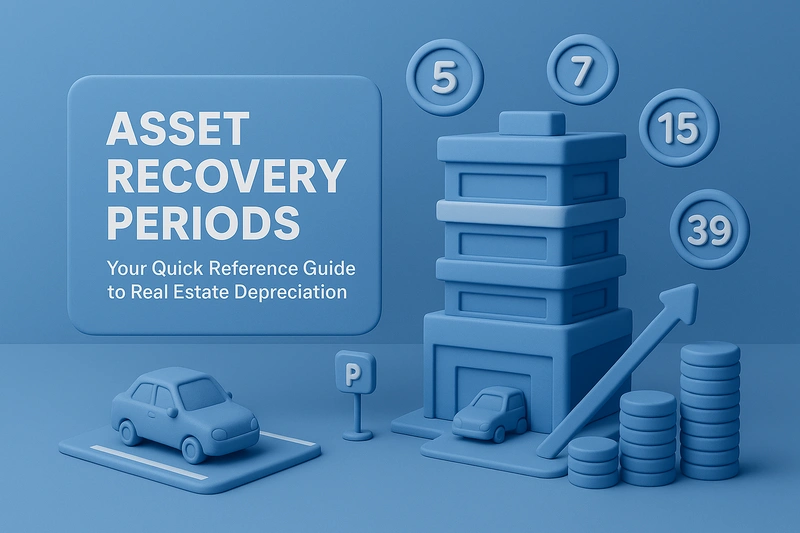
- 5-year property: Specialized electrical systems, decorative fixtures, removable flooring, appliances
- 7-year property: Furniture, equipment, certain mechanical systems
- 15-year property: Parking lots, landscaping, exterior lighting, sidewalks
A typical cost segregation study reclassifies 25-45% of a building's depreciable basis into these shorter-life categories. With 100% bonus depreciation now permanent, those reclassified assets generate immediate first-year deductions instead of trickling out over decades.
That same $1.5 million apartment building? After cost segregation, first-year depreciation jumps from $43,636 to $350,000 or more. At a 37% tax rate, that's $127,000+ in tax savings, from one study.
What exactly does cost segregation do to my depreciation schedule?
Cost segregation doesn't create new deductions. It accelerates existing depreciation by properly classifying assets according to IRS guidelines. Components that have been incorrectly bundled with the building structure get reclassified into their correct, shorter-life categories. You claim the same total depreciation over time, just front-loaded into year one when the cash flow matters most.
The Real Numbers: A Worked First-Year Example
Here's a worked example on a mid-sized apartment complex:
Property: $2,000,000 apartment complex
Depreciable basis: $1,600,000 (after subtracting land value)
Study fee: from $2,320 (fully engineered, residential)
Cost segregation identified:
| Asset Class | Amount | Percentage |
|---|---|---|
| 5-year property | $400,000 | 25% |
| 15-year property | $160,000 | 10% |
| 27.5-year property | $1,040,000 | 65% |
With 100% bonus depreciation, the investor claims $560,000 in accelerated first-year depreciation on the 5-year and 15-year property. At 35% of basis, this sits inside the 26–38% benchmark for an apartment complex with exterior amenities.
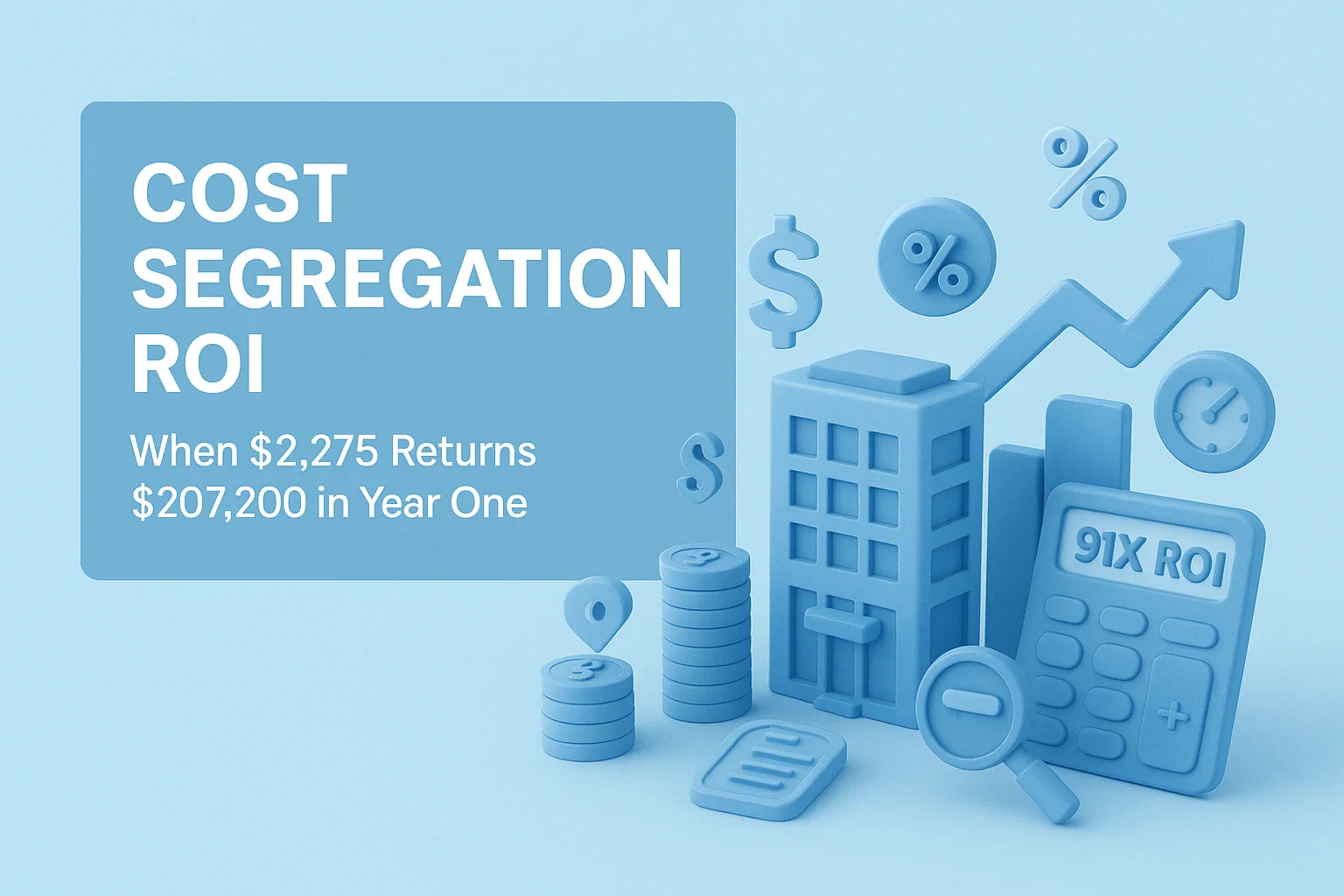
Tax savings at 37% bracket: $207,200
Study fee: from $2,320
This is an illustrative scenario, not a typical result. It assumes a top-bracket investor who can use the full loss in the year it is generated. Qualified properties commonly generate potential first-year tax savings of 10–25x or more than the study fee, and actual results depend on depreciable basis, land allocation, reclassification results, applicable tax rates, bonus depreciation eligibility, your ability to use the deductions, and the study fee.
How is the payback period calculated for cost segregation?
Payback period = study fee ÷ first-year tax savings. Qualified properties commonly generate potential first-year tax savings of 10–25x or more than a study fee that starts at $2,320. R.E. Cost Seg provides detailed projections before engagement so you know your specific numbers upfront. Most qualified properties achieve full payback on the first return after filing.
What Drives Cost Segregation ROI
Three factors determine how much you'll save:
1. Property Value and Depreciable Basis
More basis means more potential reclassification. Properties over $1 million consistently deliver the strongest returns. But there's no strict minimum. We've completed studies on smaller properties when the tax strategy justified it. The right answer depends on your full financial picture, which is why we recommend discussing with your CPA before engaging.
2. Tax Bracket
Higher bracket = bigger savings per dollar of depreciation.
| Tax Bracket | Savings per $100,000 Depreciation |
|---|---|
| 37% | $37,000 |
| 32% | $32,000 |
| 24% | $24,000 |
Real Estate Professional Status amplifies these benefits by allowing rental losses to offset W-2 income. A surgeon in the 37% bracket can use cost segregation losses to reduce tax on their medical practice income, not just rental income.
3. Property Type
Some properties have more reclassifiable components than others:
| Property Type | Typical Reclassification Rate |
|---|---|
| Hotels and motels | 29–46% |
| Self-storage | 34–44% |
| Medical and dental offices | 27–42% |
| Standard office buildings | 28–41% |
| Industrial and warehouse | 25–39% |
| Multifamily residential | 26–38% |
The low end of each range is the baseline result and the high end is what an optimized study produces when the property supports it. Every figure is a share of depreciable basis, not purchase price. For more property types, see our guide to typical reclassification percentages by property type.
Hotels and short-term rentals perform well because of high furniture, fixture, and equipment content. Every bed, TV, desk, and appliance qualifies for 5-year treatment.
What's the typical cost segregation ROI range?
With 100% bonus depreciation, qualified properties commonly generate potential first-year tax savings of 10–25x or more than the study fee, measured against fully engineered study fees that start at $2,320 for residential property and $2,730 for commercial. Most qualified properties recover the fee many times over on the first return after filing. Actual results depend on the property's depreciable basis, land allocation, reclassification results, applicable tax rates, bonus depreciation eligibility, and your ability to use the deductions.
Properties That Generate the Strongest Returns
Certain situations consistently deliver exceptional cost segregation results:
New Construction and Recent Purchases
Properties placed in service in 2025 or later capture maximum benefit from permanent 100% bonus depreciation. Every dollar of reclassified assets generates immediate deductions. Complete your study as soon as the property is in service.
Properties with Major Improvements
Capital improvements over $50,000 create significant opportunities. Restaurant build-outs, medical office conversions, and warehouse upgrades push properties toward the top of their benchmark range. These improvements qualify for full bonus depreciation under current law.
Short-Term Rentals and Hotels
These properties contain extensive personal property, furniture, appliances, decorative elements, linens, electronics. Hotels benchmark at 29–46% of depreciable basis. Short-term rental operators who meet material participation requirements can use losses against any income, not just passive income.
Situations That Require More Analysis:
- Holding period under 5 years: Depreciation recapture on sale may reduce net benefit. Run the numbers with your CPA.
- Passive loss limitations: Without Real Estate Professional Status or material participation, unused losses carry forward rather than offsetting current income. Still valuable, but delayed.
- Lower tax brackets: The math still works at 24%, but returns are proportionally smaller.
Does the age of my property affect cost segregation ROI?
Property age affects bonus depreciation eligibility for the original purchase. But improvements and renovations completed in 2025 or later qualify for 100% bonus depreciation regardless of when the underlying property was acquired. For older properties that never had a cost segregation study, Form 3115 allows catch-up adjustments, recovering years of missed depreciation in a single tax year.
Timing Your Study for Maximum First-Year Savings
When you complete your cost segregation study matters.
Get the "In Service" Date Right
Properties must be "placed in service" to claim depreciation. This means ready and available for rental use, not necessarily occupied. If you're finishing construction, get your certificate of occupancy before year-end to capture a full year of depreciation benefits.
Complete Improvements Before the Study
The site visit should happen after all improvements are finished. Adding $75,000 in renovations after the study means those assets aren't captured in the reclassification. We schedule site visits strategically to ensure maximum depreciable basis is included.
Coordinate with Your Tax Return
Cost segregation studies completed before your return is filed can be applied to the current tax year. Studies completed after filing require amended returns or Form 3115 adjustments. Neither is complicated, but timing it right simplifies the process.
The Recapture Question: What Happens When You Sell?
Smart investors ask about depreciation recapture. Here's the reality:
When you sell a property, accelerated depreciation is recaptured at a 25% rate. If cost segregation generated $200,000 in accelerated depreciation, you'll owe $50,000 in additional tax at sale.
But time value of money makes this trade worthwhile.
$200,000 in tax savings today, invested at 7% for ten years, grows to $393,000. Even after paying $50,000 in recapture, you're ahead by $143,000.
And if you 1031 exchange into a replacement property? Recapture is deferred. You can complete a new cost segregation study on the replacement property and continue the cycle indefinitely.
The five-year rule of thumb exists because holding at least five years virtually guarantees the time-value benefit exceeds recapture cost, even in conservative scenarios.
How does cost segregation affect recapture if I sell?
Depreciation recapture applies to accelerated depreciation at a 25% rate upon sale. However, the time value of tax savings almost always exceeds recapture costs when holding five years or longer. Many investors use 1031 exchanges to defer recapture indefinitely while completing new cost segregation studies on replacement properties.
Is Your Property a Year-One Payback Candidate?
Use this quick assessment:
| Criteria | Ideal Candidate |
|---|---|
| Depreciable basis | $800,000+ |
| Purchase or improvement date | 2025 or later |
| Owner’s tax bracket | 24% or higher |
| Planned holding period | 5+ years |
| Ability to use losses | REPS, STR, or sufficient passive income |
Properties meeting all five criteria are the strongest candidates for first-year savings at the upper end of the 10–25x range. Those meeting three or four warrant detailed analysis.
Quick Estimate Formula:
Estimated segregable basis × 100% bonus depreciation × Tax rate = First-year tax benefit
Example:
$400,000 segregable basis × 100% × 37% = $148,000 first-year benefit
That $148,000 figure is an illustrative calculation against a study fee starting at $2,320, not a typical result. It assumes a top-bracket investor who can use the full deduction in the year it is generated.
The Cost of Waiting
Every month you delay cost segregation is a month of lost tax savings, and lost compounding on those savings.
A $100,000 tax savings invested at 7% becomes:
- $107,000 after one year
- $140,000 after five years
- $197,000 after ten years
A study fee starting at $2,320 becomes irrelevant against these numbers. For qualified properties, the only wrong decision is waiting.
Get Your Cost Segregation Analysis
R.E. Cost Seg provides free preliminary assessments. We'll estimate your reclassification potential, calculate projected tax savings, and show you the expected return before you commit to anything.
Properties that qualify see fully engineered studies completed within 15 to 20 business days of engagement, or 5 to 10 business days with a Rapid Report.