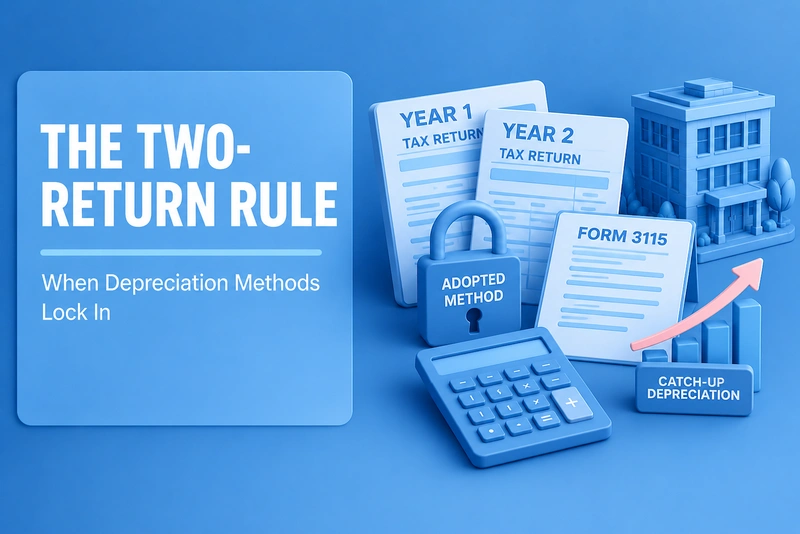

Your depreciation method can lock in fast. A correct method is adopted the first time you use it on a filed return. An incorrect method becomes adopted once you repeat it on two consecutive returns. After that, changing it requires IRS consent through Form 3115.
This catches investors off guard when they order a cost segregation study on a property held for several years. The study reclassifies components into shorter recovery periods. Implementing that reclassification changes an adopted method of accounting.
This article explains three things. First, how depreciation methods lock in. Second, when you can still change course without IRS approval. Third, how to capture missed deductions through a method change.
What "Adopting a Method" Means Under IRC § 446
IRC § 446(e) requires a taxpayer to obtain the Commissioner's consent before changing an adopted method of accounting. Treasury Regulation § 1.446-1(e)(2)(ii)(d) sets out which depreciation changes count as method changes.
Changing any one of these is a change in your method of accounting:
- Depreciation method (straight-line, declining balance)
- Recovery period (5-, 7-, 15-, 27.5-, or 39-year)
- Convention (half-year, mid-month, mid-quarter)
Timing of adoption depends on whether the method is permissible. A permissible method is adopted on the first return where you use it. An impermissible method, say, depreciating a 5-year asset over 39 years, is adopted once you use it on two consecutive returns.
The distinction matters. Either way, once the method is adopted, correcting it requires Form 3115.
The IRS finalized this framework in T.D. 9307 in December 2006, alongside its 2004 change in litigating position. The regulations confirm that changes to the depreciation method, recovery period, or convention are accounting-method changes.
What if I made a mistake on my first return? Can I just amend it?
It depends on timing. If you have not yet filed the next year's return, you can generally amend the placed-in-service year to correct the method, recovery period, or convention. Once you file a second return with the same treatment, the method is adopted. From that point, Form 3115 replaces the amended return.
The First-Year Window: Your Best Chance to Amend
The placed-in-service year is the one window to change depreciation treatment without Form 3115. The method is not yet adopted, because it has appeared on only one return.
Here is how it works. An investor places a $1.2 million property in service in 2024. The 2024 return depreciates it as 39-year nonresidential real property. Before filing the 2025 return, the investor learns it qualifies as residential rental property, with a 27.5-year recovery period.
The investor can amend the 2024 return to correct the recovery period. No Form 3115 is needed, because the method has appeared on only one return.
Now change the timeline. The investor files the 2025 return using the same 39-year period. The method is adopted across two consecutive returns. Correcting it now requires Form 3115 and a § 481(a) adjustment.
The lesson is practical. If you plan to order a cost segregation study, do it before filing the second year's return. You keep the option to implement the findings on an amended first-year return.
A method change is not a bad outcome. It simply adds a procedural step that takes time and precision.
Form 3115: The Path After Adoption
Once your method is adopted, Form 3115 (Application for Change in Accounting Method) is the way to change it. The IRS offers two routes: automatic and non-automatic.
Automatic changes follow the current IRS List of Automatic Changes, Rev. Proc. 2025-23, filed under the automatic-consent procedures of Rev. Proc. 2015-13. Most cost segregation reclassifications qualify. You attach Form 3115 to your return for the year of change and send a duplicate copy to the IRS office in Ogden, Utah. There is no user fee and no advance approval.
Non-automatic changes require advance IRS consent, a user fee, and a longer timeline. They apply to less common situations outside the automatic list.
Both routes use a § 481(a) adjustment. This adjustment captures the depreciation you should have claimed in prior years but did not.
The sign of the adjustment matters. A negative § 481(a) adjustment reduces taxable income and is taxpayer-favorable. You deduct it in full in the year of change. Only positive adjustments, which increase income, are spread over four years. Cost segregation catch-up is almost always negative, so the benefit lands immediately.
Here is the math. An investor buys a $2 million commercial property and places it in service in 2022. For four years, the return uses straight-line 39-year depreciation. A cost segregation study reclassifies $560,000 into 5- and 15-year property.
Under 39-year straight-line, those components produced about $57,436 in depreciation over four years ($560,000 ÷ 39 × 4, before the mid-month convention). Because the property was placed in service in 2022, 100% bonus depreciation applied. The reclassified components could have been fully deducted in year one, $560,000.
The § 481(a) catch-up is $560,000 − $57,436 = $502,564. At a 37% marginal rate, that is about $185,900 in tax savings, claimed in the year of the method change.
One caution on bonus depreciation. The rate follows the year the property was placed in service, not today's rate. Under the TCJA phase-down in IRC § 168(k), bonus fell to 80% in 2023, 60% in 2024, and 40% for property acquired on or before January 19, 2025 and placed in service in 2025 (20% if placed in service in 2026). The One Big Beautiful Bill Act then made 100% bonus depreciation permanent. It applies to property acquired and placed in service after January 19, 2025, per IRS guidance. So a look-back study on a 2023 property uses 80%, not 100%. Run your own numbers against your actual acquisition and placed-in-service dates.
Can I file an amended return instead of Form 3115?
Not after the method is adopted. Rev. Rul. 90-38 holds that a taxpayer may not change an adopted method by amending prior returns. The IRS rejects amended returns that reclassify depreciation after two consecutive returns use the same treatment. Form 3115 is the correct path.
How Cost Segregation Interacts with Method Changes
A cost segregation study on a property held for more than one tax year almost always triggers a method change. The study moves components from 27.5- or 39-year property into 5-, 7-, and 15-year property. That changes the recovery period, which the IRS treats as a method change.
This is standard practice, not a red flag.
The § 481(a) adjustment reaches back to the placed-in-service date. It captures the accelerated depreciation you missed in every prior year, not just the current one.
Look-back studies are built for this. R.E. Cost Seg runs the engineering analysis and delivers the reclassification schedules. Your CPA uses those schedules to prepare Form 3115 and compute the § 481(a) adjustment.
There is no statute of limitations blocking the catch-up, because you file Form 3115 rather than amend. An investor who has held a property for eight years can claim eight years of missed depreciation at once. The catch-up is capped at the depreciation allowable on the remaining basis.
What to Weigh Before You File
Two rules can limit how much of the catch-up you actually use this year.
First, passive activity loss rules. Under IRC § 469, rental losses are usually passive. A large § 481(a) deduction may be suspended until you have passive income or sell the property. Investors who qualify for Real Estate Professional Status or who use the short-term rental strategy can often apply the loss against active income instead.
Second, depreciation recapture. Accelerating depreciation lowers your basis. The 5- and 7-year components are recaptured as ordinary income under Section 1245; 15-year land improvements and the building are Section 1250 property, where only depreciation above straight line is ordinary and the rest is unrecaptured Section 1250 gain taxed at up to 25%. A § 481(a) catch-up deduction is recaptured on the same terms as if the depreciation had been claimed on schedule; the method change alters the timing but does not create a separate recapture layer. Review our guide to depreciation recapture before you model the benefit.
Neither rule cancels the value of a method change. Both affect the timing and size of your real, after-tax benefit.
Common Mistakes That Trigger IRS Scrutiny
The process is well-defined. Most problems come from skipping steps or using the wrong procedure.
- Amending instead of filing Form 3115. The IRS rejects retroactive depreciation changes made by amendment after the method is adopted.
- Using the wrong procedure. Automatic and non-automatic changes have different requirements, and the wrong one can invalidate the change.
- Skipping the duplicate filing. The original Form 3115 attaches to your return. A duplicate must also reach the IRS in Ogden, Utah.
- Omitting the § 481(a) adjustment. The catch-up must appear on the year-of-change return.
- Miscalculating the § 481(a) amount. It must reflect the difference between depreciation claimed and depreciation allowable for all prior years.
Your CPA prepares Form 3115. Your cost segregation firm supplies the reclassification schedules and depreciation computations. Close coordination prevents most filing errors.
Key Takeaways
- A correct depreciation method is adopted after one return; an incorrect one after two consecutive returns.
- The placed-in-service year is your only chance to fix the method by amendment. After the second return, Form 3115 is required.
- Form 3115 unlocks catch-up depreciation for every prior year through a § 481(a) adjustment.
- The catch-up is a negative § 481(a) adjustment, so you deduct it in full in the year of change, not spread over four years.
- Bonus depreciation on a look-back depends on both acquisition and placed-in-service dates: 80% (2023), 60% (2024), 40%/20% (2025/2026 placements of property acquired before January 20, 2025), or 100% (property acquired and placed in service after January 19, 2025).
- Passive-loss rules and recapture can limit or defer the benefit. Confirm your position with your CPA before filing.
Want to know how much missed depreciation you could recover on properties you already own? See what a look-back study could return.