
Partnerships and multi-member LLCs are among the most common ways investors hold real estate together. The entity structure offers liability protection and operational flexibility. It also creates depreciation questions that single-owner properties never face.
A cost segregation study is performed at the entity level, and the partnership claims the depreciation. That benefit then flows through to individual partners on Schedule K-1. Under IRC § 704, how much each partner actually deducts depends on the partnership's allocation provisions, passive activity limits, and at-risk rules, not simply ownership percentage.
This article explains how depreciation is allocated under §§ 704(b) and 704(c), why K-1 reporting creates partner-level complications, and how to structure your partnership agreement so every partner captures the benefit they are entitled to.
Why Partnership-Owned Properties Are Different
When a sole proprietor or single-member LLC owns a rental property, the depreciation deduction appears directly on Schedule E. The owner claims it, and the math is simple.
Partnerships add a layer. The entity computes depreciation, then allocates it among the partners according to the partnership agreement. Each partner receives a Schedule K-1 showing their share of income, deductions, and credits. The depreciation on your K-1 depends on the allocation provisions in the operating agreement, not simply your ownership percentage.
So two partners with equal ownership stakes can receive different depreciation allocations if the agreement provides for it. A study that generates $500,000 in accelerated depreciation does not automatically hand each 50% partner a $250,000 deduction. The allocation must comply with IRC § 704.
The study is performed once, at the entity level. No partner needs a separate study. But each partner's ability to use the deductions depends on individual tax circumstances: filing status, income level, participation hours, and at-risk basis.
Does each partner need a separate cost segregation study?
No. The study covers the property the partnership owns, and the results feed the entity's depreciation schedules. Those deductions then flow to partners through K-1 allocations. Your CPA uses the K-1 data, not a separate study, to prepare your individual return.
Section 704(b): How Depreciation Gets Allocated
IRC § 704(b) governs how a partnership allocates income, gain, loss, deductions, and credits. To be respected by the IRS, an allocation must have "substantial economic effect."
Treasury Regulation § 1.704-1(b)(2) sets a two-part test. First, the allocation must have economic effect: the partner who receives a tax deduction must also bear the matching economic loss. In practice, this requires the partnership to maintain capital accounts under § 704(b), liquidate according to positive capital-account balances, and include a deficit-restoration obligation or a qualified income offset. Second, that effect must be substantial: there must be a reasonable possibility the allocation meaningfully changes the dollar amounts partners receive, independent of tax savings.
In plain terms, you cannot invent allocations solely to shift deductions to the partner in the highest bracket. The allocation must reflect the real economic arrangement between the partners.
Most agreements allocate depreciation in proportion to profit-and-loss sharing ratios. A partner with a 50% profit share receives 50% of the depreciation. The IRS still permits special allocations if they meet the substantial-economic-effect test and the partnership maintains proper capital accounts.
Consider a three-member LLC that owns a $3 million apartment building, with members holding 50%, 25%, and 25% interests. A study reclassifies $840,000 into 5-, 7-, and 15-year property. Because the One Big Beautiful Bill Act restored 100% bonus depreciation for qualified property acquired after January 19, 2025, the full $840,000 can be deducted in year one. Property acquired on or before that date remains on the prior phase-down (40% for 2025), so timing matters, confirm your acquisition date before you model the deduction. For details, see our bonus depreciation guide.
Under pro-rata allocation, the $840,000 splits as follows:
- Partner A (50%): $420,000 depreciation deduction
- Partner B (25%): $210,000 depreciation deduction
- Partner C (25%): $210,000 depreciation deduction
Each partner's K-1 reflects that share. Whether each partner can actually use the deduction depends on the limitations covered below.
Section 704(c): The Contributed Property Trap
Section 704(c) applies when a partner contributes appreciated or depreciated property to the partnership instead of buying it through the entity. It prevents the contributing partner from shifting pre-contribution gain or loss to the other partners. (The same principles also apply when a partnership revalues its assets, known as a "reverse 704(c)" event.)
Here is the scenario. Partner A contributes a $1.5 million property with an adjusted basis of $900,000 to a new three-member LLC. The property carries a built-in gain of $600,000 ($1.5M fair market value minus $900,000 basis).
The partnership inherits Partner A's $900,000 tax basis under § 723 and steps into Partner A's depreciation schedule under § 168(i)(7); the same method, recovery period, and remaining schedule. A study here is therefore a look-back on Partner A's holding period, with no bonus depreciation available on the contributed carryover basis because the property was not acquired by purchase. The partnership implements the reclassification through Form 3115, and the § 481(a) catch-up reflects what Partner A should have claimed using the bonus rate in effect when the property was originally placed in service.
The $600,000 difference between the property's $1.5 million book value and $900,000 tax basis is a book-tax gap handled under § 704(c) for allocation purposes only; it is not additional tax basis. The § 704(c) rules then determine how the available depreciation is split among the partners.
Treasury Regulation § 1.704-3 provides three generally accepted methods:
- Traditional method: Allocates tax depreciation to non-contributing partners first, up to their share of book depreciation. Any remaining tax depreciation goes to the contributing partner. This can trigger a "ceiling rule" limitation, because total allocations cannot exceed the partnership's actual tax items for that property.
- Traditional method with curative allocations: Offsets ceiling-rule distortions using other tax items.
- Remedial method: Creates notional tax items to eliminate ceiling-rule distortions entirely.
The method your partnership selects changes how much depreciation each partner receives on their K-1. The remedial method gives non-contributing partners the fullest benefit, but it adds reporting complexity and is not automatically the right choice for every deal. Make this decision when the partnership forms, not after the study is complete.
K-1 Complications: What Partners Actually See
Depreciation from a study appears on each partner's Schedule K-1 in Box 2 (net rental real estate income or loss). A large accelerated deduction often creates a rental loss that flows to the partner's individual return.
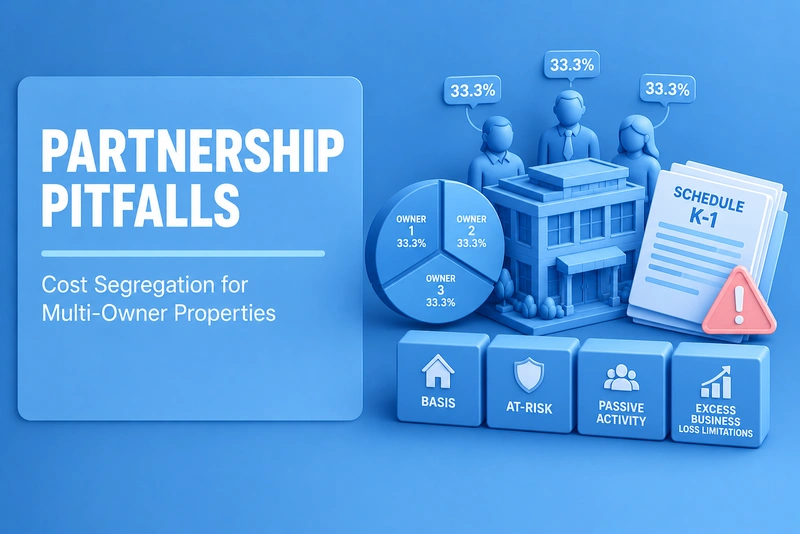
Whether a partner can use that loss depends on four separate limitations, applied in order:
1. Basis limitation (§ 704(d)). A partner cannot deduct losses exceeding their basis in the partnership. Basis includes capital contributions, the partner's share of partnership debt, and cumulative income less distributions. Any excess loss carries forward.
2. At-risk limitation (§ 465). A partner can deduct losses only to the extent they are "at risk", generally capital contributions plus recourse debt for which the partner is personally liable. Nonrecourse debt usually does not count. There is an important exception under IRC § 465(b)(6): qualified nonrecourse financing secured by real property counts toward at-risk amounts.
3. Passive activity limitation (§ 469). Rental activities are generally passive, per IRS Publication 925. Partners who do not materially participate can deduct passive losses only against passive income.
4. Excess business loss limitation (§ 461(l)). Once a loss survives the passive activity rules, the individual partner's total business losses for the year are capped at roughly $256,000 for a single filer or $512,000 for a joint return in 2026, aggregated across all of the partner's trades and businesses. Any excess becomes a net operating loss carryforward.
The limited partner question, and why LLC members are different. Under IRC § 469(h)(2), a true limited partner's interest is presumed passive. But that presumption is rebuttable: a limited partner can still establish material participation by meeting one of three tests under the temporary regulations, more than 500 hours in the activity, material participation in 5 of the prior 10 years, or a qualifying personal-service history (Passive Activity Losses and Credits Limited, 76 Fed. Reg. 72875). And courts have held that members of a multi-member LLC are not automatically "limited partners" for this purpose, so many LLC members may use all seven material-participation tests. If you hold a general-partner or manager interest alongside a limited interest, those hours also count. Do not assume LLC membership alone makes you passive; confirm your status with your CPA.
Can a limited partner benefit from cost segregation deductions?
Yes, with limits. A limited partner receives their allocated share of accelerated depreciation on the K-1. If the partner has passive income from other sources, the losses offset that income dollar for dollar. With no passive income, the losses carry forward until the partner has passive income or sells the interest in a fully taxable transaction. Limited partners in real estate syndications commonly rely on this approach.
Don't Forget Recapture on Exit
Accelerated depreciation is not a permanent write-off. When the property sells, the depreciation you claimed on 5-, 7-, and 15-year assets is subject to § 1245 recapture, taxed as ordinary income to the extent of prior deductions. This matters most in syndications with a fixed hold period and a "tax flip," where early losses reverse into later gain. Model the after-tax result across the full hold, not just year one.
Structuring Your Partnership for Maximum Benefit
The partnership or operating agreement is the foundation. Its allocation provisions determine how the cost segregation benefit reaches each partner.
Review your allocation provisions. Most standard agreements use pro-rata allocations tied to ownership percentages. That works well when all partners share the same tax profile. When partners differ, for example, one is a real estate professional, and another is a passive investor, targeted allocations may produce better overall results.
Targeted allocations direct specific deductions to the partners who can use them most effectively. They must still meet the substantial-economic-effect test under § 704(b). Work with a tax attorney to draft provisions that comply while optimizing partner-level outcomes.
Syndication structures need particular care. General partners typically manage the property and may qualify for real estate professional treatment; see our guide on qualifying as a real estate professional. Limited partners invest capital but do not manage. The general partner often takes a larger share of early depreciation, with income allocated later. The study must align with the waterfall in the private placement memorandum.
A secondary purchase can create a separate opportunity. When an incoming partner buys an interest in an existing partnership, a § 754 election can give that partner a § 743(b) basis adjustment equal to the difference between the purchase price and the buyer's share of the partnership's inside basis. That adjustment belongs only to the buying partner and is treated as newly acquired property. Unlike contributed carryover basis, it may qualify for bonus depreciation when the buyer and seller are unrelated. A separate cost segregation study can be performed on the § 743(b) adjustment, accelerating depreciation for the incoming partner without changing the other partners' schedules. The § 754 election must already be in place or be made on the partnership return for the year of transfer, and the adjustment study is separate from the partnership's original study.
Contributed property requires advance planning. If any partner contributes property rather than cash, select the § 704(c) method before ordering the study. Coordinate the study with your partnership's tax counsel so the structure and the numbers match.
Build the Right Structure Before You Order the Study
- Cost segregation is performed once, at the entity level. Individual partners do not need separate studies.
- § 704(b) allocations must have substantial economic effect, with two parts: economic effect and substantiality. You cannot shift deductions to high-bracket partners without economic substance.
- § 704(c) applies to contributed property. Choose your allocation method at formation, not after the study.
- Four limitations gate partner deductions: basis, at-risk, passive activity, and the excess business loss limitation, applied in that order.
- True limited partners are presumed passive but can rebut it with three material-participation tests; LLC members are often not treated as limited partners at all.
- Accelerated depreciation is recaptured as ordinary income on sale, so plan for the full hold period.
Want to see how accelerated depreciation would flow through your specific partnership? Get a free proposal and bring it to your tax counsel to structure the study for maximum partner-level benefit.