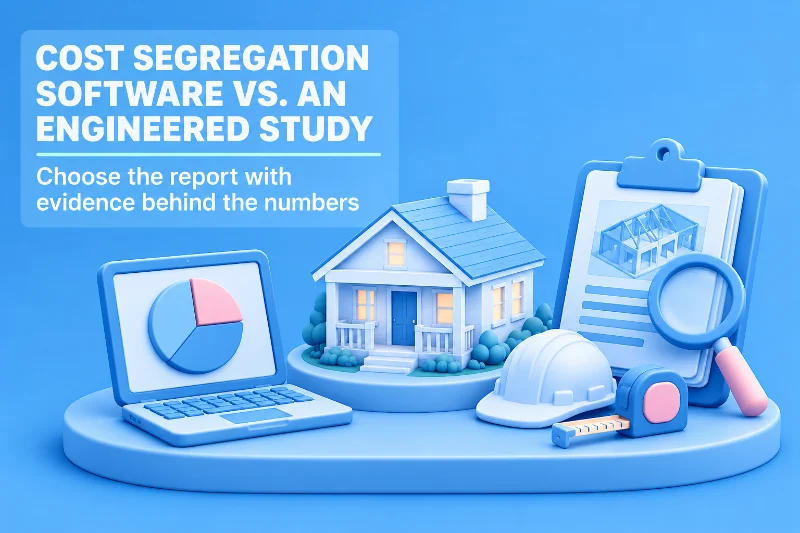

An engineering-based cost segregation study ties each asset classification to identified building components and documented costs, which is the support IRS examiners look for. A cheap software-only report can estimate depreciation faster, but it is easier to challenge if the IRS asks about methodology, site evidence, or component support. R.E. Cost Seg offers both an engineer-reviewed Rapid Report and a Fully Engineered Study, with published starting prices.
For depreciation positions on your tax return, choose an engineering-based cost segregation study or an engineer-reviewed report with property-specific support. Use unreviewed, percentage-based software to estimate whether a study is worth ordering, rather than treating its output as sufficient documentation. This is a buying recommendation, not an IRS rule banning software.
The important difference is the evidence behind the numbers. A fast online report can include professional review. An expensive report can still leave important assumptions unexplained. Before comparing fees, ask how the provider identifies assets, assigns costs, and supports the result.
That distinction matters when a report promises a large first-year deduction. Your CPA needs more than a total. The report should explain which property qualifies for faster depreciation and how the preparer calculated each allocation.
When an engineering-based study fits
- You want audit-ready workpapers that explain each classification and cost.
- The property is commercial, multifamily (five or more units), mixed-use, or complex residential.
- The property has renovations, specialized systems, or features a standard residential model cannot adequately explain.
When a lighter report can fit
- The property is a simple one-to-four-unit residential rental within the published Rapid Report limits.
- You need a fast result before year-end, and your CPA agrees the scope is enough for your return.
How R.E. Cost Seg helps
- Two tiers with published starting prices: the Rapid Report from $950 and the Fully Engineered Study from $2,320 (residential) or $2,730 (commercial).
- A 30–60 minute virtual inspection is included with the Fully Engineered Study, with in-person visits available for an extra fee.
- Optional Form 3115 CPA Support ($600 per property) gives your CPA a draft Form 3115 and catch-up calculation when you claim missed depreciation on a property placed in service in an earlier year.
- Audit support covers written responses to questions about the study’s methodology, classifications, and conclusions. It does not include IRS representation.
Key takeaways
- Choose a report for its supporting evidence, not whether it arrives online or includes an engineer's name.
- Unreviewed percentage-based software is useful for screening, but its output should not replace property-specific substantiation.
- R.E. Cost Seg's Rapid Report uses modeling backed by detailed engineering review and starts at $950 for eligible residential properties.
- A Fully Engineered Study adds detailed quantity measurements, cost-per-unit analysis, and a virtual inspection, with in-person visits available for an extra fee.
- The IRS evaluates methodology and documentation, rather than prescribing one required cost segregation approach.
- A larger deduction does not necessarily produce immediate tax savings, because loss limitations and future recapture affect the result.
What does cost segregation software actually do?
Cost segregation software uses property inputs and an underlying model to estimate or allocate costs among depreciation categories. A self-service tool may ask for your purchase price, land allocation, building size, age, and improvements. It then applies its stored assumptions to generate an allocation or report.
Cost segregation is the process of identifying property components that qualify for shorter depreciation periods than the building itself. Software can help perform that work, but a calculation engine and a supported study are different deliverables.
Some tools produce output within minutes. Others combine software with human review, additional information requests, or engineering work. An online cost segregation study therefore does not automatically mean an unreviewed software report.
For screening, a model can answer a useful question: could this property's potential benefit justify investigating a study? Treat that estimate as a planning input. Do not assume its suggested allocation proves the classifications or costs.
Can software-generated reports support a tax return?
They can, if the underlying work adequately supports the deductions. Software delivery itself does not make a report compliant or noncompliant. Ask whether the provider documents property-specific facts, explains cost sources, and reviews unusual features before you rely on the output.
If the only explanation is that similar buildings usually allocate a certain percentage to short-life assets, request the work behind that assumption. A polished PDF does not supply missing evidence.
What does an engineered cost segregation study add?
An engineered study connects asset classifications to identifiable components and documented costs. Instead of stopping at a modeled allocation, the preparer examines what exists and explains how its cost was determined.
That may involve construction records, photographs, plans, measurements, and cost estimates. Actual records are useful when available. For an acquired building without original invoices, documented engineering estimates can provide the cost analysis.
R.E. Cost Seg's Fully Engineered Study uses actual and estimated cost assignments, including detailed quantity measurements and cost per unit. It includes a 30–60 minute virtual inspection, and an in-person visit is available for an additional fee depending on location. For example, the analysis can identify a component's quantity and applicable unit cost, then document the resulting allocation.
The tax classification still requires judgment. A component's function matters, especially for electrical, plumbing, and other systems serving particular equipment rather than the building generally.
Under the general depreciation system, residential rental buildings generally use 27.5 years and nonresidential real property generally uses 39 years. Certain components qualify for shorter periods. IRS Publication 946 identifies examples including five-year residential rental appliances and certain 15-year land improvements.
Those examples are not permission to move every appliance connection or exterior improvement into a shorter class. The report must support the treatment of the actual asset.
Is an engineer-reviewed report the same thing?
No. Engineering review adds professional oversight, but it does not necessarily add detailed measurements or an inspection.
R.E. Cost Seg's Rapid Report uses a modeling approach backed by detailed engineering review. Owners complete a self-directed property questionnaire. Detailed quantity measurements and a site visit are not included.
The Rapid Report is intended for residential properties with up to four units, each under 3,500 square feet, and less than $1.2 million in depreciable basis. Capital improvements must total less than $80,000.
How do software, Rapid Report, and Fully Engineered compare?
The main differences are how costs are supported, who reviews the work, and how much property detail the service captures. Use this table to compare scope before comparing fees.
| Comparison point | Unreviewed self-service software | R.E. Cost Seg Rapid Report | R.E. Cost Seg Fully Engineered Study |
|---|---|---|---|
| Cost | Provider-specific; verify current pricing and add-ons | From $950 | From $2,320 residential; $2,730 commercial |
| Asset classification and costs | Owner inputs and a stored model; inspect the supporting detail | Modeling approach backed by detailed engineering review | Detailed engineering with actual and estimated cost assignments |
| Engineer review | Not included in the unreviewed category compared here; confirm the product tier | Included | Included |
| Site visit | Provider-specific; do not assume one is included | Not included | Virtual inspection included; in person for an extra fee |
| Detailed quantity measurements | Verify rather than assuming | Not included | Included, with cost per unit |
| Client time | Provider-specific; depends on intake and documentation | 5–30 minutes | 30–60 minutes for the virtual inspection |
| Standard delivery | Some generate output within minutes; verify review and delivery terms | 5 business days after all requested information is received | 15–20 business days after all requested information and documentation is received; 5-business-day rush available, subject to capacity |
| Audit support assistance | Provider-specific; may be separate or conditional | Included: written responses on methodology, classifications, and conclusions; no IRS representation | Included: written responses on methodology, classifications, and conclusions; no IRS representation |
| Best fit | Preliminary screening, or further evaluation of the report's substantiation | Eligible small residential properties whose owners know the details | Residential and commercial properties requiring more detailed analysis |
Compare the current Rapid Report and Fully Engineered Study before ordering. Starting prices are not quotes for every property. Confirm scope, eligibility, and support terms in the engagement.
The software column describes an unreviewed service category, not every online provider. For named platforms and current offers, use our separate cost segregation provider comparison.
What does the IRS look for in a cost segregation report?
The IRS looks for substantiated classifications and costs, supported by an explained methodology. Its Cost Segregation Audit Techniques Guide, Publication 5653, discusses several approaches rather than requiring one method.
The guide identifies preparer expertise, appropriate documentation, legal analysis, and documented cost calculations among the elements of a quality study. It describes detailed engineering using actual records, engineering estimates, and sampling or modeling approaches.
That does not make every model reliable. The guide cautions against a “rule of thumb” approach using “little or no documentation.” It also tells examiners not to categorically reject such a study. They should examine and verify its documentation on its merits.
The practical distinction is between a supported estimate and an unexplained percentage. If cost records are unavailable, the preparer should document the estimation method and cost-data sources.
Does the IRS require an engineer or an in-person visit?
The guide does not prescribe one mandatory professional credential or one required methodology. It does emphasize relevant expertise and experience. An engineer's review is valuable when it contributes real analysis, rather than functioning as a label.
Likewise, do not confuse the absence of an in-person visit with the absence of evidence. Ask what information supports the asset identification and costs. A virtual inspection, photographs, records, and interviews can serve different roles depending on the study.
Our guide to the 13 elements of a quality cost segregation study provides a checklist. Our IRS audit guide explains how examiners evaluate the work.
Which option fits your property and tax situation?
Choose the least expensive service that supplies adequate documentation for your property, then confirm whether you can use the resulting deduction. Property complexity and tax circumstances matter more than a universal purchase-price cutoff.
Straightforward residential property or an STR
An eligible single-family rental or two-to-four-unit property can be a candidate for an engineer-reviewed report. Confirm the basis and size limits, and make sure you can provide accurate property details. If you are working against a year-end deadline, confirm with your CPA that the Rapid Report’s scope is enough for your return.
For a short-term rental, evaluate the report and the loss treatment separately. Short stays alone do not establish that depreciation losses can offset wages. Your CPA must assess the activity's tax treatment and participation facts.
Multifamily, commercial, mixed-use, or specialized property
Favor detailed engineering when the property has specialized systems, multiple uses, or costs that a standard residential model cannot adequately explain. Ask how the preparer handles equipment-specific systems, shared building components, and site improvements. Multifamily buildings with five or more units fall outside Rapid Report eligibility, so they call for a Fully Engineered Study.
A commercial property does not become simple because its purchase price is modest. The relevant question is whether the proposed methodology captures its actual features.
Recent renovations or unusual improvements
Bring the scope of work and cost records into the discussion before selecting a service. Improvements can introduce separate dates, costs, and classification questions. Ask whether a streamlined report can handle those facts or whether engineering document review is more appropriate.
Small basis or losses you cannot currently use
Run a benefit analysis before paying for any report. A small basis can still produce useful deductions, but the fee, expected holding period, and usable tax benefit determine the economics.
IRS Publication 925 explains that rental activities are generally passive, subject to exceptions. Real estate professional status also requires material participation for the relevant rental activity to be nonpassive. Certain short-stay activities fall outside the rental-activity definition, but material participation remains important.
A suspended loss is not necessarily lost. It simply may not reduce this year's tax. Ask your CPA about basis, at-risk, passive-loss, and other applicable limits before counting projected savings.
Missed depreciation on a property you already own
A study can still help after the first tax year. If a property placed in service in an earlier year was depreciated without cost segregation, your CPA can generally claim the missed depreciation through an automatic change in accounting method on Form 3115, with a Section 481(a) catch-up adjustment, rather than amending prior-year returns.
R.E. Cost Seg offers Form 3115 CPA Support as an optional add-on at $600 per property; it is not included in the study fee. It provides a draft Form 3115, supporting statements, and the Section 481(a) catch-up depreciation calculation. Your CPA reviews the materials against your tax records, then finalizes and files the form. Signing and filing are not part of the standard service.
A worked example: deduction versus usable savings
Assume a rental property is acquired and placed in service in 2026, with no earlier binding contract. Assume full income-producing use and no applicable bonus-depreciation exclusions.
IRS Notice 2026-11 explains the permanent 100% bonus allowance restored by the One Big Beautiful Bill Act (OBBBA). It applies to qualified property acquired and placed in service after January 19, 2025, subject to the applicable rules and elections. IRC §168(k)(2) defines eligible property; a short recovery period alone does not settle every eligibility requirement.
Use these hypothetical inputs:
| Step | Calculation | Result |
|---|---|---|
| Purchase price | Assumed | $600,000 |
| Land allocation | Assumed supported allocation of 20% | $120,000 |
| Depreciable basis | $600,000 − $120,000 | $480,000 |
| Qualifying short-life components | Hypothetical study-supported 25% of basis | $120,000 |
| First-year bonus deduction on those components | $120,000 × 100% | $120,000 |
| Federal tax reduction attributable to that deduction, if fully usable | $120,000 × assumed 37% marginal rate | $44,400 |
The 20% land allocation and 25% component allocation are assumptions, not recommended percentages or promised results. Remaining building depreciation is excluded from this calculation. State tax is also excluded.
The $44,400 is not the incremental benefit over depreciation without a study. Some depreciation would otherwise be available. Compare complete schedules before estimating the study's additional first-year value.
If the entire additional loss is suspended, its immediate federal tax benefit is zero. If only $40,000 is currently usable, its effect at the assumed 37% rate is $14,800.
Accelerated depreciation also affects taxes on sale. IRS Publication 544 explains depreciation recapture, including ordinary-income treatment for Section 1245 property within the applicable limits. Have your CPA model the exit as well as the first-year deduction.
What happens if a software report is challenged?
A challenged report must be supported with evidence explaining the classifications and costs. Contact your CPA and the provider, preserve the underlying records, and respond within the applicable deadlines.
An adjustment can change depreciation timing and create additional current tax. Interest, penalties, and professional correction costs may also arise, depending on the facts. None is an automatic outcome simply because software was used.
Ask what “audit support” actually covers. Technical explanations about a study are different from representing you before the IRS or defending unrelated return positions.
For R.E. Cost Seg studies, audit support includes a written response to questions about the study’s engineering methodology, asset classifications, and conclusions. It does not include representation before the IRS or any taxing authority, serving as a fact or expert witness, preparing or amending tax returns, or defending positions not covered by the study.
For a longer illustration, see the failed-study example in our DIY cost segregation guide. [INTERNAL LINK PENDING: insert the verified canonical URL for /post/diy-cost-segregation-study before publication.]
What should you ask before buying a report?
Ask for a sample report and clear answers about the work included before choosing a provider. Use these questions to make competing proposals comparable:
- Who prepares and reviews the analysis, and what relevant experience do they have?
- How are property-specific assets identified and classified?
- Are the cost sources and allocation methodology explained?
- Does engineering review include resolving unusual features or questionable inputs?
- Are a site visit and detailed quantity measurements included?
- What property types, basis limits, and improvement situations fit this product?
- What information is required, and when does the delivery clock start?
- What does audit support assistance include, exclude, or charge separately?
If the provider cannot explain the evidence behind the allocation, a lower price does not resolve that gap.
Which should you choose?
Choose an engineering-based study or a properly supported engineer-reviewed report when you need documentation for a depreciation position. Use unreviewed software for preliminary estimates, and judge any final report by its methodology and supporting evidence.
R.E. Cost Seg offers both a streamlined reviewed option and detailed engineering for properties needing more analysis. Request a free cost segregation proposal to compare the appropriate scope and fee for your property.
Confirm eligibility, loss limitations, and the expected after-tax benefit with your tax advisor before proceeding.
Disclosure: R.E. Cost Seg provides the services discussed in this article. This is general information, not individualized tax advice.